The History of Pizza
Quick Answer
Pizza as we know it took shape in Naples, Italy, where it was sold as cheap street food to the city's working poor in the 1700s and early 1800s. Topped flatbreads are far older. Italian immigrants brought pizza to American cities around 1900, and after World War II it spread across the United States through neighborhood pizzerias, regional styles and national chains. In 2017 UNESCO listed the Neapolitan pizza maker's craft as cultural heritage.
On this page
- Did the Ancient Romans and Greeks Eat Pizza?
- How Did Pizza Begin as Street Food in Naples?
- Was Pizza Margherita Really Named for Queen Margherita in 1889?
- How Did Pizza Come to the United States?
- Why Did Pizza Spread Across America After World War II?
- What Is Italian About Pizza, and What Is American?
- Why Did UNESCO Recognize Neapolitan Pizza Making?
- Frequently Asked Questions
- Our Take
- Sources
Key Takeaways
- Ancient Egyptians, Greeks and Romans ate topped flatbreads, but pizza as a named street food belongs to Naples in the 1700s and 1800s.
- The famous 1889 story that Pizza Margherita was created for Queen Margherita is a popular tradition; a tomato, mozzarella and basil pizza was described in Naples by 1853.
- Lombardi's in New York is often called America's first pizzeria (1905), but city directories show a New York pizzeria by 1894.
- Pizza became a national American food only after World War II, followed by chains such as Pizza Hut (1958) and regional styles.
Did the Ancient Romans and Greeks Eat Pizza?
They ate something like it, but not pizza as Naples later defined it. Egyptians, Romans and Greeks all ate flatbreads with toppings, and the Greek version, dressed with herbs and oil, resembled today's focaccia [4].
What was missing was the combination that defines pizza today. The tomato, now its signature topping, came to Europe from the Americas and was long treated with suspicion, because it belongs to the nightshade family and was linked in the popular mind with poison [3]. Calling a Roman flatbread "pizza" is like calling a medieval feast day a modern holiday: the roots are real, but the thing itself came later. Readers who want more on the classical world can browse our ancient world era page.
How Did Pizza Begin as Street Food in Naples?
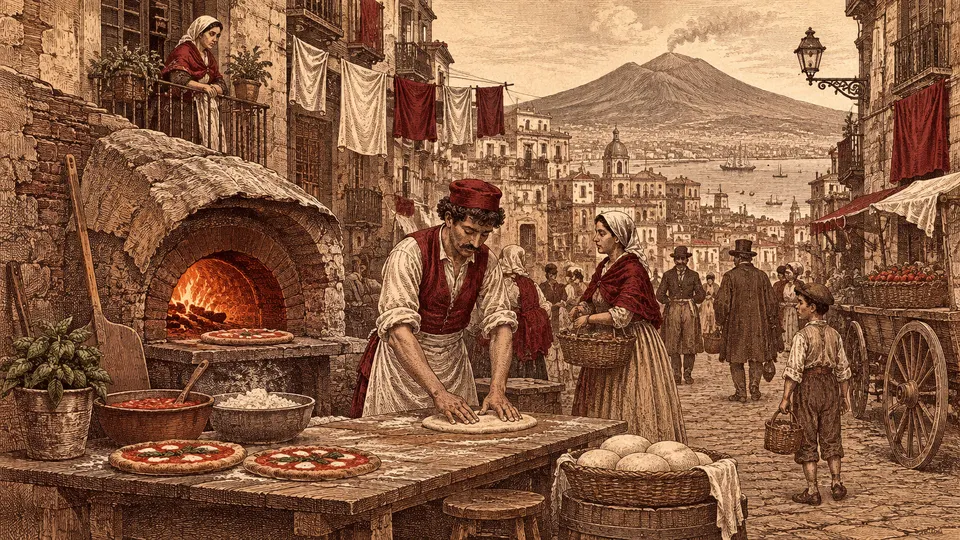
It began as fast food for the poor. In the 1700s and early 1800s Naples was a busy waterfront city and the capital of an independent kingdom, home to large numbers of working poor known as lazzaroni [4]. "The closer you got to the bay, the denser their population and much of their living was done outdoors," historian Carol Helstosky of the University of Denver told HISTORY. Street vendors and informal restaurants sold them pizza because it was cheap and could be eaten quickly. Helstosky added that "judgmental Italian authors often called their eating habits 'disgusting'" [4].
Written descriptions confirm that the modern pizza existed well before the royal story usually told about it. Emanuele Rocco's 1853 collection of essays on Neapolitan customs describes a pizza topped with basil, mozzarella and tomatoes, and the writer Matilde Serao's late 19th century book The Belly of Naples describes pizza as cheap street food [3].
Pizza stayed a local dish for a long time. According to HISTORY, it remained little known in Italy beyond Naples until the 1940s [4].
Was Pizza Margherita Really Named for Queen Margherita in 1889?
That is the popular story, and historians have strong doubts about it. As usually told, King Umberto I and Queen Margherita visited Naples in 1889, a pizza maker named Raffaele Esposito baked three pizzas for the queen, and her favorite, topped with tomato, mozzarella and basil in the colors of the Italian flag, was named in her honor [4]. HISTORY calls the story a legend. The main evidence for it is a letter dated June 11, 1889, which says, "I confirm that the three kinds of pizza prepared by you for her Royal Highness the Queen were found to be excellent" [3].
National Geographic's 2022 review of the research lists the problems. The letter is signed by a royal official, Camillo Galli, but samples of Galli's handwriting do not match the signature. The Gazette of the Kingdom of Italy, which reported royal news, does not mention the pizza visit or the letter. The letter calls Esposito "Raffaele Esposito Brandi," a surname that belonged to his wife's family, and Giovanni and Pasquale Brandi took over the pizzeria in 1932 and renamed it Pizzeria Brandi. That led researchers to suggest the brothers may have produced the letter to attract business. A similar story of the queen praising a pizza maker had even appeared in the newspaper Il Bersagliere in 1880. And, as the magazine puts it, "Probably the most damning is that the dish existed at least three decades before any royal visit to Naples," pointing to Rocco's 1853 description [3].
A forged letter would not prove that Esposito never cooked for the queen, but it would mean the most famous evidence for the story cannot be trusted. The safest summary is that the pizza is older than the name, and the name's royal origin is a tradition, not a documented fact. We handle legends like this the same way across the site, from the first Thanksgiving to Halloween's supposed Celtic roots.
How Did Pizza Come to the United States?
It came with Italian immigrants. During the late 19th and early 20th centuries, Neapolitans who crossed the Atlantic for factory jobs made pizza in New York, Trenton, New Haven, Boston, Chicago and St. Louis [4]. Many arrived through New York Harbor, past the Statue of Liberty. Helstosky's 2008 book Pizza: A Global History, as quoted in a 2015 University at Buffalo history thesis, explains that pizza was made at home or sold by bakeries to factory workers and to Italian American families on meatless Fridays, and that "few Americans outside this area had even heard of pizza" before World War II [6].
Which pizzeria came first is still argued. The date most often repeated is 1905, when G. Lombardi's on Spring Street in Manhattan is said to have been licensed to sell pizza, making it one of the first documented pizzerias in the country [4]. Independent researcher Peter Regas, working from New York city directories and other records, disputes both halves of that claim. He found Giovanni Albano's pizzeria at 59 1/2 Mulberry Street "already operating in 1894." He concluded that Filippo Milone very likely set up the store at 53 Spring Street as a pizzeria and grocery in 1898, that Giovanni Santillo was running it by August 1904, and that Gennaro Lombardi owned it briefly in 1908 and then from about 1918 until his death in 1958 [5].
The fairest statement is that Lombardi's is the oldest famous name in American pizza, not proven to be the first pizzeria. Other early names followed. HISTORY lists Mario's in the Bronx (1919), Totonno's on Coney Island (1924) and Pepe's in New Haven (1925) [4].
Why Did Pizza Spread Across America After World War II?
Two changes came together. First, many historians and pizza writers credit soldiers returning from Italy. Helstosky writes that servicemen who had eaten pizza there came home and began "nostalgically" visiting Italian American restaurants, places that until then had few non-Italian customers [6]. Our World Wars era page covers the war that sent them there. Second, Italian Americans moved out of the old city neighborhoods to the suburbs and the West, and pizza went with them [4].
Regional styles followed. Chicago's deep dish pizza, with a thick, buttery crust holding deep layers of cheese and tomato sauce, is usually traced to the 1940s and to Ike Sewell and Ric Riccardo, whose restaurant became Pizzeria Uno [6]. Later came styles such as the California gourmet pie [4].
Chains turned pizza into a national business. Pizza Hut began in 1958 when two brothers, Dan and Frank Carney, both Wichita University students, opened a restaurant at the corner of Bluff and Kellogg in Wichita, Kansas. The original building now stands at Wichita State University as a museum [7].
What Is Italian About Pizza, and What Is American?
Both countries shaped the food. The table separates what developed in Italy from what developed in the United States.
| Development | Where | What the record shows |
|---|---|---|
| Pizza as cheap street food | Naples, Italy | Sold to the city's poor in the 1700s and early 1800s [4] |
| Tomato, mozzarella and basil pizza | Naples, Italy | Described by Emanuele Rocco in 1853 [3] |
| First pizzerias in America | New York City | Albano's listed by 1894; Lombardi's often dated 1905 [5] |
| Deep dish pizza | Chicago | Usually traced to the 1940s and Pizzeria Uno [6] |
| National pizza chains | Wichita, Kansas, and beyond | First Pizza Hut opened in 1958 [7] |
| Recognition of the pizza maker's craft | Naples, Italy | Added to UNESCO's Representative List in 2017 [2] |
Food critic John Mariani told HISTORY that "like blue jeans and rock and roll, the rest of the world, including the Italians, picked up on pizza" after it became popular in America [4]. Pizza is an Italian invention that became a global food largely by way of the United States.
Why Did UNESCO Recognize Neapolitan Pizza Making?
UNESCO did not list pizza itself. In 2017, at the 12th session of its intergovernmental committee on Jeju Island, South Korea, it inscribed the "Art of Neapolitan 'Pizzaiuolo'" on its Representative List of the Intangible Cultural Heritage of Humanity [2]. UNESCO describes the craft as a culinary practice of four phases, from preparing the dough to baking in a wood-fired oven, including the pizza maker's rotating movement of the dough. It says about 3,000 pizzaiuoli live and work in Naples, the capital of the Campania region, and that their skills are passed on mainly in the "bottega," where apprentices learn by watching masters [1].
The committee's decision notes that communities took part from the start of the nomination in 2010, including a petition with about one million signatures [2]. What UNESCO protects is a living skill handed down in Naples, not a recipe or a brand. To explore other origin stories, see our history-of collection or find out what else happened on this day in history.
Frequently Asked Questions
Where was pizza invented?
Pizza as a named food took shape in Naples, Italy, where street vendors sold it to the city's working poor in the 1700s and early 1800s. Topped flatbreads were eaten much earlier by Egyptians, Greeks and Romans {{cite:history-who-invented-pizza}}.
Who made the first Pizza Margherita?
No one can say for certain. The popular story credits Raffaele Esposito, who supposedly baked it for Queen Margherita in 1889, but a pizza with tomato, mozzarella and basil was described in Naples in 1853, and the 1889 letter cited as proof has a signature that does not match the royal official's handwriting {{cite:natgeo-pizza-margherita}}.
What was the first pizzeria in America?
Lombardi's in New York is often called the first, with a date of 1905. Researcher Peter Regas found Giovanni Albano's pizzeria on Mulberry Street listed by 1894 and argues that the 53 Spring Street store was opened by Filippo Milone in 1898, not by Gennaro Lombardi {{cite:regas-53-spring-street}}.
When did pizza become popular in the United States?
After World War II. Before the war it was eaten mostly in Italian neighborhoods of northeastern cities; returning soldiers helped spread it nationwide {{cite:buffalo-pizza-thesis}}.
Our Take
We think pizza's real history is better than its royal legend. The Margherita story is charming, but the record points to something more interesting: a food of the Naples poor, mocked by some writers of its day, that crossed the Atlantic in immigrant kitchens and came back to the world as one of America's most familiar meals. The two famous "firsts," the queen's pizza and Lombardi's 1905 license, both deserve caution, because the documents behind them are thinner than the stories. When researchers such as Peter Regas go back to directories and records, the dates move. We would rather show that uncertainty than repeat a tidy origin story. Our editorial policy explains how we separate tradition from record.
Sources
- Art of Neapolitan 'Pizzaiuolo'. UNESCO.
- Decision of the Intergovernmental Committee: 12.COM 11.B.17. UNESCO, 2017.
- Pizza Margherita may be fit for a queen, but was it really named after one?. National Geographic, 2022.
- Who Invented Pizza?. HISTORY, 2012.
- Who Owned the Pizzeria at 53 Spring Street?. Pizza History Book (Peter Regas), 2021.
- No Wonder Pizza is already as American as Apple Pie! The Integration of an Ethnic Dish into 1950's America. University at Buffalo, 2015.
- Pizza Hut Museum. Wichita State University.
Where historians disagree, we say so and show the main views. Dates are checked against two sources; legend and documented record are labeled separately. Spotted an error? Tell us.
Keep Reading
The History of the Statue of Liberty
The history of the Statue of Liberty: Laboulaye's 1865 idea, Bartholdi and Eiffel's work in Paris, Pulitzer's pedestal drive, the 1886 dedication and beyond.
The History of the Olympics
The history of the Olympics: the traditional 776 BCE start at Olympia, the end around 393 CE, Coubertin's revival, Cold War boycotts and the Paralympics.