The History of Thanksgiving: Tradition vs Record
Quick Answer
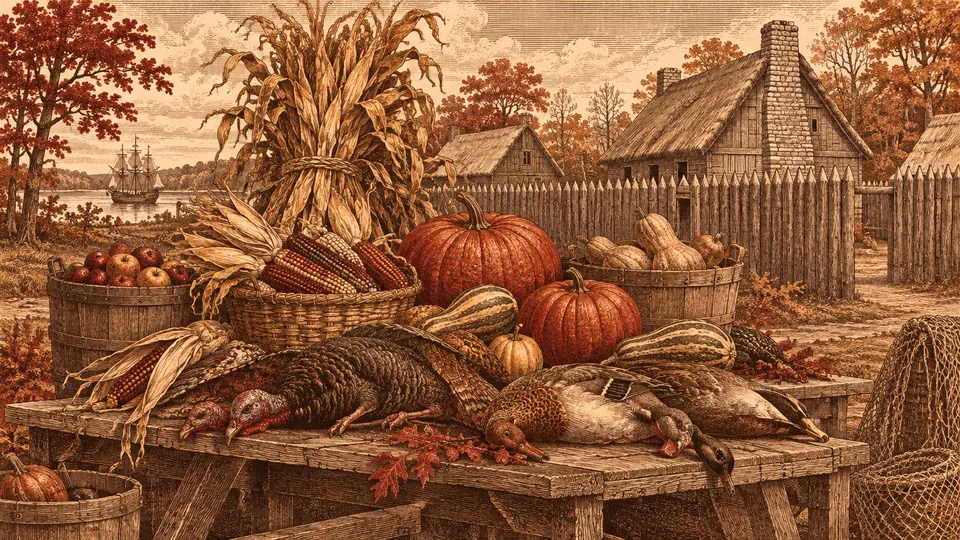
The history of Thanksgiving starts with a three-day harvest celebration at Plymouth Colony in autumn 1621, attended by about 50 English colonists and roughly 90 Wampanoag men with their leader Massasoit. The colonists did not call it a thanksgiving. It became the "First Thanksgiving" in 19th century memory, Lincoln made the holiday national and annual in 1863, and a 1941 law fixed it on the fourth Thursday of November.
On this page
- What Do the Two Eyewitness Accounts of 1621 Actually Say?
- Who Were the Wampanoag at the 1621 Harvest?
- What Did People Eat in 1621, Compared With a Modern Thanksgiving?
- Did the Colonists Call It Thanksgiving?
- Were There Earlier Days of Thanksgiving in America?
- How Did Sarah Josepha Hale and Lincoln Make It a National Holiday?
- Why Is Thanksgiving on the Fourth Thursday of November?
- Frequently Asked Questions
- Our Take
- Sources
Key Takeaways
- Only two firsthand accounts of the 1621 harvest celebration survive, both written by English colonists: Edward Winslow's letter and William Bradford's history.
- The only eyewitness description of the meal names two foods, wildfowl and venison; turkey is probable, while potatoes and pumpkin pie were almost certainly absent.
- For the Plymouth colonists, a "thanksgiving" was a religious day spent in church, and their first recorded one came in 1623, not 1621.
- Sarah Josepha Hale campaigned for decades for a national holiday; Lincoln proclaimed one on October 3, 1863, and Congress fixed the fourth Thursday in 1941.
What Do the Two Eyewitness Accounts of 1621 Actually Say?
They say less than most people expect. Pilgrim Hall Museum, in Plymouth, Massachusetts, puts it plainly: there are "two, and only two" primary source descriptions of the harvest event in the fall of 1621, and both come from the English side [1]. No Wampanoag account was written down at the time.
The fuller one is a letter by Edward Winslow dated December 11, 1621. It was printed in London in 1622 in Mourt's Relation, the first published account of Plymouth Colony [1]. Winslow wrote that after the harvest the governor sent four men out fowling, and that they brought back enough birds in one day to serve the company "almost a week." He then described the visitors: "their greatest king Massasoit, with some ninety men," whom the colonists entertained and feasted for three days. The Wampanoag men went out, killed five deer, and gave them to the governor, the captain and others [4].
The second account is William Bradford's history Of Plymouth Plantation. Bradford, the colony's governor at the time, does not describe the feast itself. He describes the season: fishing for cod and bass, a weekly allowance of Indian corn meal, and a "great store of wild turkeys" that fall [1].
Everything else people "know" about 1621, from the long table to the invitation, comes from later imagination, not from these two texts. Even the date is loose. Plimoth Patuxet Museums places the celebration sometime between September 21 and November 9, 1621, and says the English knew this kind of event as a "Harvest Home" [5].
Who Were the Wampanoag at the 1621 Harvest?
They were the colonists' Native neighbors, led by Ousamequin, the Wampanoag leader whom Winslow called Massasoit. The 1621 gathering was, in Pilgrim Hall Museum's words, "a diplomatic event." It reinforced an alliance the colonists had made with Ousamequin that April [1].
The numbers show who held the stronger hand. Plimoth Patuxet Museums counts at least 140 people at the celebration: about 50 English who had survived the first winter, and the 90 or so men who came with Massasoit [4]. The Wampanoag guests outnumbered their hosts almost two to one.
The record also leaves real gaps. The museum states that "we don't know for sure why the Wampanoag joined the gathering" [5], and it is careful about who else attended. Wampanoag women grew corn, beans and squash, gathered wild foods and processed game, but the sources do not say how many, if any, came to Plymouth. The museum notes that their role has been "traditionally overlooked." It also explains why the gift of five deer mattered: deer was central to the Wampanoag way of life, giving meat as well as material for clothing and tools, so the gift was part of the diplomacy itself [4].
For many Native people, the holiday carries a different meaning. In 1970, the 350th anniversary year of the colonists' arrival, Wamsutta Frank James of the Aquinnah Wampanoag was invited to speak at a commemoration. When organizers judged his remarks too inflammatory, he spoke in Plymouth instead. That gathering began the National Day of Mourning, held each Thanksgiving Day on Cole's Hill above Plymouth Rock to honor Native ancestors and draw attention to the struggles of Native peoples today [3].
What Did People Eat in 1621, Compared With a Modern Thanksgiving?
Less of the modern menu than you might think. Plimoth Patuxet Museums notes that "the only eyewitness account mentions just two foods": venison and wildfowl [4]. Turkey is probable because Bradford recorded plenty of wild turkeys that fall, but the letter does not name it.
The museum's historians list many likely foods based on what the colonists and the Wampanoag grew, gathered and caught: smaller birds, mussels, lobster and eel, corn made into porridge or bread, beans and squash, and wild foods such as cranberries, grapes and nuts. Water was probably the main drink. Several modern favorites were almost certainly missing. Potatoes had not yet been adopted in England. There were no apples in Plymouth yet, so no apple pie. Pumpkin was likely eaten, but probably not as pie, because the colony lacked enough butter and wheat flour for crust. Cranberry sauce did not appear in print until about half a century later [4].
| Food | 1621 status | Basis |
|---|---|---|
| Wildfowl | Recorded | Winslow's letter |
| Venison | Recorded | Winslow's letter (five deer) |
| Turkey | Probable | Bradford: wild turkeys that fall |
| Corn porridge or bread | Likely | Colonial and Wampanoag crops |
| Mussels, lobster, eel | Likely | Local seafood |
| Potatoes | Unlikely | Not yet adopted in England |
| Pumpkin pie | Unlikely | Too little butter and wheat flour |
| Apple pie | Absent | No apples in Plymouth yet |
| Cranberry sauce | Unlikely | Not in print until about 50 years later |
Did the Colonists Call It Thanksgiving?
No. Pilgrim Hall Museum states that the colonists "did not call this harvest event a 'thanksgiving'" [2]. To them, a Day of Thanksgiving was purely religious. In the museum's description, "the entire day would have been spent in church, with no feasting or amusements." A secular harvest celebration with games and food was a different thing.
The first recorded religious Day of Thanksgiving in Plymouth Colony came in 1623, in response to a providential rainfall, two years after the famous harvest. Later, a 1636 Plymouth law let the governor call days of fasting and of thanksgiving as occasions arose, and in 1668 the colony asked its churches to give thanks together on November 25 [2]. The 1621 harvest only entered American popular imagination as "the First Thanksgiving" in the 19th century [5].
Were There Earlier Days of Thanksgiving in America?
Yes, and Plymouth was not unusual. Thanksgiving services were common wherever Europeans settled. In Virginia, the Library of Virginia notes that the first Day of Thanksgiving meant to be kept as an annual holiday was celebrated at the Berkeley Hundred plantation on December 4, 1619, two years before the Plymouth harvest [9]. The National Park Service mentions an even older candidate: a possible thanksgiving in 1541 between the Spanish expedition of Francisco Vásquez de Coronado and the Teya people at Palo Duro Canyon, in present-day Texas [6].
After independence, thanksgiving days became national occasions, but not yet annual ones. The Continental Congress proclaimed a thanksgiving for December 18, 1777, for all 13 states, and such proclamations continued until 1784 [2]. On September 28, 1789, the first Federal Congress asked the president to recommend a day of thanksgiving. On October 3, 1789, George Washington named Thursday, November 26, 1789, the first Thanksgiving under the new Constitution [7]. Later presidents issued proclamations too, but the dates and even the months varied. By the 1840s most states held a Thanksgiving each year, proclaimed by their own governors [2]. You can follow the wider story of the colonial period in our colonial America era guide.
How Did Sarah Josepha Hale and Lincoln Make It a National Holiday?
By persistence, and then by timing. Sarah Josepha Hale began writing essays calling for a national Thanksgiving in 1827, as editor of Boston's Ladies' Magazine. In 1846, as editor of Godey's Lady's Book, she launched a letter-writing campaign to officials. On September 28, 1863, she wrote directly to President Abraham Lincoln [6].
Days later, on October 3, 1863, Lincoln proclaimed a national Thanksgiving to be held on "the last Thursday of November." The National Park Service notes that Secretary of State William Seward wrote the text, and that Lincoln issued nine Thanksgiving proclamations during the Civil War [6]. The National Archives describes the 1863 proclamation as the point when the traditional celebration became a nationwide holiday held each year in November [8]. The war itself is covered in why the Civil War started.
Hale also helped tie the holiday to Plymouth. In 1865 she wrote in Godey's that the Pilgrim Fathers had made an early thanksgiving day part of their moral influence [2].
Why Is Thanksgiving on the Fourth Thursday of November?
Because of a shopping-season dispute in 1939. Lincoln's "last Thursday" rule held for decades. In 1939, though, the last Thursday of November fell on the last day of the month. Worried that a short Christmas shopping season could slow the economic recovery, President Franklin D. Roosevelt moved Thanksgiving to the second-to-last Thursday [7]. The recovery he had in mind followed the crisis described in why the Great Depression happened.
The country split. According to the National Archives, 32 states issued matching proclamations and 16 refused, keeping the last Thursday. For two years, the United States had two Thanksgivings, a week apart. To end the confusion, the House passed a joint resolution on October 6, 1941, making the last Thursday the legal holiday. The Senate amended it to the fourth Thursday, which allows for Novembers with five Thursdays. The House agreed, and Roosevelt signed the resolution on December 26, 1941 [7]. Since 1941, federal law has set Thanksgiving on the fourth Thursday of November. The National Park Service gives the same 1941 outcome [6]. For other days on the national calendar, see our holidays section, including the history of Labor Day.
Frequently Asked Questions
When was the first Thanksgiving?
The event usually called the first Thanksgiving was a three-day harvest celebration at Plymouth Colony in autumn 1621; Plimoth Patuxet Museums places it between September 21 and November 9 {{cite:plimoth-thanksgiving}}. Earlier thanksgiving days were held elsewhere, including at Berkeley Hundred in Virginia on December 4, 1619 {{cite:library-we-give-thanks-for-thanksgiving}}.
Did the Pilgrims eat turkey in 1621?
Possibly. The only eyewitness description names wildfowl and venison, not turkey. Bradford wrote that there were plenty of wild turkeys that fall, so historians at Plimoth Patuxet Museums call turkey probable {{cite:plimoth-what-did-they-eat-at}}.
Who made Thanksgiving a national holiday?
Abraham Lincoln, with a proclamation on October 3, 1863, after a long campaign by magazine editor Sarah Josepha Hale. Secretary of State William Seward wrote the text {{cite:national-lincoln-and-thanksgiving}}. The fourth-Thursday date was fixed by law in 1941 {{cite:national-congress-establishes}}.
How many Wampanoag came to the 1621 harvest?
Edward Winslow wrote that Massasoit came "with some ninety men." With about 50 English colonists, that makes at least 140 people in all {{cite:plimoth-what-did-they-eat-at}}.
Our Take
We think the real history of Thanksgiving is more useful than the pageant version. The record is thin: one letter paragraph, one season's description, and no Wampanoag account from the time. That thinness is the point. It shows how much of the familiar story, from the invitation to the pumpkin pie, was added later, much of it in the 19th century when Hale and others were building a national holiday. We also think the 1621 event makes more sense as diplomacy between two peoples than as a dinner party, and that the National Day of Mourning belongs in any honest telling of the holiday's history. Where the sources are silent, as on why the Wampanoag came or whether women attended, we say so rather than fill the gap. Our editorial policy explains how we separate tradition from record, as we also do for the history of Valentine's Day.
Sources
- The 'First Thanksgiving'. Pilgrim Hall Museum.
- Evolution of an American Holiday. Pilgrim Hall Museum.
- National Day of Mourning. Pilgrim Hall Museum.
- What did they eat at the 1621 harvest celebration?. Plimoth Patuxet Museums.
- Thanksgiving. Plimoth Patuxet Museums.
- Lincoln and Thanksgiving. National Park Service.
- Congress Establishes Thanksgiving. National Archives.
- Thanksgiving. National Archives.
- We Give Thanks for Thanksgiving. Library of Virginia, 2015.
Where historians disagree, we say so and show the main views. Dates are checked against two sources; legend and documented record are labeled separately. Spotted an error? Tell us.
Keep Reading
The History of Memorial Day
Memorial Day began as Decoration Day after the Civil War. Here is who claims to be first, Logan's 1868 order, the Monday move and today's moment of silence.
The History of Juneteenth
How Juneteenth began with General Order No. 3 in Galveston on June 19, 1865, why freedom came late to Texas, and how it became a federal holiday in 2021.
The History of Halloween
How Halloween grew from Samhain tales, the November 1 feast of All Saints, souling and guising, and Irish turnip lanterns into America's pumpkin holiday.
The History of Labor Day
Labor Day began with a New York parade on September 5, 1882, spread through state laws from 1887 and became a federal holiday in June 1894. Here is the story.
The History of Valentine's Day
Where Valentine's Day really came from: the early martyrs, the disputed Lupercalia link, Chaucer's love poem, and the lace cards that built a U.S. industry.