Why Did the Great Depression Happen?
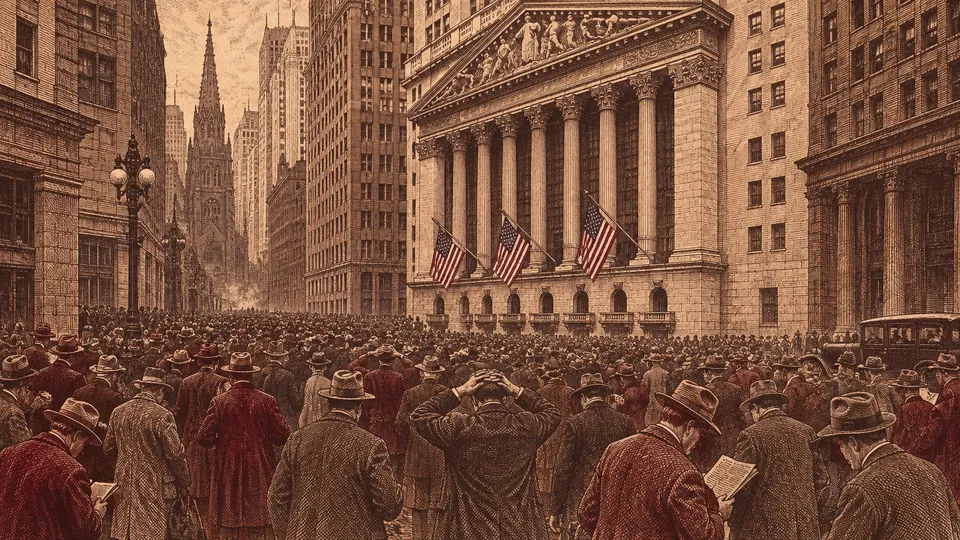
Quick Answer
The Great Depression happened because several shocks hit a fragile economy at once. A recession began in August 1929, the stock market crashed that October, and waves of bank panics from 1930 to 1933 shrank the money supply by nearly 30 percent. The Federal Reserve did too little, the gold standard spread the damage abroad, and trade barriers and drought made it worse. Economists still debate how much each factor mattered.
On this page
- What went wrong during the 1920s boom?
- Did the 1929 stock market crash cause the Great Depression?
- Why did so many banks fail?
- What role did the Federal Reserve and the gold standard play?
- How did the Smoot-Hawley Tariff and the Dust Bowl make it worse?
- What ended the Great Depression?
- Frequently Asked Questions
- Our Take
- Sources
Key Takeaways
- The downturn began in August 1929, before the October stock market crash, and hit bottom in March 1933.
- More than 9,000 U.S. banks suspended operations from 1930 to 1933, and the money supply fell by nearly 30 percent.
- Milton Friedman and Anna Schwartz blamed the Federal Reserve for letting money contract; other economists stress broken credit, the gold standard and falling demand.
- Unemployment reached 24.9 percent in 1933, according to figures from the FDR Library and the Bureau of Labor Statistics.
- Recovery began after the U.S. left the gold standard in 1933, but full employment returned only with World War II production around 1941.
What went wrong during the 1920s boom?
The Roaring Twenties looked strong on the surface, especially on Wall Street. The Dow Jones Industrial Average rose six-fold, from 63 in August 1921 to 381 in September 1929 [2]. Much of that climb ran on borrowed money. Buyers "on margin" typically put down 10 percent of a stock's price and borrowed the rest, using the shares themselves as collateral [2].
Underneath the boom there were weak spots:
- Farms and small banks. An average of more than 600 banks a year failed between 1921 and 1929, ten times the rate of the decade before. Most were small rural banks hurt by the "severe agricultural problems" of the decade [8].
- Tight money. Worried about stock speculation, the Federal Reserve tightened policy starting in the spring of 1928, which Friedman and Schwartz later called its "first grave mistake" [6]. The New York Fed's discount rate reached 6 percent in August 1929 [2].
- Older theories. Earlier economists blamed overinvestment and overbuilding in the 1920s, or households that could not buy all the goods being produced [6].
According to the Federal Reserve's history site, the Great Depression "began in August 1929, when the economic expansion of the Roaring Twenties came to an end" [1]. That date matters: the economy was already sliding before the stock market crashed.
Did the 1929 stock market crash cause the Great Depression?
The crash deepened the downturn, but most historians do not treat it as the single cause. The Dow peaked on September 3, 1929, at 381.17 [2]. On Black Thursday, October 24, 1929, panicking investors sold 16 million shares [9]. The Dow fell nearly 13 percent on Black Monday, October 28, and nearly 12 percent more on Black Tuesday, October 29 [2].
Prices kept sliding. The Dow closed at 41.22 on July 8, 1932, 89 percent below its peak, and did not regain its 1929 high until November 23, 1954 [2].
Did the crash cause the slump? Gary Richardson and his co-authors at the Federal Reserve write that the crash hurt business and deepened a contraction that had begun that summer, but that its effect faded within months. They argue that problems elsewhere in the financial system turned "what may have been a short, sharp recession" into something far worse. They also note that Allan Meltzer and other scholars see the crash as "a symptom, not a contributing force" [2].
Why did so many banks fail?
Bank runs turned a recession into a depression. In November 1930 a series of crises among commercial banks began, set off by the collapse of the Caldwell banking group in Tennessee. On December 11, 1930, the Bank of United States, the fourth-largest bank in New York City, closed [3]. A new crisis broke out in Chicago in June 1931.
Each wave fed the next. Frightened depositors pulled out cash, banks called in loans and sold assets, and asset prices fell further, so more banks failed [8]. The FDIC counts the suspensions this way:
| Year | U.S. commercial bank suspensions |
|---|---|
| 1929 | 659 |
| 1930 | 1,350 |
| 1931 | 2,293 |
| 1932 | 1,453 |
| 1933 | 4,000 |
Source: FDIC, A Brief History of Deposit Insurance in the United States (1998), Table 5.
By Inauguration Day, March 4, 1933, every state had declared a bank holiday, and President Franklin D. Roosevelt proclaimed a nationwide holiday starting March 6 [8]. More than 9,000 banks failed in the four years before deposit insurance began in 1934; only nine failed in 1934 itself. [8]
What role did the Federal Reserve and the gold standard play?
This is the center of the debate among economists.
The monetary view. In A Monetary History of the United States, 1867-1960 (1963), Milton Friedman and Anna Schwartz argued that the collapse was "a tragic testimonial to the importance of monetary forces" [6]. From the fall of 1930 through the winter of 1933, the money supply fell by nearly 30 percent, and average prices fell by about the same amount [1]. The Fed did not act as a lender of last resort during the panics, partly because many officials believed failing banks were simply badly managed [8]. In 2002, then Fed Governor Ben Bernanke told Friedman and Schwartz: "You're right, we did it. We're very sorry." [7]
The credit view. Bernanke's own 1983 research added a nonmonetary channel: bank failures "disrupted the process of credit creation," raising the cost of working capital for firms [3]. He has described this as an addition to the Friedman and Schwartz account rather than a rival to it [7].
The gold standard view. Bernanke argued that "a complete understanding of the Depression requires attention to the operation of the international gold standard" [6]. Gold tied interest rates and monetary policy across countries [1]. When Britain left gold in September 1931, foreigners converted dollar deposits to gold, and the New York Fed sharply raised its rate to stop the outflow instead of supporting banks at home [8]. Britain and the Scandinavian countries, which left gold in 1931, recovered much earlier than France and Belgium, which stayed on it longer [6].
| Explanation | Main argument | Associated with |
|---|---|---|
| Monetary | The Fed let the money supply collapse | Friedman and Schwartz (1963) |
| Credit disruption | Bank failures cut off lending to firms and households | Bernanke (1983) |
| Gold standard | Gold rules spread tight money between countries | Eichengreen and Sachs (1985), Bernanke (2004) |
| Real-side and demand | Overbuilding and weak spending after the 1920s | Earlier theories summarized by Bernanke (2004) |
How did the Smoot-Hawley Tariff and the Dust Bowl make it worse?
The Tariff Act of 1930, better known as the Smoot-Hawley tariff, kept and extended the high protection of the 1920s [12]. World trade fell by some 66 percent between 1929 and 1934. The State Department's historians note that scholars still disagree about how much protection the tariff added and whether it set off a wave of foreign retaliation that deepened the Depression. They also call it a symbol of "beggar-thy-neighbor" policies that "did nothing to foster cooperation among nations" [12].
The Dust Bowl hit farm families who were already in trouble. The 1930s Dust Bowl drought is still the most notable drought and extreme heat event in the U.S. record, and the longest drought episodes ran from July 1928 to May 1942 [13]. The National Park Service traces the dust storms to "severe drought and a failure to apply dryland farming methods" [14]. Falling farm prices and the drought led to foreclosures across the Great Plains [9]. The drought did not start the Depression, but it compounded the hardship in farm country.
What ended the Great Depression?
There is no single agreed answer, and the evidence supports several parts of the story.
Leaving gold and reflation. Roosevelt took office on March 4, 1933 [9]. A proclamation on April 20, 1933, suspended the gold standard [4], and the Gold Reserve Act, signed January 30, 1934, raised the official gold price from $20.67 to $35 an ounce [5]. Economic historians including Friedman and Schwartz, Meltzer, Bernanke and Christina Romer generally agree that reflation helped, and Barry Eichengreen and Jeffrey Sachs found that recovery began when countries suspended the gold standard [4].
The New Deal. Roosevelt had promised "a New Deal for the American people," and its first programs passed in the First Hundred Days, along with banking reforms such as the Banking Act of 1933, which created the FDIC [9] [8]. Between 1933 and the recession of 1937-38, the economy grew strongly, until a "misguided tightening" by the Fed contributed to a new downturn [6].
World War II. Unemployment stayed in double digits through 1940. A 1948 Bureau of Labor Statistics table counts 12,830,000 unemployed in 1933 out of a civilian labor force of 51,590,000 [10], and BLS annual figures still show 14.6 percent unemployment in 1940 and 9.9 percent in 1941 [11]. The FDR Library says the Depression "hung on until 1941," when defense and war-industry jobs brought the economy back to full production [9], and the Fed's history site also dates the return to full output and employment to the Second World War [1]. The attack that brought the U.S. into the war followed in late 1941.
Monetary recovery started the climb in 1933, but it took wartime production to bring jobs fully back. For how the war itself began, see why World War II started, and for the presidents of these years, the list of U.S. presidents in order. The Depression sits between two global conflicts: why World War I started explains the first, and our world wars era page gathers the rest, alongside more why history happened answers.
Frequently Asked Questions
How long did the Great Depression last?
In the United States the downturn began in August 1929 and hit bottom in March 1933 {{cite:federal-the-great-depression}}. Recovery was interrupted by the 1937-38 recession, and full employment returned around 1941 with war production {{cite:fdr-great-depression-facts}}.
How high did unemployment get during the Great Depression?
At the height of the Depression in 1933, 24.9 percent of the work force, or 12,830,000 people, was unemployed {{cite:fdr-great-depression-facts}}. Real output fell nearly 30 percent from 1929 to 1933 {{cite:federal-money-gold-and-the-great}}.
Was Black Tuesday the start of the Great Depression?
No. The downturn had already started in August 1929, two months before Black Tuesday on October 29 {{cite:federal-the-great-depression}}. The crash made the slump worse, but the bank panics of 1930 to 1933 did more lasting damage.
Did the Smoot-Hawley Tariff cause the Great Depression?
Most accounts treat it as an aggravating factor, not the cause. World trade fell by about two-thirds between 1929 and 1934, but scholars disagree about how much the tariff and foreign retaliation contributed {{cite:office-protectionism-in-the-interwar}}.
Our Take
We think the clearest answer to "why did the Great Depression happen" is that an ordinary recession met a broken financial system. The 1920s left weak farm banks and heavy borrowing, the crash shook confidence, and then the bank panics of 1930 to 1933 did the real damage while the Federal Reserve held back and the gold standard tied its hands. On that last point, the evidence assembled by Friedman and Schwartz, Bernanke, and Eichengreen and Sachs is hard to ignore. We also think readers should keep the debate open on what ended it: leaving gold started the recovery, the New Deal rebuilt trust in banks, and war production finished the job. You can read more answers like this one on our why history happened page and in the world wars era, and our editorial policy explains how we check sources.
Sources
- The Great Depression. Federal Reserve History, 2013.
- Stock Market Crash of 1929. Federal Reserve History, 2013.
- Banking Panics of 1930-31. Federal Reserve History, 2013.
- Roosevelt's Gold Program. Federal Reserve History.
- Gold Reserve Act of 1934. Federal Reserve History, 2013.
- Money, Gold, and the Great Depression. Federal Reserve Board, 2004.
- On Milton Friedman's Ninetieth Birthday. Federal Reserve Board, 2002.
- A Brief History of Deposit Insurance in the United States. FDIC, 1998.
- Great Depression Facts. FDR Library.
- Labor Force, Employment, and Unemployment, Estimating Methods (Monthly Labor Review). Bureau of Labor Statistics, 1948.
- Employment status of the civilian noninstitutional population, annual averages. Bureau of Labor Statistics.
- Protectionism in the Interwar Period. Office of the Historian.
- Historical Drought. Drought.gov.
- A New Deal to Rebuild a Nation: Lesson 1. National Park Service.
Where historians disagree, we say so and show the main views. Dates are checked against two sources; legend and documented record are labeled separately. Spotted an error? Tell us.
Keep Reading
Why Did the Cold War Start?
Why did the Cold War start? How the U.S.-Soviet alliance broke down from Yalta and Potsdam to the Truman Doctrine, Berlin Airlift, NATO and the Soviet bomb.
Why Did the Civil War Start?
Why did the Civil War start? What the seceding states said in their own words, the fight over slavery in the West, Lincoln's election, and Fort Sumter.
Why Did World War II Start?
Why did WW2 start? Versailles, the Depression, Hitler's aims, Japan in China, appeasement at Munich, the Nazi-Soviet Pact, Poland in 1939 and Pearl Harbor.
Why Did the Roman Empire Fall?
Why did the Roman Empire fall? What 476 CE really marks, the main causes historians cite, why the East lasted to 1453, and the decline vs transformation debate.
Why Did the Titanic Sink?
The Titanic sank after an iceberg opened her five forward compartments in April 1912. Why she flooded, why about 1,500 died, and what changed at sea after.
Why Did World War I Start?
Why did WW1 start? The long-term causes, the Sarajevo assassination, the July Crisis day by day, how alliances spread the war, and why the U.S. joined in 1917.