Why Did World War I Start?
Quick Answer
World War I started because a local crisis met a dangerous system. On June 28, 1914, a Bosnian Serb nationalist killed Archduke Franz Ferdinand of Austria-Hungary in Sarajevo. Backed by Germany, Austria-Hungary declared war on Serbia on July 28. Alliances, war plans built for speed, imperial rivalry and nationalism then pulled Russia, Germany, France and Britain into the fighting by August 4, 1914.
On this page
- What were the long-term causes of World War I?
- What happened in Sarajevo on June 28, 1914?
- How did the July Crisis turn into a world war?
- How did the alliances pull in each great power?
- Who was to blame for World War I?
- Why did the United States join World War I in 1917?
- Frequently Asked Questions
- Our Take
- Sources
Key Takeaways
- The trigger was the assassination of Archduke Franz Ferdinand in Sarajevo on June 28, 1914.
- The deeper causes are often taught as "MAIN": militarism, alliances, imperialism and nationalism.
- Austria-Hungary declared war on Serbia on July 28, 1914; Britain entered on August 4 after Germany invaded neutral Belgium.
- Historians still disagree about responsibility, from Fritz Fischer's case against Germany to views that spread the blame more widely.
- The United States stayed neutral until April 6, 1917, after Germany resumed unrestricted submarine warfare and the Zimmermann Telegram became public.
What were the long-term causes of World War I?
Teachers often sum up the background with the acronym MAIN: militarism, alliances, imperialism and nationalism. It is a classroom memory aid, not a verdict that historians agree on, but it is a useful checklist for what made Europe so flammable in 1914.
| Cause | What it meant before 1914 | How it showed up in the crisis |
|---|---|---|
| Militarism | Large armies and detailed war plans that depended on speed | Germany's plan called for a quick strike on France while Russia was still mobilizing |
| Alliances | Europe split into two armed camps | Germany backed Austria-Hungary; France was Russia's ally |
| Imperialism | Rivalry for territory, markets and influence, including in the Balkans | Austria-Hungary and Russia both saw the Balkans as their sphere |
| Nationalism | Movements seeking new nation-states or national glory | Serb nationalists wanted Bosnia joined to Serbia |
Militarism. Germany's war plan relied on knocking out France quickly while Russia, France's ally, was "slowly mobilising" [9]. A plan like that put a premium on striking first, which made every mobilization order look like a threat.
Alliances. Germany, Austria-Hungary and Italy were partners in the Triple Alliance [5]. On the other side, France and Russia were allies, while Britain's ties to them were looser. In the House of Commons on August 3, 1914, a member quoted the Foreign Secretary's statement that Britain was "under no obligation" and that the House was free to decide [10]. The National Army Museum describes the assassination as sending a "shockwave through Europe's intricate alliance system" [9].
Imperialism and nationalism. Austria-Hungary had a long-running feud with Serbia, and secret societies and nationalist groups were working toward an independent Slavic nation free of foreign rule [4]. For the multinational Habsburg empire, that kind of nationalism was a threat to its survival.
What happened in Sarajevo on June 28, 1914?
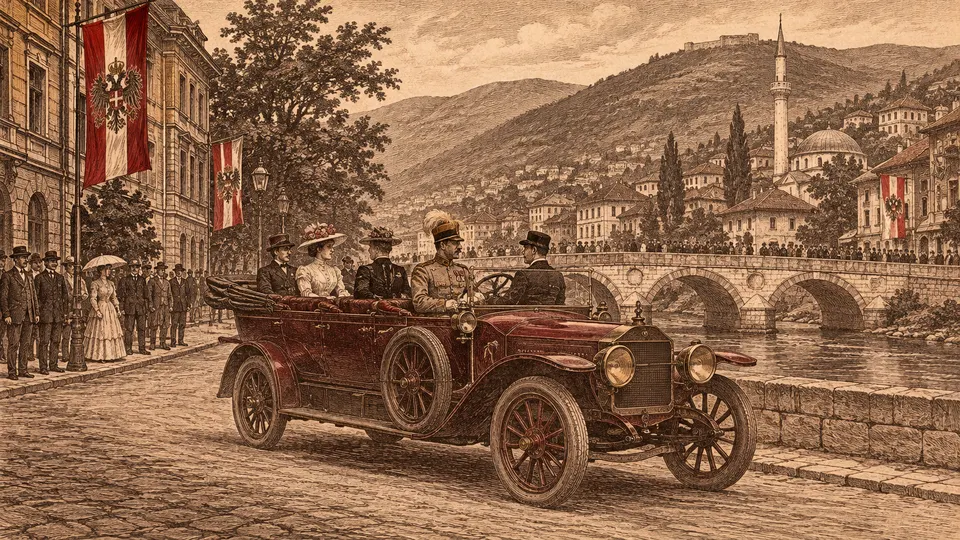
Archduke Franz Ferdinand, heir to the Austro-Hungarian throne, was in Bosnia-Herzegovina to oversee military maneuvers. On June 28, 1914, he and his wife, Sophie, were shot in Sarajevo by Gavrilo Princip, a Bosnian Serb nationalist, and both died [2] [7]. An earlier attempt that morning, a bomb thrown at the motorcade, had failed.
Princip "is said to be affiliated" with the Serbian nationalist society known as the Black Hand, which had reported ties to the Serbian government and wanted Bosnia united with Serbia [3]. The Austrian government suspected Serbia was responsible [1], and the killing became a pretext for aggressive action against Serbia [4].
The assassination was the trigger, not the whole cause: it mattered because of how the great powers chose to respond.
How did the July Crisis turn into a world war?
The five weeks after Sarajevo are known as the July Crisis. Each step below made the next one more likely.
- July 5: Germany's promise. Germany promised Austria-Hungary support against Russia if Russia opposed an attack on Serbia [8]. Historians call this the "blank cheque."
- July 23: the ultimatum. Austria-Hungary sent Serbia an ultimatum the National Army Museum calls "impossible," and it was rejected [8]. By July 26, a Berlin newspaper was reporting that diplomatic relations had been broken [4].
- July 27: a hope that it would stay small. The U.S. ambassador to Austria-Hungary, Frederic Courtland Penfield, cabled Washington: "War certain and probably localized Balkans" [4].
- July 28: war on Serbia. Austria-Hungary declared war on Serbia, the date usually given as the start of World War I [1] [7].
- July 29 to 31: Russia and Germany. Russian mobilization was ordered on July 29 [7]. On July 31, Germany demanded that Russia halt it; Russia answered that its mobilization was aimed only at Austria-Hungary [8].
- August 1 to 4: the war spreads west. Germany declared war on Russia on August 1, demanded free passage through Belgium on August 2, declared war on France on August 3, and crossed into Belgium on August 4. That same day Britain declared war on Germany [7] [8].
In 37 days, a crime in one Balkan city became a war among five great powers.
How did the alliances pull in each great power?
The alliance system did not work like a row of automatic switches, but it shaped every choice. Each power that entered had a partner, a promise or a plan that pointed it toward war.
Germany's war on France ran through Belgium because its plan called for a quick strike at France while Russia mobilized slowly [8]. Britain went to war in response to the violation of the 1839 Treaty of London, which guaranteed Belgian neutrality [9]. On August 1, Germany and the Ottoman Empire also signed a secret alliance aimed against Russia [8].
The declarations kept coming after the first week. Dates below are confirmed by both the University of Oxford chronology and the National Army Museum timeline [7] [8].
| Date | Who went to war with whom |
|---|---|
| July 28, 1914 | Austria-Hungary declares war on Serbia |
| August 1, 1914 | Germany declares war on Russia |
| August 3, 1914 | Germany declares war on France |
| August 4, 1914 | Germany invades Belgium; Britain declares war on Germany |
| August 6, 1914 | Austria-Hungary declares war on Russia |
| August 12, 1914 | Britain declares war on Austria-Hungary |
| August 23, 1914 | Japan declares war on Germany |
| May 23, 1915 | Italy declares war on Austria-Hungary |
The exceptions matter as much as the rule. Italy was a partner in the Triple Alliance, yet it stayed neutral in 1914, resigned from the alliance on May 3, 1915, and declared war on Austria-Hungary on May 23, 1915 [5]. Alliances made a wider war likely, but governments still chose whether and when to fight.
Who was to blame for World War I?
Historians have argued about responsibility for more than a century, and the debate is not settled. The peace treaty itself took a side: Article 231 of the Treaty of Versailles became known as the "war guilt" clause. In the years after 1918, the German government encouraged and sponsored a misrepresentation of the history in an effort to escape it [11].
Three broad positions stand out:
- Germany bears the main responsibility. The German historian Fritz Fischer argued that Germany planned the war and wanted control over continental Europe, a claim that caused a huge uproar in Germany. The historian Annika Mombauer, in a survey of the debate, argues that Fischer was "basically right," according to Matthew Hughes's review of her book [11].
- Responsibility was spread across several capitals. Christopher Clark's The Sleepwalkers, one of the most discussed books published around the centenary, puts the agency of decision-makers at the center of the story. Recent work has also looked harder at the role of powers other than Berlin and Vienna [12].
- War was not inevitable. In the same body of centenary scholarship, Jean-Jacques Becker and Gerd Krumeich concluded that "war was not inevitable," which shifts attention from the long-term causes to the choices of July 1914 [12].
These views overlap more than the labels suggest. Every account has to explain the early decisions in Vienna and Berlin, such as the "blank cheque," and every account has to explain why Russia, France and Britain followed. The disagreement is mainly about weight: how much blame belongs to Germany, and how much to a system that every power helped build. We present these positions side by side, as our editorial policy asks, rather than declaring a winner.
Why did the United States join World War I in 1917?
The United States stayed out for almost three years. President Woodrow Wilson followed a policy of "strict and impartial neutrality," although many Americans sympathized with the Allies [6]. On August 5, 1914, Wilson even offered American good offices for peace [7].
Submarine warfare was the main grievance. In May 1915, a German U-boat sank the Lusitania, killing 128 Americans [6] [15]. Germany later gave the "Sussex pledge" of May 1916 to limit such attacks, but on January 31, 1917, it announced that unrestricted submarine warfare would resume, and Wilson broke off diplomatic relations on February 3 [13].
Then came the Zimmermann Telegram. German Foreign Minister Arthur Zimmermann proposed an alliance with Mexico, which would get help to reconquer territory in Texas, New Mexico and Arizona. Britain gave the decoded message to Wilson on February 24, 1917, and it appeared in the American press on March 1 [14].
On April 2, 1917, Wilson asked Congress for war, declaring that "the world must be made safe for democracy" [15]. The Senate voted 82 to 6 on April 4, and the House passed the resolution 373 to 50 on April 6, the day the United States entered the war [6]. War on Austria-Hungary followed on December 7, 1917 [13]. America did not join because of Sarajevo; it joined because of what the war at sea did to American ships and lives.
The war ended with the armistice of November 11, 1918, but its settlement shaped the next two decades, from the Great Depression to the road to World War II. Americans who died in this and later wars are honored on Memorial Day. You can explore more of the period in our World Wars era guide or browse other questions about why history happened.
Frequently Asked Questions
What does MAIN stand for in the causes of World War I?
MAIN stands for militarism, alliances, imperialism and nationalism. It is a memory aid used in many classrooms to group the long-term causes. Historians use it as a starting point, not a final explanation, because the war also depended on specific decisions made in July 1914.
Who killed Archduke Franz Ferdinand?
Gavrilo Princip, a Bosnian Serb nationalist, shot Archduke Franz Ferdinand and his wife, Sophie, in Sarajevo on June 28, 1914 {{cite:national-the-events-of-wwi}}. Princip is said to have been linked to the Black Hand, a Serbian nationalist society.
When did World War I start and end?
The war began when Austria-Hungary declared war on Serbia on July 28, 1914. Fighting on the Western Front ended at 11:00 a.m. Paris time on November 11, 1918, when Germany signed the armistice {{cite:national-interactive-wwi-timeline}}.
Was World War I inevitable?
Historians disagree. Some stress long-term pressures such as alliances and arms, while others, including Jean-Jacques Becker and Gerd Krumeich, conclude that war was not inevitable and that choices in July 1914 decided the outcome {{cite:reviews-cambridge-history-of-the-first}}.
Our Take
We think the most useful answer to "why did WW1 start" has two layers. The long-term causes explain why Europe was ready to burn: rival alliances, war plans that rewarded speed, imperial competition and nationalism. They do not explain why it burned in the summer of 1914. For that, the record points to a short chain of decisions, starting with Germany's promise to Austria-Hungary on July 5 and ending with Britain's declaration on August 4. Historians still weigh those decisions differently, and we think readers should see the Fischer view and the shared-responsibility view side by side. The lesson we take from the sources is that alliances raised the stakes, but people still made the choices.
Sources
- Interactive WWI Timeline. National WWI Museum and Memorial.
- The Events of WWI. National WWI Museum and Memorial.
- June 28, 1914. National WWI Museum and Memorial.
- On the Brink. National WWI Museum and Memorial.
- Italy Enters World War I. National WWI Museum and Memorial.
- U.S. Enters the War. National WWI Museum and Memorial.
- WW1: Chronology and Battles. University of Oxford.
- First World War Timeline. National Army Museum.
- 1914: To arms. National Army Museum.
- War in Europe (House of Commons, 3 August 1914). UK Parliament Hansard, 1914.
- The Origins of the First World War: Controversies and Consensus (review no. 291). Reviews in History, 2002.
- Cambridge History of the First World War (review no. 1618). Reviews in History, 2014.
- American Entry into World War I, 1917. Office of the Historian.
- Zimmermann Telegram (1917). National Archives.
- Joint Address to Congress Leading to a Declaration of War Against Germany (1917). National Archives.
Where historians disagree, we say so and show the main views. Dates are checked against two sources; legend and documented record are labeled separately. Spotted an error? Tell us.
Keep Reading
Why Did the Cold War Start?
Why did the Cold War start? How the U.S.-Soviet alliance broke down from Yalta and Potsdam to the Truman Doctrine, Berlin Airlift, NATO and the Soviet bomb.
Why Did the Great Depression Happen?
Why did the Great Depression happen? The 1920s boom, the 1929 crash, bank panics, Fed mistakes, the gold standard, Smoot-Hawley, Dust Bowl and what ended it.
Why Did the Civil War Start?
Why did the Civil War start? What the seceding states said in their own words, the fight over slavery in the West, Lincoln's election, and Fort Sumter.
Why Did World War II Start?
Why did WW2 start? Versailles, the Depression, Hitler's aims, Japan in China, appeasement at Munich, the Nazi-Soviet Pact, Poland in 1939 and Pearl Harbor.
Why Did the Roman Empire Fall?
Why did the Roman Empire fall? What 476 CE really marks, the main causes historians cite, why the East lasted to 1453, and the decline vs transformation debate.
Why Did the Titanic Sink?
The Titanic sank after an iceberg opened her five forward compartments in April 1912. Why she flooded, why about 1,500 died, and what changed at sea after.