Why Did the Cold War Start?
Quick Answer
The Cold War started because the United States and the Soviet Union, allies against Nazi Germany, could not agree on the shape of postwar Europe. Disputes over Poland, Germany, Iran and atomic weapons turned into open rivalry between 1945 and 1949. The Truman Doctrine of March 1947 made containment official U.S. policy, and the Berlin Blockade, NATO and the first Soviet atomic test then locked the two blocs in place.
On this page
- Why is there no single start date for the Cold War?
- How did wartime allies become rivals in 1945?
- What happened in 1946: the Long Telegram and the Iron Curtain?
- How did the Truman Doctrine and the Marshall Plan divide Europe?
- Why did the Berlin Blockade matter?
- How did NATO and the Soviet bomb lock in the Cold War by 1949?
- Who do historians blame for the Cold War?
- Frequently Asked Questions
- Our Take
- Sources
Key Takeaways
- The Cold War has no single start date; many historians and the U.S. Office of the Historian date U.S. containment policy from 1947.
- Yalta (February 1945) and Potsdam (July to August 1945) left Eastern Europe and Germany's future unsettled.
- In 1946, Kennan's Long Telegram and Churchill's "Iron Curtain" speech described a divided Europe and a hostile Soviet Union.
- The Truman Doctrine, the Marshall Plan, the Berlin Blockade and NATO turned that rivalry into two armed blocs by 1949.
- Historians still disagree about responsibility: orthodox, revisionist and post-revisionist schools tell the story differently.
Why is there no single start date for the Cold War?
Wars usually begin with a declaration or an invasion. The Cold War began with a slow breakdown of trust, so historians point to different moments. The U.S. Office of the Historian treats 1947 to 1989 as the period in which containment was the basic U.S. strategy [7]. That is why 1947, the year of the Truman Doctrine, is a common starting point.
Other historians look earlier. Some revisionist writers argue that American hostility to communism dated back to the early 20th century, so the roots predate World War II [16]. The timeline below shows the main turning points from 1945 to 1949; for more dates like these, see what happened on this day.
How did wartime allies become rivals in 1945?
The alliance began to strain before the war ended. At Yalta, held February 4 to 11, 1945, President Franklin D. Roosevelt, Prime Minister Winston Churchill and Soviet Premier Joseph Stalin agreed that Eastern European governments should be "friendly" to the Soviet regime, while the Soviets pledged free elections in territories liberated from Nazi Germany [1]. Those two promises pulled in opposite directions.
Roosevelt died on April 12, 1945, and by the end of that month the new Truman administration was already clashing with the Soviets over Eastern Europe and the United Nations [1]. Truman's place in the line of presidents is covered in our list of U.S. presidents in order.
The Potsdam Conference, July 17 to August 2, 1945, divided a disarmed Germany into four occupation zones but postponed a national German government indefinitely [2]. The United States had tested the first atomic bomb on July 16. When Truman told Stalin about it on July 24, Stalin was already well informed through Soviet intelligence. The Big Three never again met together to plan postwar reconstruction.
What happened in 1946: the Long Telegram and the Iron Curtain?
1946 brought a string of disputes. Soviet troops stayed in northern Iran despite the 1943 Tehran Declaration, Moscow pressed Turkey for base and transit rights in the Turkish Straits, and in June the Soviet government rejected the Baruch Plan for international control of atomic energy [5]. The Soviets opposed any plan that let the United States keep its nuclear monopoly [6].
On February 22, 1946, George F. Kennan, the U.S. chargé d'affaires in Moscow, sent telegram number 511 to the Secretary of State. It argued that the Soviet leadership believed it lived in "antagonistic 'capitalist encirclement'" and that Soviet power was "impervious to logic of reason" but "highly sensitive to logic of force" [3]. Kennan did not call for war; he urged patience, public education and a stronger American society.
Less than two weeks later, on March 5, 1946, Churchill spoke at Westminster College in Fulton, Missouri: "From Stettin in the Baltic to Trieste in the Adriatic, an iron curtain has descended across the Continent" [4]. The phrase gave the West a name for the division of Europe.
How did the Truman Doctrine and the Marshall Plan divide Europe?
Britain announced it would stop aiding the Greek government, which was fighting a civil war against Greek Communists, with the cutoff taking effect on March 31, 1947. On March 12, 1947, Truman asked Congress for $400 million for Greece and Turkey and declared it U.S. policy "to support free peoples who are resisting attempted subjugation" [5]. The same source notes that Stalin had in fact refrained from backing the Greek Communists, a reminder that each side misread the other.
Later that year, Kennan's anonymous "X-Article" in Foreign Affairs called for "a long-term, patient but firm and vigilant containment of Russian expansive tendencies" [7]. Containment became the framework for U.S. policy.
On June 5, 1947, Secretary of State George C. Marshall proposed at Harvard a program to rebuild Europe. Congress appropriated $13.3 billion for European recovery over the next four years [9]; the Office of the Historian describes the total as over $12 billion. Stalin would not open the Soviet Union to Western scrutiny and kept his Eastern European satellites out [8]. Aid that was offered to all of Europe ended up marking the line between East and West.
During 1947 and 1948, a Soviet-sponsored coup brought a communist government to power in Czechoslovakia, and in March 1948 Britain, France, Belgium, the Netherlands and Luxembourg signed the Brussels Treaty [13]. The comparison below sums up how the two blocs took shape.
Why did the Berlin Blockade matter?
Berlin sat deep inside the Soviet zone of Germany, and Potsdam had left Germany's future unresolved [10]. In March 1948 the Soviets walked out of the Allied Control Council. In June, without telling the Soviets, U.S. and British officials introduced the new Deutschmark in their zones and West Berlin. Moscow answered with its own currency, the Ostmark, and on June 24, 1948, blockaded rail, road and water access to the Allied sectors of Berlin.
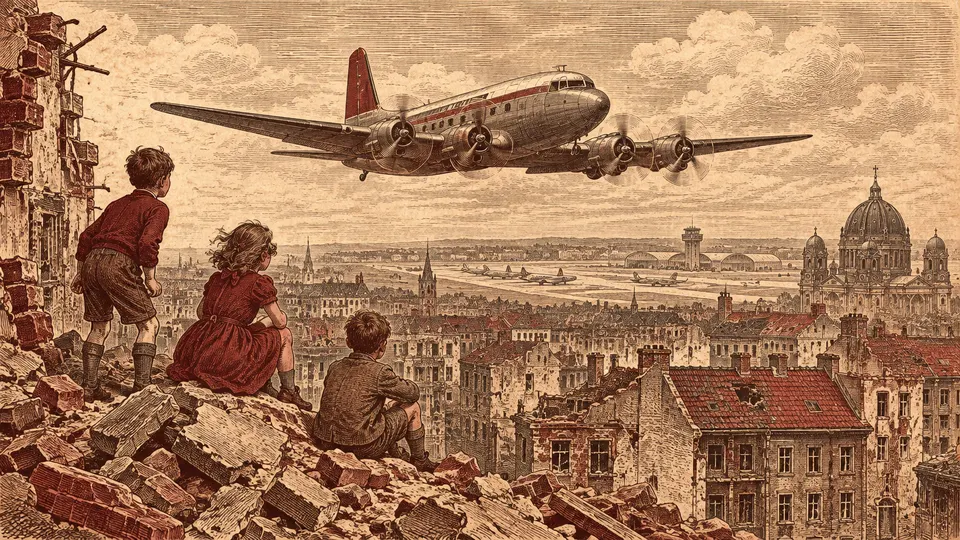
The West chose to supply the city by air. The U.S. "Operation Vittles" began on June 26, 1948, and Britain's "Operation Plainfare" followed two days later [10]. Truman's advisers reasoned that if the Soviets used force against an unarmed airlift, they would be the aggressors.
The stakes were high on both sides. On June 13, 1948, General Lucius Clay reported that staying in Berlin was essential to American prestige, and the United States sent B-29 bombers, capable of carrying nuclear weapons, to Britain. Moscow offered to lift the blockade if the Western Allies withdrew the Deutschmark from West Berlin, and the Allies refused. In September 1948, 300,000 West Berliners rallied at the Reichstag [10].
The numbers grew fast. The airlift carried more than two million tons of supplies to Berlin [12]. On its record day, April 16, 1949, crews flew more than 12,940 short tons in 24 hours on 1,398 flights, and at least 78 people died in airplane accidents during the operation [11]. At the peak, a plane landed at Tempelhof every 45 seconds [10].
Moscow lifted the land blockade in May 1949; the Office of the Historian gives both May 11 and May 12 on the same page, and the AlliiertenMuseum gives May 12. Berlin showed that both sides would risk a crisis over Germany but stop short of shooting.
How did NATO and the Soviet bomb lock in the Cold War by 1949?
On April 4, 1949, twelve countries signed the North Atlantic Treaty: the United States, Canada, Belgium, Denmark, France, Iceland, Italy, Luxembourg, the Netherlands, Norway, Portugal and the United Kingdom [13]. It was the first peacetime military alliance the United States joined outside the Western Hemisphere. Its collective-defense clause, Article 5, says that "an armed attack against one or more of them... shall be considered an attack against them all" [14]. West Germany was established about two weeks after the blockade ended, and East Germany followed [10].
Then the American nuclear monopoly ended. On September 23, 1949, Truman announced: "We have evidence that within recent weeks an atomic explosion occurred in the U.S.S.R." [15]. In 1950, the policy paper NSC 68 called for a drastic expansion of the U.S. military budget and extended containment worldwide [7]. By then, the Cold War was the organizing fact of world politics. For the story of how the earlier global wars began, see why World War II started and why World War I started, or browse the World Wars era.
Who do historians blame for the Cold War?
There is no agreed verdict. Historians usually sort the debate into three schools [16]:
| School | Main argument | Key works named by historians |
|---|---|---|
| Orthodox (traditional) | The Soviet Union was expansionist, and U.S. containment was a response | Herbert Feis, Roosevelt-Churchill-Stalin (1957); Arthur Schlesinger Jr., "The Origins of the Cold War" (1967) |
| Revisionist | U.S. economic expansion and long-standing anti-communism share or carry the blame | William Appleman Williams, The Tragedy of American Diplomacy (1959); Walter LaFeber, America, Russia, and the Cold War (1972) |
| Post-revisionist | Both sides contributed; accepts some revisionist findings but rejects their sharpest conclusions | John Lewis Gaddis, The United States and the Origins of the Cold War, 1941-1947 (1972); Melvyn P. Leffler, A Preponderance of Power (1992) |
The orthodox view dominated until the 1960s. Revisionism began with Williams in 1959, and some revisionists, such as Gar Alperovitz, tied the conflict's start to the atomic bomb. Post-revisionists, writing from the 1970s, tried to balance the two; Thomas G. Paterson's Soviet-American Confrontation (1973) held both sides "equally culpable," while Gaddis still saw Soviet actions in Eastern Europe as the catalyst [16]. Each school reads the same 1945 to 1949 events, but weighs Soviet fears and American power differently. More debates like this one are collected on our Why page and in the Cold War era section.
Frequently Asked Questions
When did the Cold War start and end?
There is no single start date. The Office of the Historian treats 1947 to 1989 as the period when containment was the basic U.S. strategy, ending with the collapse of communism in 1989 {{cite:office-kennan-and-containment-1947}}. Some historians start the story at Yalta in 1945, and some revisionists look back to the early 20th century.
Why is it called the "Cold" War?
The United States and the Soviet Union never fought each other directly. The rivalry was waged through alliances, aid, propaganda, arms build-ups and crises such as the Berlin Blockade, where both sides avoided open fighting.
What did the Iron Curtain mean?
It was Churchill's image, used on March 5, 1946, for the line dividing Soviet-controlled Eastern Europe from the West, "from Stettin in the Baltic to Trieste in the Adriatic" {{cite:international-the-sinews-of-peace-iron}}.
Was the Marshall Plan offered to the Soviet Union?
Yes. The Soviet Union and Eastern European nations were initially possible participants, but Stalin refused to open the Soviet economy to Western scrutiny and did not let his satellites take part {{cite:office-marshall-plan-1948}}.
Our Take
We think the clearest answer is that the Cold War started gradually, through a chain of decisions that each side saw as defensive. The sources show Soviet moves in Iran, Turkey and Czechoslovakia alarming Washington, and they also show Moscow viewing the Marshall Plan and the Deutschmark as threats to its sphere. The Office of the Historian's own note that Stalin held back from the Greek Communists is a useful warning against simple stories. We would not pick a single culprit: the orthodox, revisionist and post-revisionist schools each explain part of the record. What the documents make plain is the timing. Between Yalta in 1945 and the Soviet bomb in 1949, mistrust became policy, and policy became two armed blocs.
Sources
- The Yalta Conference, 1945. Office of the Historian.
- The Potsdam Conference, 1945. Office of the Historian.
- The Chargé in the Soviet Union (Kennan) to the Secretary of State (FRUS 1946, Vol. VI, Document 475). Office of the Historian, 1946.
- The Sinews of Peace ('Iron Curtain Speech'). International Churchill Society.
- The Truman Doctrine, 1947. Office of the Historian.
- The Acheson-Lilienthal and Baruch Plans, 1946. Office of the Historian.
- Kennan and Containment, 1947. Office of the Historian.
- Marshall Plan, 1948. Office of the Historian.
- Marshall Plan (1948). National Archives.
- The Berlin Airlift, 1948-1949. Office of the Historian.
- The Berlin Airlift 1948/49. AlliiertenMuseum.
- Luftbrücke: Air Bridge of Survival and Hope. U.S. Army, 2008.
- North Atlantic Treaty Organization (NATO), 1949. Office of the Historian.
- A short history of NATO. NATO.
- Statement by the President Announcing the First Atomic Explosion in the U.S.S.R.. Truman Library, 1949.
- A Tale of Two Nations: The Evolution of Cold War Historiography. University of Ottawa.
Where historians disagree, we say so and show the main views. Dates are checked against two sources; legend and documented record are labeled separately. Spotted an error? Tell us.
Keep Reading
Why Did the Great Depression Happen?
Why did the Great Depression happen? The 1920s boom, the 1929 crash, bank panics, Fed mistakes, the gold standard, Smoot-Hawley, Dust Bowl and what ended it.
Why Did the Civil War Start?
Why did the Civil War start? What the seceding states said in their own words, the fight over slavery in the West, Lincoln's election, and Fort Sumter.
Why Did World War II Start?
Why did WW2 start? Versailles, the Depression, Hitler's aims, Japan in China, appeasement at Munich, the Nazi-Soviet Pact, Poland in 1939 and Pearl Harbor.
Why Did the Roman Empire Fall?
Why did the Roman Empire fall? What 476 CE really marks, the main causes historians cite, why the East lasted to 1453, and the decline vs transformation debate.
Why Did the Titanic Sink?
The Titanic sank after an iceberg opened her five forward compartments in April 1912. Why she flooded, why about 1,500 died, and what changed at sea after.
Why Did World War I Start?
Why did WW1 start? The long-term causes, the Sarajevo assassination, the July Crisis day by day, how alliances spread the war, and why the U.S. joined in 1917.