Why Did the Titanic Sink?
Quick Answer
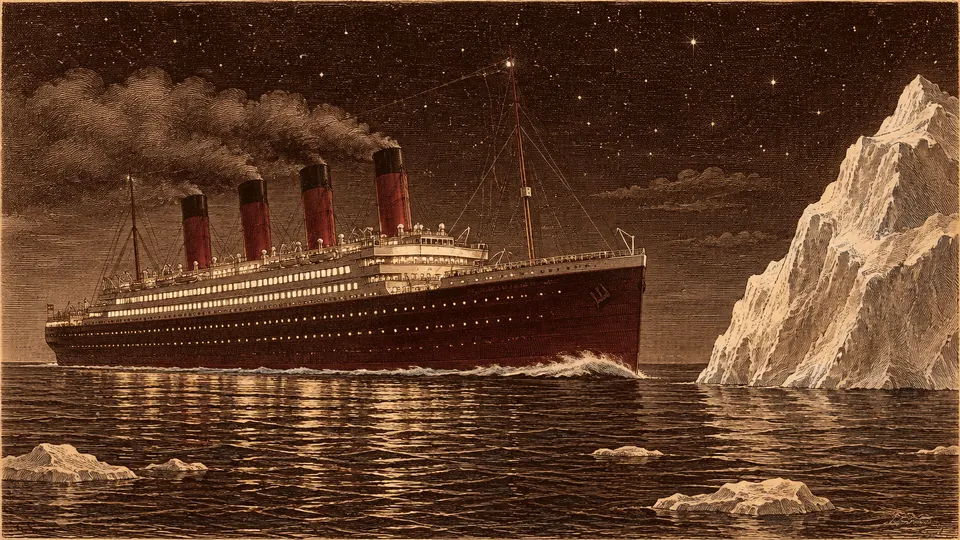
The Titanic sank because an iceberg struck her starboard bow late on April 14, 1912, and let the sea into her five forward compartments at once. She was designed to stay afloat with only two main compartments flooded. As the bow went down, water spilled over the tops of the bulkheads, and she sank about two hours and forty minutes later, early on April 15.
On this page
Key Takeaways
- The iceberg flooded the five forward compartments almost at once; the ship was built to survive two flooded main compartments.
- Many bulkheads stopped at E deck, so water poured aft over their tops as the bow sank.
- Lifeboats had room for 1,176 people, but the U.S. Senate counted 2,223 aboard and only 706 saved.
- Ice warnings, the ship's speed, the nearby Californian and the quality of the rivets are still argued over.
- The disaster led to the 1914 Safety of Life at Sea convention and the International Ice Patrol.
What happened on the night of April 14, 1912?
The Titanic was on her maiden voyage from Southampton to New York, by way of Cherbourg and Queenstown, when she struck the iceberg [1]. The night was clear and the sea calm. The U.S. Senate committee that investigated the disaster found the weather clear throughout the voyage apart from about ten minutes of fog [3].
Warnings had come in all day. The first ice warning of April 14 arrived from the liner Caronia at 9:00 a.m. [1]. The Senate report lists messages from the Baltic, the Californian and the Amerika, and says at least three reached the Titanic's commander [3].
The exact minute of the collision depends on the source. Royal Museums Greenwich gives 23:40 ship's time. The Senate report gives "11.46 p.m. ship's time, or 10.13 p.m. New York time" [4]. The ship foundered at 02:20 on April 15 [1]. The rescue ship Carpathia stopped near the scene at 4 a.m., picked up the first boat at 4:10 a.m., and had the last survivors aboard by 8:30 a.m. [7].
Why couldn't the Titanic stay afloat after hitting the iceberg?
The Titanic could not stay afloat because the damage reached more compartments than her design could tolerate. The Senate report describes 15 transverse watertight bulkheads dividing the ship into 16 main compartments. It says the ship was built so that "any 2 main compartments might be flooded" without endangering her [4].
The iceberg opened far more than two. According to the Senate report, the forepeak tank, No. 1 hold, No. 2 hold, No. 3 hold and the forward boiler room filled with water, and "the 5 extreme forward compartments were flooded practically immediately" [4].
The height of the bulkheads made it worse. Bulkhead No. 1 rose to C deck, and Nos. 2 and 10 through 15 rose to D deck, but Nos. 3 through 9 went only as high as E deck. As the bow settled, water overflowed E deck and flooded the compartments behind No. 3 hold, one after another [4]. Once five forward compartments were open to the sea, the Titanic could not be saved.
Why did so many people die?
Most of the people who died were lost because there were not enough lifeboat seats for everyone aboard, and the seats that did exist were not all used. Royal Museums Greenwich puts the toll at about 1,500 of roughly 2,200 people on board [1].
Too few lifeboats, and many launched partly empty
The Senate report lists 14 lifeboats for 65 people each, 2 emergency boats for 35 each and 4 collapsible boats for 49 each, a total capacity of 1,176. That arrangement met "all the requirements of the British Board of Trade" [2]. The Titanic carried lifeboats for only about half the people aboard, and the rules of the day allowed it.
The boats that left were not full. The committee wrote that the ship had boats "for 1,176 persons, while but 706 were saved," and that the unused space resulted in "the needless sacrifice of several hundred lives" [6].
The numbers differ by source
Reliable sources give totals that differ by dozens of people, so any single figure should be read as approximate.
| Source | People aboard | Saved | Lost | Lifeboat capacity |
|---|---|---|---|---|
| U.S. Senate report (1912) | 2,223 | 706 | 1,517 | 1,176 |
| Royal Museums Greenwich | about 2,200 | not given | about 1,500 | 1,178 (20 boats) |
| NOAA | 2,240 | not given | more than 1,500 | not given |
NOAA gives 2,240 passengers and crew and more than 1,500 deaths [9]. Royal Museums Greenwich estimates the losses at 815 passengers and 688 crew [1].
Survival depended on class
The Senate's own summary shows how unevenly the boats were filled [2]:
| Group | Aboard | Saved | Share saved |
|---|---|---|---|
| First class | 329 | 199 | 60% |
| Second class | 285 | 119 | 42% |
| Third class | 710 | 174 | 25% |
| Crew | 899 | 214 | 24% |
The cold water and the ship that did not come
For those left in the sea, the water was around -2 degrees Celsius, about 28 degrees Fahrenheit [1]. The Carpathia was 58 miles away when she heard the distress call and arrived after the Titanic had gone down [5].
A closer ship, the Californian, did not respond. Her captain reported that she was 19 miles away, but the Senate committee concluded she was nearer. Her officers admitted seeing rockets in the Titanic's direction, and her wireless operator "was not aroused until 3.30 a.m., New York time." The committee called this conduct "most reprehensible" and said it placed "a grave responsibility" on her commander [5]. Those are the committee's findings from 1912, made after hearing the Californian's officers.
Which causes are still debated?
Three questions keep coming back: the ship's speed, how the ice warnings were handled, and the quality of her steel and rivets. The iceberg is not in dispute; how much each human and material factor mattered still is.
Speed and ice warnings
The Senate committee found the Titanic was going "not less than 21 knots" at the time of the collision, her highest speed of the voyage, and that "the speed was not relaxed" despite the warnings [3]. For comparison, Royal Museums Greenwich lists her service speed as 21 knots [1]. The committee treated the unchanged speed as a serious fault. How much a slower speed would have changed the outcome cannot be measured, which is why this factor is still argued over.
Steel and rivets
The materials question is newer and less settled. A National Institute of Standards and Technology (NIST) metallurgist, Tim Foecke, studied steel and rivet samples recovered from the debris field. NIST says the wrought iron rivets contained "three times today's allowable amount of slag," which may have made them brittle in icy water. His analysis "strongly suggested" that rivet heads broke off and let water in between the hull plates. Sonar mapping found only six thin tears in the hull, with a total open area of about one square meter [11].
The hull steel itself has a mixed record in research. Physics World reports that early tests suggested the steel turned brittle in the cold, while later, more sensitive tests suggest the plating "was adequate to bend with the impact rather than fracture" [12]. Both ideas are hypotheses about how fast the water got in, not alternatives to the iceberg.
What changed after the Titanic sank?
The Titanic changed the rules of the sea within two years. The U.S. Senate committee recommended "sufficient lifeboats to accommodate every passenger and every member of the crew," boat drills "not less than twice each month," and a wireless operator on duty "at all times, day and night" [8].
Nations then acted together. According to a Coast Guard article in NOAA's Mariners Weather Log, the first international conference on safety at sea opened in London on November 12, 1913, and delegates signed the International Convention for the Safety of Life at Sea (SOLAS) in January 1914. It was scheduled to take effect on July 1, 1915 [10]. NOAA also dates the first SOLAS convention to 1914 [9].
The International Ice Patrol
The patrol that still watches the iceberg zone began right after the sinking. For the rest of 1912, U.S. Navy cruisers stood guard on the Grand Banks of Newfoundland; in 1913 the Revenue Cutter Service, now the U.S. Coast Guard, took over. SOLAS mandated an International Ice Patrol run by the United States and paid for by the signatory nations, and on February 7, 1914, President Woodrow Wilson directed the Revenue Cutter Service to begin it as soon as possible [10].
As of that 2001 article, the patrol reported "no reported losses of life or property for vessels that have heeded published warnings" since monitoring began in 1913 [10]. The Ice Patrol is the most direct living legacy of the Titanic.
Where is the Titanic now?
The wreck lies about 350 nautical miles off Newfoundland at a depth of about 12,500 feet, or 3,800 meters, and was discovered on September 1, 1985 [9]. NOAA's page also gives 12,000 feet in another section, so treat the depth as approximate. The spot where she sank is at the same latitude as Providence, Rhode Island [10].
For more turning points from the same years, see our explainer on why World War I started, the wider world wars era, and the full list of why questions in history. The Titanic was bound for New York harbor, the same harbor watched over by the statue in our history of the Statue of Liberty. Our On This Day pages follow events like this one through the calendar.
Frequently Asked Questions
How long did it take the Titanic to sink?
About two hours and forty minutes. Royal Museums Greenwich times the collision at 23:40 on April 14 and the sinking at 02:20 on April 15, ship's time {{cite:rmg-titanic-facts}}.
Was the Titanic called unsinkable?
The ship had a reputation as "the unsinkable ship," as a Coast Guard history of the Ice Patrol puts it {{cite:noaa-mwl-ice-patrol}}. Her actual design was more limited: she was built to float with two main compartments flooded, not five {{cite:senate-report-collision}}.
How many lifeboats did the Titanic have?
Twenty: 14 standard lifeboats, 2 emergency boats and 4 collapsibles, with room for 1,176 people according to the Senate report {{cite:senate-report-titanic}}. Royal Museums Greenwich gives a capacity of 1,178.
Our Take
We think the Titanic is best understood as a chain, not a single blow. The iceberg caused the damage, but the death toll came from choices that were legal in 1912: lifeboats for about half the people aboard, a high speed kept up after repeated ice warnings, and no round-the-clock wireless watch on nearby ships. The 1912 Senate committee said as much, and the rules written in 1913 and 1914 answered each of those failures directly. The material questions about rivets and steel are worth following, but in our reading of the sources they explain how fast the water came in, not why so many people had no place to go. That is why the lifeboat rule and the Ice Patrol, not the ship, are the Titanic's real legacy.
Sources
- RMS Titanic facts. Royal Museums Greenwich.
- Titanic Disaster, Senate Report No. 806: Titanic (general particulars, lifeboats, passengers and survivors). United States Senate, 1912.
- Titanic Disaster, Senate Report No. 806: Voyage (weather, ice warnings, speed). United States Senate, 1912.
- Titanic Disaster, Senate Report No. 806: Collision (flooding, watertight compartments). United States Senate, 1912.
- Titanic Disaster, Senate Report No. 806: Pleas for Help (Carpathia, Californian). United States Senate, 1912.
- Titanic Disaster, Senate Report No. 806: Abandoning Ship. United States Senate, 1912.
- Titanic Disaster, Senate Report No. 806: The Rescue. United States Senate, 1912.
- Titanic Disaster, Senate Report No. 806: Recommendations. United States Senate, 1912.
- R.M.S. Titanic: History and Significance. NOAA.
- International Ice Patrol (Kenward and Strong, U.S. Coast Guard). NOAA Mariners Weather Log, 2001.
- Science Showed How a Tiny Iron Flaw Doomed the Titanic. NIST, 2017.
- The perfect storm. Physics World, 2012.
Where historians disagree, we say so and show the main views. Dates are checked against two sources; legend and documented record are labeled separately. Spotted an error? Tell us.
Keep Reading
Why Did World War I Start?
Why did WW1 start? The long-term causes, the Sarajevo assassination, the July Crisis day by day, how alliances spread the war, and why the U.S. joined in 1917.
Why Did the Great Depression Happen?
Why did the Great Depression happen? The 1920s boom, the 1929 crash, bank panics, Fed mistakes, the gold standard, Smoot-Hawley, Dust Bowl and what ended it.
The History of the Statue of Liberty
The history of the Statue of Liberty: Laboulaye's 1865 idea, Bartholdi and Eiffel's work in Paris, Pulitzer's pedestal drive, the 1886 dedication and beyond.
Why Did the Cold War Start?
Why did the Cold War start? How the U.S.-Soviet alliance broke down from Yalta and Potsdam to the Truman Doctrine, Berlin Airlift, NATO and the Soviet bomb.
Why Did the Civil War Start?
Why did the Civil War start? What the seceding states said in their own words, the fight over slavery in the West, Lincoln's election, and Fort Sumter.
Why Did World War II Start?
Why did WW2 start? Versailles, the Depression, Hitler's aims, Japan in China, appeasement at Munich, the Nazi-Soviet Pact, Poland in 1939 and Pearl Harbor.