The History of the Statue of Liberty
Quick Answer
The Statue of Liberty began in 1865, when the French historian and abolitionist Édouard de Laboulaye proposed that France give the United States a statue representing liberty. Sculptor Frédéric-Auguste Bartholdi built it in Paris over an iron framework designed by Gustave Eiffel. It crossed the Atlantic in crates in 1885 and was dedicated in New York Harbor on October 28, 1886.
On this page
- Who came up with the idea for the Statue of Liberty?
- How was the Statue of Liberty built?
- Who paid for the Statue of Liberty?
- How did the statue get from Paris to New York?
- How did the Statue of Liberty become a symbol for immigrants?
- What happened to the statue after 1886?
- Frequently Asked Questions
- Our Take
- Sources
Key Takeaways
- Laboulaye proposed the gift in 1865, and the National Park Service ties it to the Union victory and the abolition of slavery.
- Bartholdi shaped the copper skin; Eiffel designed the flexible frame inside, years before his famous tower.
- France paid for the statue and Americans paid for the pedestal, finished only after Joseph Pulitzer's 1885 newspaper drive.
- The statue arrived as 350 pieces in 214 crates in June 1885 and was dedicated on October 28, 1886.
- Emma Lazarus's 1883 poem, placed on a plaque in 1903, helped turn the statue into a symbol of welcome for immigrants.
Who came up with the idea for the Statue of Liberty?
The idea came from Édouard de Laboulaye, a French historian and abolitionist. The National Park Service's chronology says that in 1865 he proposed "that France give a statue representing liberty to the United States for its centennial" [1]. The NPS biography of Laboulaye gives the same year [2].
Laboulaye was an abolitionist and a supporter of Abraham Lincoln during the Civil War, and he was president of the French Anti-Slavery Society [2]. The Park Service describes the statue as, in part, "a celebration of the Union's victory in the American Civil War and the abolition of slavery." A broken shackle and chain lie at the statue's right foot [3]. That background ties the monument to the causes of the Civil War and to the end of slavery that Juneteenth marks.
The statue's first meaning was about the end of slavery and the survival of a democratic republic, not immigration. The same NPS page adds a caution: the freedom the broken shackle stood for "was not yet a reality for African Americans in 1886" [3].
Laboulaye also had a French motive. He argued that honoring the American republic would strengthen the cause of democracy in France. The project was announced about ten years later, in September 1875, together with its fundraising body, the Franco-American Union. The statue was named Liberty Enlightening the World, and the plan split the costs: the French would pay for the statue and Americans for the pedestal [2].
How was the Statue of Liberty built?
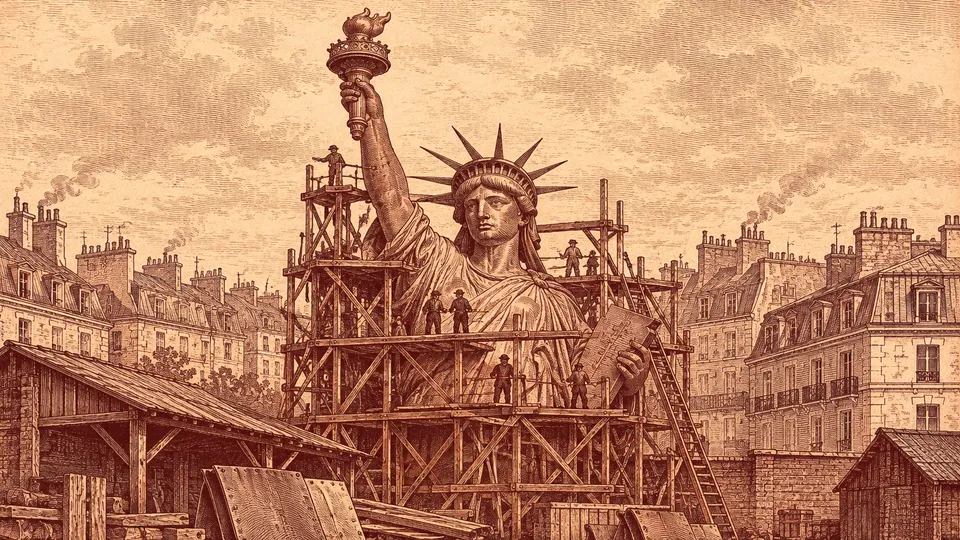
The statue was built in Paris as a thin copper skin hung on an internal frame. Bartholdi, born in 1834 in Colmar, France, did the sculpting [4]. The NPS chronology lists the steps: Bartholdi became the sculptor in 1870, traveled to the United States in 1871 to promote the project, and settled on Bedloe's Island in New York Harbor as the site in 1872. He began constructing the statue in 1876 [1].
Parts of the statue toured before the whole existed. The torch was displayed in Madison Square in New York City from 1877 to 1882 [12]. The head and shoulders were shown at the Paris Universal Exposition of 1878 [1].
Gustave Eiffel's frame
The first engineer, Eugène Viollet-le-Duc, died in 1879, and Bartholdi and the Franco-American Union hired Gustave Eiffel to replace him. Eiffel designed a central pylon 92 feet (28 meters) tall with a lightweight truss around it. Flat metal bars are bolted to the pylon at one end and to the copper skin at the other, and they act like springs, so the statue can adjust to wind and temperature changes [5]. The skin does not hold the statue up; the frame inside does, and the skin is allowed to move.
The first rivet went into the structure in 1881 [1], and Eiffel supervised the internal work until late 1883. His tower in Paris came afterward: it was completed for the Universal Exposition of 1889 [5]. On July 4, 1884, France formally presented the finished statue in Paris to the U.S. minister, Levi P. Morton [12].
The Park Service publishes these measurements [6]:
| Measurement | Feet and inches | Meters |
|---|---|---|
| Ground to tip of torch | 305 ft 1 in | 92.99 |
| Ground to top of pedestal | 154 ft 0 in | 46.94 |
| Top of base to torch | 151 ft 1 in | 46.05 |
| Heel to top of head | 111 ft 1 in | 33.86 |
| Copper skin thickness | 3/32 in | not given |
| Weight of copper | 176,000 lb | not given |
| Weight of framework | 440,000 lb | not given |
The copper is 3/32 of an inch thick, which the NPS compares to "two pennies placed together." The crown has 25 windows and seven rays, and the tablet reads "JULY IV MDCCLXXVI," for July 4, 1776 [6].
Who paid for the Statue of Liberty?
The people of France paid for the statue, and Americans paid for the pedestal. The French committee raised about 400,000 francs starting in 1875. In the United States, the pedestal fund raised $125,000 between 1877 and 1884. Congress accepted the statue as a gift in 1877, American architect Richard Morris Hunt was commissioned to design the pedestal in 1881, and its cornerstone was laid on Bedloe's Island in 1884. That same year the money ran out and work on the pedestal stopped [1].
Joseph Pulitzer's newspaper drive
Joseph Pulitzer, owner of the New York newspaper The World, rescued the pedestal. He promised that everyone who gave would see their name printed in the paper. By the fall of 1885, more than 120,000 people had donated more than $100,000, and work on the pedestal could be finished [7]. The Statue of Liberty-Ellis Island Foundation gives the same totals [13]. The pedestal was paid for mostly by ordinary Americans giving small sums, not by a single rich patron.
How did the statue get from Paris to New York?
The statue crossed the Atlantic in pieces. For the voyage it was "reduced to 350 individual pieces and packed in 214 crates" and carried by the French ship Isère, which arrived in New York Harbor on June 17, 1885 [13] [1]. Because the pedestal was not ready, the crates were unloaded onto Bedloe's Island to wait [7].
The pedestal was completed in 1886, workers reassembled the statue on top of it, and the statue was finished on October 23. Five days later, on October 28, 1886, it was formally unveiled at a dedication ceremony on Bedloe's Island. The same year the torch was set to be lit by electricity, and the statue was placed under the U.S. Lighthouse Board [1]. President Grover Cleveland oversaw the dedication in front of thousands of spectators [13]. He is one of the leaders on our list of U.S. presidents in order.
How did the Statue of Liberty become a symbol for immigrants?
The statue became a symbol for immigrants because of where it stood and because of a poem. In 1883, Emma Lazarus was asked to write a sonnet for an art and literary auction that raised money for the pedestal. She wrote "The New Colossus" on November 2, 1883 [8]. The poem calls the statue "Mother of Exiles" and includes the line "Give me your tired, your poor" [9].
Lazarus had worked with Jewish immigrants held by officials at Castle Garden, and that experience shaped her writing. She died in New York City on November 19, 1887. The poem was then largely forgotten until Georgina Schuyler found it in a book in 1901 and organized an effort to revive it. In 1903 its words were placed on a plaque inside the pedestal [8] [1].
Geography did the rest. The federal immigration station opened on nearby Ellis Island in 1892, and the NPS says almost 14 million immigrants entered the United States through New York between 1886 and 1924. Many newcomers read the torch as a sign of welcome rather than the "enlightenment" its creators had in mind [10]. Ellis Island was America's largest immigration station from 1892 to 1924 and processed more than 12 million people [11]. The NPS credits Franklin D. Roosevelt's 1936 speech for the statue's 50th anniversary with helping make it "an icon of immigration" [10].
| Meaning | When it took hold | What the sources show |
|---|---|---|
| Liberty, abolition and the Union victory | 1865 to 1886 | Laboulaye's purpose and the broken shackle at the feet (NPS) |
| Friendship between France and the U.S. | 1875 to 1886 | A gift paid for by French donors, with an American pedestal |
| Welcome to immigrants | After 1903, and strongly from the 1930s | Lazarus's poem on the pedestal, Ellis Island nearby, Roosevelt's 1936 speech (NPS) |
What happened to the statue after 1886?
Control of the statue passed from the Lighthouse Board to the War Department in 1901. It was first illuminated in 1916, and its copper skin got its first repairs in 1918 [1]. On October 15, 1924, President Calvin Coolidge used the Antiquities Act to declare it a national monument [12]. The National Park Service took charge in 1933, and the torch went dark under blackout rules from 1942 to 1945, during World War II. In 1965 Ellis Island was added to the monument [1].
The 1980s restoration and the new torch
By the 1980s the statue needed major work. In 1982 President Ronald Reagan appointed Lee Iacocca to head a private foundation for the restoration, which began in 1984. Workers replaced the rusted iron armature bars with stainless steel bars [1]. In November 1985 a replica of Bartholdi's original torch design was installed, and it was formally dedicated during the Liberty Weekend celebration on July 4, 1986. The original torch is now displayed in the Statue of Liberty Museum [13]. The statue reopened on July 5, 1986, and its centennial was marked on October 28, 1986 [1].
More stories like this are in our history of things section and our guide to the Civil War era.
Frequently Asked Questions
How tall is the Statue of Liberty?
From the ground to the tip of the torch, the Statue of Liberty is 305 feet 1 inch (92.99 meters) tall. The statue itself, from the top of its base to the torch, is 151 feet 1 inch (46.05 meters) {{cite:nps-statistics}}.
Who designed the Statue of Liberty?
Frédéric-Auguste Bartholdi designed and sculpted the statue. Gustave Eiffel designed its internal frame after Eugène Viollet-le-Duc died in 1879, and Richard Morris Hunt designed the pedestal {{cite:nps-eiffel}} {{cite:nps-chronology}}.
Was the Statue of Liberty connected to the end of slavery?
Yes, according to the National Park Service. Laboulaye was an abolitionist, the NPS calls the statue in part a celebration of the Union victory and the abolition of slavery, and a broken shackle and chain lie at its feet {{cite:nps-abolition}}.
Our Take
We think the Statue of Liberty is best read as a monument whose meaning grew after it was built. The sources show a French idea from 1865 rooted in abolition and the Union victory, an engineering feat shared between a sculptor and an engineer, and a pedestal paid for in small sums by readers of a New York newspaper. The welcome to immigrants that most Americans now see in it came later, through a poem that sat almost unnoticed for twenty years and through the ships that passed it on the way to Ellis Island. In our reading, none of these meanings cancels the others. The broken chain at its feet and the poem on its pedestal belong to the same story, and the statue is richer when both are remembered.
Sources
- Liberty Island Chronology. National Park Service.
- Édouard de Laboulaye. National Park Service.
- Abolition. National Park Service.
- Frédéric-Auguste Bartholdi. National Park Service.
- Alexandre-Gustave Eiffel. National Park Service.
- Statue Statistics. National Park Service.
- Pulitzer- In Depth. National Park Service.
- Emma Lazarus. National Park Service.
- The New Colossus. National Park Service.
- The Immigrant's Statue. National Park Service.
- History and Culture (Ellis Island). National Park Service.
- Body of Iron, Soul of Fire: The Statue of Liberty. National Archives, 2024.
- Overview + History. Statue of Liberty-Ellis Island Foundation.
Where historians disagree, we say so and show the main views. Dates are checked against two sources; legend and documented record are labeled separately. Spotted an error? Tell us.
Keep Reading
Why Did the Civil War Start?
Why did the Civil War start? What the seceding states said in their own words, the fight over slavery in the West, Lincoln's election, and Fort Sumter.
The History of Juneteenth
How Juneteenth began with General Order No. 3 in Galveston on June 19, 1865, why freedom came late to Texas, and how it became a federal holiday in 2021.
U.S. Presidents in Order: The Complete List
All 47 U.S. presidencies in order, from George Washington in 1789 to Donald Trump in 2025, with term dates, ages and how each presidency came to an end.
Why Did World War II Start?
Why did WW2 start? Versailles, the Depression, Hitler's aims, Japan in China, appeasement at Munich, the Nazi-Soviet Pact, Poland in 1939 and Pearl Harbor.
Why Did the Titanic Sink?
The Titanic sank after an iceberg opened her five forward compartments in April 1912. Why she flooded, why about 1,500 died, and what changed at sea after.
The History of the Olympics
The history of the Olympics: the traditional 776 BCE start at Olympia, the end around 393 CE, Coubertin's revival, Cold War boycotts and the Paralympics.