The History of the Olympics
Quick Answer
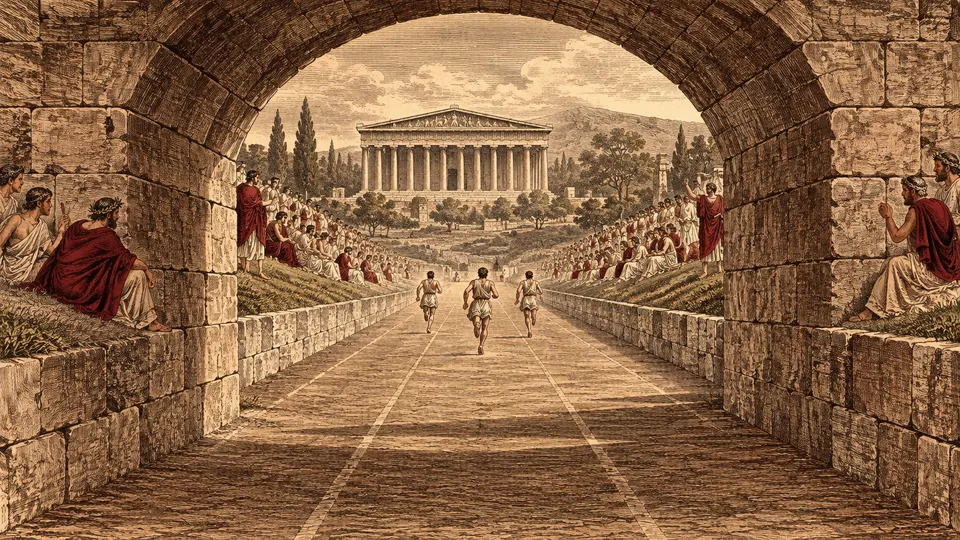
The Olympics began as a religious festival for Zeus at Olympia in Greece, traditionally dated to 776 BCE, though archaeology suggests major contests came a few generations later. The Roman emperor Theodosius I abolished the ancient Games in 393 or 394 CE. Pierre de Coubertin revived them: the International Olympic Committee was founded in Paris in 1894, and Athens hosted the first modern Games in 1896.
On this page
- When Did the Ancient Olympic Games Begin?
- Who Could Compete at Ancient Olympia, and What Did They Win?
- Why Did the Ancient Olympics End, and When?
- How Did Pierre de Coubertin Revive the Olympics?
- How Did Women and Para Athletes Join the Games?
- How Did Boycotts and Politics Shape the Modern Games?
- Where Are the Olympics Now?
- Frequently Asked Questions
- Our Take
- Sources
Key Takeaways
- The 776 BCE start date is a tradition based on the first recorded victor; archaeologists date major athletic contests at Olympia to around 700 or 680 BCE.
- Only free-born Greek men and boys competed in the ancient Games, but a Spartan princess, Kyniska, was twice named victor as the owner of a winning chariot team.
- The ancient Games ended under Theodosius I in 393 or 394 CE, after centuries in which the records grow thin.
- The modern Games grew from 13 nations in Athens in 1896 to 206 in Paris in 2024, despite world wars and Cold War boycotts.
When Did the Ancient Olympic Games Begin?
By tradition, in 776 BCE. That is the date given for the first recorded Olympic victor, Koroibos of Elis, who won a footrace. The Perseus Digital Library at Tufts University stresses that legends cloud the true origins, so no certain start date can be given [5].
Greek myths offered their own starts. In one, the guardians of the infant god Zeus held the first footrace. In another, the hero Pelops founded the Games after beating King Oenomaus in a chariot race [1]. These are tradition, not record.
Archaeology tells a slower story. Writing for Archaeology magazine in 2004, Donald G. Kyle described the first Games as "humble and local." Excavators found that worship of Zeus came before athletics at Olympia, that the oldest wells near the stadium date to the early seventh century BCE, and that "major athletic competitions did not emerge until ca. 700 or even 680," when horse races were added [7]. The 776 BCE date marks where the Greek victor lists begin, not proof that a large festival existed that year.
The program grew slowly. A single footrace was the only event for the first 13 Olympiads, and the pentathlon and wrestling were the first new sports, added at the 18th Olympiad [1]. Later Games added boxing, the pankration, and chariot and horse races [6].
The festival came with a promise of peace. Every four years heralds traveled the Greek world proclaiming a sacred truce that gave "safe passage through any state for all travelers to and from the games" [7]. The International Olympic Truce Centre describes the truce as stopping fighting from seven days before to seven days after the Games [8]. The core guarantee in both accounts is safe travel to and from Olympia.
Who Could Compete at Ancient Olympia, and What Did They Win?
The Games were "open to any free-born Greek in the world," with separate divisions for men and boys. Judges from Elis sorted youths into the boys' or men's division by size and strength as much as by age [2].
Women could not compete. Married women were barred from even watching, "under penalty of death," while unmarried girls could attend. Young women did have their own footrace in honor of the goddess Hera, held in the same stadium [3].
There was one loophole. In the chariot races the owner, not the driver, was named the victor. That let "monarchs, tyrants, and even women" win, and Kyniska, daughter of a Spartan king, won the four-horse chariot race in 396 and 392 BCE [7].
The prize was symbolic. A winner received a crown of olive leaves and the right to set up a statue of himself at Olympia, but no money at the Games. Back home, cities often rewarded champions with benefits such as having all their meals at public expense [4].
Why Did the Ancient Olympics End, and When?
The usual answer is 393 CE, but the honest one is "393 or 394 CE." The Perseus Digital Library says the emperor Theodosius I "legally abolished the games in 393 or 394 A.D." [5]. The reason was religious. The Games honored Zeus, and as the Roman Empire became Christian and emperors moved against older pagan worship, a festival for Zeus had no place left.
The end was also gradual. By the third century CE the lists of victors become unreliable, and by the end of that century they stop altogether [5]. Kyle's account dates the Games only "to at least the late fourth century A.D." [7], which leaves room for the debate. A precise "last Olympics" is hard to name, because the records fade well before the law that ended them. The same slow change in religion and power is part of the larger story of why the Roman Empire fell.
How Did Pierre de Coubertin Revive the Olympics?
He called a meeting. Pierre de Coubertin, a Parisian baron born on January 1, 1863, organized the first Olympic Congress at the Sorbonne in Paris on June 16 to 24, 1894 [9] [10]. According to the Olympedia database, 78 delegates from 37 sports bodies in nine nations attended. They agreed to re-establish the Games, to form an International Olympic Committee of 13 members, and to award the first modern Games to Athens in 1896. Demetrios Vikelas of Greece became the first IOC president [10]. The City of Paris dates the founding of the IOC to a ceremony at the Sorbonne on June 23, 1894, when Coubertin was 31 [9].
Athens 1896 was small by later standards. Olympedia counts 13 nations and 43 medal events, held from April 6 to 15, and notes that "many of the top athletes in the world did not compete" [12] [11]. Paris 1900 drew 26 nations, and its events stretched from May to October [13].
Winter sports came next. The first Winter Games were held at Chamonix, France, from January 24 to February 5, 1924, with 19 nations and 17 medal events [14] [11]. War interrupted the cycle three times: the Summer Games planned for 1916, 1940 and 1944, and the Winter Games of 1940 and 1944, were never held [11]. Those gaps line up with the two world wars; see why World War I started and why World War II started.
How Did Women and Para Athletes Join the Games?
Women arrived early but slowly. At Paris in 1900, Olympedia records that "women made their Olympic début," the first known competitors being croquet players and one sailor [13]. Track and field took longer. Women's athletics events were not held until Amsterdam 1928, and even then only five events were offered, which the women's sports federation of the day considered far too few [15].
The Paralympic movement began in a hospital. On July 29, 1948, Dr. Guttmann organized the first competition for wheelchair athletes at Stoke Mandeville in England, with 16 injured servicemen and women competing in archery. The first Paralympic Games followed in Rome in 1960, with 400 athletes from 23 countries, and the first Winter Paralympics were held in Sweden in 1976 [21]. The International Paralympic Committee was founded on September 22, 1989, in Düsseldorf, Germany. Since Seoul 1988 for summer and Albertville 1992 for winter, the Paralympics have used the same host cities and venues as the Olympics. [21]
How Did Boycotts and Politics Shape the Modern Games?
Most sharply during the Cold War. After the Soviet invasion of Afghanistan, the Carter administration "called for a boycott of the 1980 Moscow Olympics" [22]. Olympedia estimates that about 63 countries eventually stayed away, while noting that an exact count is hard because some nations skipped the Games without calling it a boycott. Only 80 nations took part [16].
Four years later the boycott ran the other way. In May 1984 the Soviet Union announced it would not attend the Los Angeles Games, citing safety concerns for its athletes, and most Eastern European countries followed. Even so, 140 nations competed [17]. North Korea, Cuba and Ethiopia stayed away from Seoul in 1988 [18]. Barcelona 1992 was the first boycott-free Games "after four consecutive Olympics with some form of protest or boycott" [19]. For the wider rivalry behind these choices, see why the Cold War started.
Where Are the Olympics Now?
As of November 2026, the most recent Olympic Games were the Milano Cortina Winter Games in Italy, which opened on February 6, 2026, and closed on February 22. The next Summer Games are scheduled for Los Angeles in 2028, followed by Brisbane in 2032 [11]. The LA28 organizers have published a Games plan that includes sports such as cricket, flag football, lacrosse and squash [23].
Recent Games show how much has changed since Athens. Tokyo 2020 was held a year late, opening on July 23, 2021 [11]. Paris 2024 drew 206 nations and staged 329 medal events [20].
| Games | Year | Nations | Medal events | Note |
|---|---|---|---|---|
| Athens | 1896 | 13 | 43 | First modern Games |
| Paris | 1900 | 26 | 95 | First women competitors |
| Chamonix (Winter) | 1924 | 19 | 17 | First Winter Games |
| Moscow | 1980 | 80 | 203 | U.S.-led boycott |
| Los Angeles | 1984 | 140 | 221 | Soviet-led boycott |
| Paris | 2024 | 206 | 329 | Most recent Summer Games |
Figures in the table come from Olympedia's edition pages [12]. Los Angeles has hosted the Summer Games twice before, in 1932 and 1984, and 2028 will be its third time, according to the same database's list of editions [11]. To explore other ancient topics, browse our ancient world era page or more history-of articles.
Frequently Asked Questions
When were the first Olympic Games?
By tradition, in 776 BCE at Olympia, the date of the first recorded victor, Koroibos of Elis {{cite:perseus-the-ancient-olympics-end-of}}. Archaeological work suggests major athletic contests there emerged around 700 or 680 BCE. The first modern Games were held in Athens in April 1896.
Why did the ancient Olympics stop?
The Games were a festival for Zeus. As the Roman Empire became Christian, Emperor Theodosius I abolished them in 393 or 394 CE, and the victor lists had already faded by then {{cite:perseus-the-ancient-olympics-end-of}}.
Could women compete in the ancient Olympics?
No. Women could not compete, and married women were barred from watching. Women could win the chariot races as owners, and the Spartan princess Kyniska did so in 396 and 392 BCE {{cite:archaeology-winning-at-olympia}}.
Who started the modern Olympics?
Pierre de Coubertin, a French baron, organized the 1894 Sorbonne Congress that created the International Olympic Committee and awarded the first modern Games to Athens {{cite:olympedia-1st-olympic-congress-paris}}.
Our Take
We think the most useful thing to know about the history of the Olympics is where the record is thin. The 776 BCE start is a tradition built on a victor list, and archaeologists place major contests later. The 393 CE end is a convenient round answer for a decline that the sources show lasting generations. Coubertin's revival is far better documented, yet even there counts differ, so we name the database behind each figure. What stands out to us is how political the Games have always been, from a truce that protected travelers to the boycotts of 1980 and 1984. Our editorial policy explains how we separate tradition from record.
Sources
- The Ancient Olympics: Origins. Perseus Digital Library, Tufts University.
- The Ancient Olympics: Athletes. Perseus Digital Library, Tufts University.
- The Ancient Olympics: Women. Perseus Digital Library, Tufts University.
- The Ancient Olympics: Prizes. Perseus Digital Library, Tufts University.
- The Ancient Olympics: End of the Games. Perseus Digital Library, Tufts University.
- The Ancient Olympics: Sports. Perseus Digital Library, Tufts University.
- Winning at Olympia. Archaeology (Archaeological Institute of America), 2004.
- The History of Olympic Truce. International Olympic Truce Centre.
- Pierre de Coubertin and the origin of the Olympic Games. City of Paris.
- 1st Olympic Congress, Paris 1894. Olympedia.
- Olympic Games editions. Olympedia.
- 1896 Summer Olympics. Olympedia.
- 1900 Summer Olympics. Olympedia.
- 1924 Winter Olympics. Olympedia.
- 1928 Summer Olympics. Olympedia.
- 1980 Summer Olympics. Olympedia.
- 1984 Summer Olympics. Olympedia.
- 1988 Summer Olympics. Olympedia.
- 1992 Summer Olympics. Olympedia.
- 2024 Summer Olympics. Olympedia.
- IPC History. International Paralympic Committee.
- The Soviet Invasion of Afghanistan and the U.S. Response, 1978-1980. Office of the Historian, U.S. Department of State.
- Games Plan. LA28.
Where historians disagree, we say so and show the main views. Dates are checked against two sources; legend and documented record are labeled separately. Spotted an error? Tell us.
Keep Reading
The History of the Statue of Liberty
The history of the Statue of Liberty: Laboulaye's 1865 idea, Bartholdi and Eiffel's work in Paris, Pulitzer's pedestal drive, the 1886 dedication and beyond.
The History of Pizza
How pizza went from cheap street food in Naples to a global favorite: the Margherita legend, the first U.S. pizzerias, postwar chains and UNESCO's 2017 listing.