The History of Juneteenth
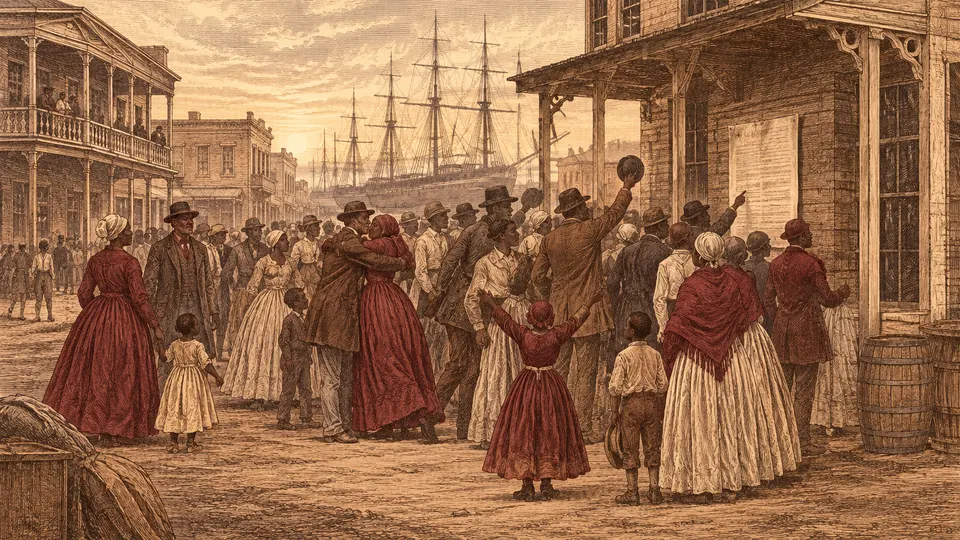
Quick Answer
Juneteenth marks June 19, 1865, when Union Maj. Gen. Gordon Granger issued General Order No. 3 in Galveston, Texas, announcing that all enslaved people in Texas were free. That came two and a half years after the Emancipation Proclamation. Freed Texans began celebrating the day in 1866, carried it across the country as they moved, and won a Texas state holiday in 1980 and a federal holiday on June 17, 2021.
On this page
- What happened in Galveston on June 19, 1865?
- Why did freedom reach Texas so long after the Emancipation Proclamation?
- Did Juneteenth end slavery in the United States?
- How did freed people first celebrate Juneteenth?
- How did Juneteenth spread beyond Texas?
- How did Juneteenth become a state and federal holiday?
- Why does Juneteenth matter today?
- Frequently Asked Questions
- Our Take
- Sources
Key Takeaways
- On June 19, 1865, General Order No. 3 told the people of Texas that "all slaves are free," about two and a half years after the Emancipation Proclamation took effect.
- About 250,000 enslaved people lived in Texas at the end of the Civil War, and for many of them freedom arrived in practice only over the following months.
- Juneteenth itself did not end slavery everywhere: the 13th Amendment, ratified on December 6, 1865, abolished it nationwide.
- Freed Texans held yearly celebrations from 1866, bought land for "emancipation grounds," and carried the day to other states as they migrated.
- Texas made June 19 a state holiday starting in 1980, and Juneteenth National Independence Day became a federal holiday on June 17, 2021.
What happened in Galveston on June 19, 1865?
On June 19, 1865, Maj. Gen. Gordon Granger, who commanded the Union army's District of Texas, issued General Order No. 3 in Galveston. His troops had reached the port city the day before [1]. The order opened with a sentence that changed the lives of hundreds of thousands of people: "The people of Texas are informed that, in accordance with a proclamation from the Executive of the United States, all slaves are free."
The order went on to establish equal personal and property rights between former enslavers and the people they had held. It also carried limits that the freed people felt at once. It advised them to stay at their homes and work for wages, and it said they would not be allowed to gather at military posts or be supported in idleness [5].
Texas held about 250,000 enslaved people at the end of the war [6]. Granger's force of about 2,000 soldiers reprinted the order and spread it along the Gulf Coast and into East Texas, where about 40 percent of Black Texans lived. For many enslaved Texans, freedom did not arrive on a single morning: according to the National Archives, most slaveholders began releasing the people they held only during late 1865. [4]
Freed people did not wait for permission to shape their new lives. Many moved to cities and built their own neighborhoods, often called Freedmen's Towns, such as Houston's Fourth Ward, Dallas's Tenth Street district and Wheatville in Austin [4].
Why did freedom reach Texas so long after the Emancipation Proclamation?
President Abraham Lincoln issued the Emancipation Proclamation on January 1, 1863. It declared that "all persons held as slaves" in the states and parts of states still in rebellion "are, and henceforward shall be free." But it left slavery untouched in the loyal border states, and it expressly excluded parts of the Confederacy that Union forces already controlled [2].
Most important for Texas, the proclamation's promise depended on Union military victory. Freedom spread as Union armies advanced, and until June 1865 no Union army had come to enforce it in Texas. In law, the proclamation covered enslaved Texans from January 1, 1863 [10]. In practice, it waited on Granger's arrival.
The National Archives also notes that some slaveholders moved to Texas to escape the reach of the proclamation, bringing enslaved people with them, and kept the news of emancipation from the people they held [4]. As historian Peniel Joseph of the University of Texas at Austin put it, word of emancipation did not reach that part of Texas until June 19, 1865, after the Confederate surrender [8]. The story of why the Civil War started explains how slavery sat at the center of the conflict that made these orders necessary.
Did Juneteenth end slavery in the United States?
No. General Order No. 3 announced freedom in Texas, but it did not end slavery everywhere. Slavery became illegal across the whole country only with the 13th Amendment, which was ratified on December 6, 1865, almost six months after Granger's order.
The Senate approved the amendment in April 1864, and the House followed on January 31, 1865, by a vote of 119 to 56. Its first section says that neither slavery nor involuntary servitude, "except as a punishment for crime whereof the party shall have been duly convicted," shall exist in the United States [3]. Because the Emancipation Proclamation had not applied to the loyal border states, the amendment was what finally ended slavery there.
The three documents are often confused. The chart below sets them side by side.
| Document | Date | Issued by | Where it applied |
|---|---|---|---|
| Emancipation Proclamation | January 1, 1863 | President Abraham Lincoln | Areas still in rebellion against the Union |
| General Order No. 3 | June 19, 1865 | Maj. Gen. Gordon Granger | Texas |
| 13th Amendment | Ratified December 6, 1865 | Congress, ratified by the states | The entire United States |
How did freed people first celebrate Juneteenth?
Freed Texans began marking June 19 a year after Granger's order, and the first celebrations were as much about citizenship as about memory. On June 19, 1866, freed people in Galveston held what the National Archives calls the first annual celebration, known as Jubilee Day, and the gatherings also gave the Black community instructions on voting. [4] The Texas State Historical Association likewise describes the early celebrations as political rallies that taught freed people about their voting rights [6].
Historians do not fully agree on where the first June 19 observance took place. The long-standing account, used by the National Archives, places it in Galveston. In June 2026, Rice University historian Caleb McDaniel reported newspaper evidence that on June 19, 1866, an estimated 3,000 to 4,000 Black Texans, including visitors from Galveston, marched through Houston behind two Black ministers, Elias Dibble and Sandy Parker. He calls it the first recorded public observance of the anniversary, a finding set to appear in the Journal of Texas History [7]. Both accounts agree that freed Texans themselves created the holiday within a year of emancipation.
Other Black communities marked freedom on other dates. Black residents of Richmond, Virginia, for example, held their Emancipation Day on April 3, the day Union troops took their city [11].
In Texas, the celebrations grew into something like a second Fourth of July. The Texas State Library lists prayer services, speeches, readings of the Emancipation Proclamation, stories from formerly enslaved people, food, red soda water, games, rodeos and dances [5].
Why did freed people buy emancipation parks?
To give the celebrations a permanent home, freed men and women bought their own land. In 1872, Jack Yates and other Houston church leaders bought 10 acres in the city's Third Ward and named it Emancipation Park [4]. Elias Dibble, one of the leaders of the 1866 Houston march, also helped found the park [7]. The Texas State Library names two more such grounds: what is now Booker T. Washington Park in Mexia and Emancipation Park in Austin.
How did Juneteenth spread beyond Texas?
Juneteenth traveled with the people who celebrated it. As Black Texans moved to Louisiana, Arkansas and Oklahoma, and later to Alabama, Florida and California, they brought the day with them [5].
The largest movement came with the Great Migration. Jim Crow laws and white supremacist violence in the late 1800s and early 1900s led many African Americans to leave Texas for northern and western states. Distance from family and the schedules of factory work made the old celebrations harder to keep up [4]. Yet Peniel Joseph credits those same "waves of migration in the 20th century" with setting the holiday loose nationally, with large celebrations in cities such as San Francisco, Denver, Milwaukee and Philadelphia [8].
The holiday also had quiet decades. Celebrations declined during World War II, returned in 1950 at the State Fair grounds in Dallas, faded again in the late 1950s and 1960s, and revived in the 1970s. Austin's celebration returned in 1976 after a 25-year pause [5]. By the early 1970s, according to the National Archives, Juneteenth events had spread to Chicago, Los Angeles, Oakland, Seattle and Minneapolis.
How did Juneteenth become a state and federal holiday?
Texas was first. State Representative Al Edwards, a Democrat from Houston, introduced a bill to make Juneteenth a state holiday. The legislature passed it in 1979, Governor William P. Clements Jr. signed it, and the first state-sponsored celebration took place in 1980 [6]. The law, House Bill 1016, named June 19 "Emancipation Day in Texas" [5].
Other states followed over the next four decades. In 2020, the governors of Virginia, New York and New Jersey made Juneteenth a paid day off for state employees [4].
On June 17, 2021, President Joe Biden signed the Juneteenth National Independence Day Act, which made June 19 a legal public holiday for the whole country. The bill, S. 475, became Public Law 117-17 [9]. It had passed the Senate unanimously before passing the House. As of June 2026, all 50 states and the District of Columbia recognized Juneteenth as a holiday or observance, and at least 31 states and D.C. had made it a permanent paid or legal holiday [10]. For how it fits among the other days Americans mark, see our guide to American holidays.
Why does Juneteenth matter today?
Juneteenth began as something freed people made for themselves, and for more than a century it was kept alive by Black communities rather than by any government. Its history includes the limits of 1865 as well as the joy: an order that announced freedom while telling freed people to stay home and work, and a national amendment that still allowed involuntary servitude as punishment for a crime. It now sits on the calendar alongside other holidays with roots in the Civil War era, such as Memorial Day, and newer ones shaped by working Americans, such as Labor Day.
For more on the period, browse our Civil War era collection, or see how Lincoln's life ended in our article on presidents who were assassinated. You can also follow other anniversaries on our On This Day pages.
Frequently Asked Questions
Why is it called Juneteenth?
The name is a blend of "June" and "nineteenth," the date in 1865 when General Order No. 3 was issued in Galveston. The day has also been called Freedom Day, Emancipation Day and Jubilee Day {{cite:national-archives-safeguards-original}}.
Is Juneteenth a federal holiday?
Yes. The Juneteenth National Independence Day Act, signed on June 17, 2021, made June 19 a legal public holiday {{cite:u-s-public-law-117-17-juneteenth}}. Texas had already observed it as a state holiday since 1980.
Did enslaved people in Texas know about the Emancipation Proclamation?
Some did not. The National Archives notes that slaveholders who moved to Texas concealed the proclamation from many of the roughly 250,000 people they held, and the proclamation depended on Union troops to enforce it, which did not arrive until June 1865 {{cite:national-juneteenth-the-celebration-of-a}}.
Where is the original General Order No. 3 today?
The handwritten order is in a bound volume of the District of Texas's general orders, kept at the National Archives Building in Washington, D.C. {{cite:national-archives-safeguards-original}}.
Our Take
We think the most important fact about Juneteenth is who kept it alive. No government created this holiday in 1866. Freed Texans did, by gathering, teaching each other about voting, and pooling their money to buy land of their own for the celebrations. It took more than a century before Texas, and then the nation, recognized what those communities had observed all along. In our reading of the National Archives and Texas State Library records, the day is best understood not as the moment slavery ended, which took the 13th Amendment and months of further struggle, but as the moment freedom was announced to people who had waited two and a half years for it. We also think the limits written into General Order No. 3 deserve a place in the story, not just its first sentence.
Sources
- National Archives Safeguards Original 'Juneteenth' General Order. National Archives, 2020.
- Emancipation Proclamation. National Archives.
- 13th Amendment to the U.S. Constitution: Abolition of Slavery. National Archives.
- Juneteenth: The Celebration of a New Freedom in America. National Archives, 2021.
- Texas Observes Juneteenth. Texas State Library and Archives Commission.
- Juneteenth (Handbook of Texas). Texas State Historical Association.
- Houston was first: Rice historian uncovers origins of Juneteenth celebrations. Rice University, 2026.
- Juneteenth: Black Americans' True Independence Day. University of Texas at Austin, 2020.
- Public Law 117-17: Juneteenth National Independence Day Act. U.S. Government Publishing Office, 2021.
- Juneteenth: Fact Sheet. Congressional Research Service, 2026.
- Juneteenth in Gettysburg. National Park Service.
Where historians disagree, we say so and show the main views. Dates are checked against two sources; legend and documented record are labeled separately. Spotted an error? Tell us.
Keep Reading
Why Did the Civil War Start?
Why did the Civil War start? What the seceding states said in their own words, the fight over slavery in the West, Lincoln's election, and Fort Sumter.
The History of Memorial Day
Memorial Day began as Decoration Day after the Civil War. Here is who claims to be first, Logan's 1868 order, the Monday move and today's moment of silence.
The History of Labor Day
Labor Day began with a New York parade on September 5, 1882, spread through state laws from 1887 and became a federal holiday in June 1894. Here is the story.
How Many Presidents Have Been Assassinated?
Four U.S. presidents were assassinated: Lincoln, Garfield, McKinley and Kennedy. When and where each died, who took over, and how protection changed.
The History of Thanksgiving: Tradition vs Record
What the 1621 Plymouth harvest really was, what the two eyewitness accounts say, what people ate, and how Hale, Lincoln and FDR made the modern holiday.
The History of Halloween
How Halloween grew from Samhain tales, the November 1 feast of All Saints, souling and guising, and Irish turnip lanterns into America's pumpkin holiday.