The History of Labor Day
Quick Answer
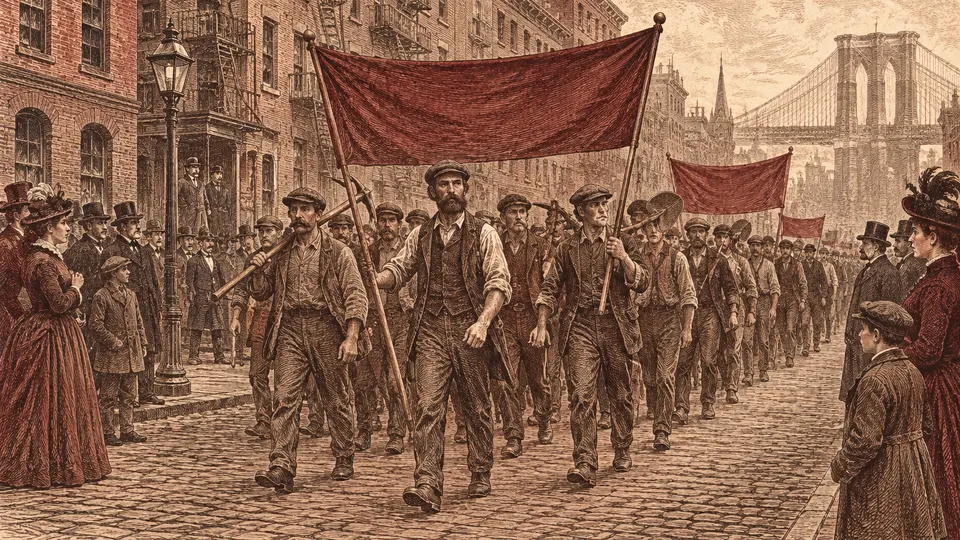
Labor Day began as a union parade in New York City on Tuesday, September 5, 1882. Oregon made it the first state holiday on February 21, 1887, and dozens of states followed. On June 28, 1894, Congress made the first Monday in September a national holiday, and President Grover Cleveland signed the act during the Pullman railroad boycott.
On this page
- Where and when was the first Labor Day parade?
- How did Labor Day spread from New York to the states?
- Why did Grover Cleveland sign the Labor Day law in 1894?
- Who really founded Labor Day: Peter McGuire or Matthew Maguire?
- Why is Labor Day in September instead of May 1?
- How is Labor Day observed today?
- Frequently Asked Questions
- Our Take
- Sources
Key Takeaways
- The first Labor Day was a parade and picnic organized by New York's Central Labor Union on September 5, 1882.
- States came first: Oregon on February 21, 1887, then four more that year, and by the Labor Department's count 31 states by 1894.
- The federal law of June 28, 1894 fixed the date as the first Monday in September; it was signed while the Pullman boycott was spreading.
- Two men with nearly the same name, Peter J. McGuire and Matthew Maguire, are both credited with the idea, and the record still favors no single founder.
- The September date came first; May 1 became an international workers' day only after 1886 and 1889.
Where and when was the first Labor Day parade?
The first Labor Day was held in New York City on Tuesday, September 5, 1882, organized by the city's Central Labor Union [1]. It was not yet a holiday in any law. Workers who marched were taking an unpaid day off, and the Labor Department's own account of the day says it "was almost a disaster" [2].
That account describes a tense morning. Police surrounded City Hall by 9 a.m. in case of trouble. At 10 a.m. the grand marshal, William McCabe, was ready with his aides and police escort, but only a few marchers had arrived and there was no music. Onlookers urged him to call it off. Then about 200 members of a jewelers' union from Newark arrived with a band, and the parade turned onto lower Broadway [2].
The march went up through lower Manhattan to Reservoir Park, which it reached at noon. Final reports put the marchers at "10,000 to 20,000 men and women." The day ended with speeches, a picnic and kegs of beer at Wendel's Elm Park, at 92nd Street and Ninth Avenue, where nearly 25,000 union members and their families gathered [2]. National Geographic also dates what is "now considered the nation's first Labor Day parade" to September 5, 1882 [6]. The Central Labor Union held a second Labor Day exactly a year later, on September 5, 1883 [1].
How did Labor Day spread from New York to the states?
Labor Day spread state by state for seven years before Congress acted. New York was the first state to introduce a Labor Day bill, but Oregon was the first to pass one, on February 21, 1887 [1]. National Geographic gives the same year for Oregon [6].
Four more states passed Labor Day laws later in 1887: Colorado, Massachusetts, New Jersey and New York. By the end of the decade, Connecticut, Nebraska and Pennsylvania had followed, and by 1894 another 23 states had adopted the holiday [1]. Added together, the Labor Department's figures come to 31 states before the federal law. Popular accounts give somewhat different totals, so treat the exact count as the department's tally rather than a settled number.
| Stage | When | What happened |
|---|---|---|
| City | September 5, 1882 | Central Labor Union parade and picnic in New York City |
| City | September 5, 1883 | Second New York Labor Day |
| First state | February 21, 1887 | Oregon passes the first state Labor Day law |
| More states | Later in 1887 | Colorado, Massachusetts, New Jersey, New York |
| More states | By end of 1889 | Connecticut, Nebraska, Pennsylvania |
| More states | By 1894 | 23 more states, per the Department of Labor |
| Nation | June 28, 1894 | Federal act: first Monday in September |
Why did Grover Cleveland sign the Labor Day law in 1894?
Congress passed an act on June 28, 1894, "making the first Monday in September of each year a legal holiday," and President Grover Cleveland signed it [1]. The statute still survives in the federal holiday law, whose notes trace it to the act of June 28, 1894, chapter 118, 28 Stat. 96 [4].
The reason most often given is the Pullman Strike. George Pullman's company, which built railroad sleeping cars near Chicago, had cut jobs and wages and lengthened hours without lowering rents in its company town. The newly formed American Railway Union, led by Eugene V. Debs, backed the strikers, and on June 26 Pullman cars were cut from trains across the country. When violence broke out, Pullman won President Cleveland's support for the use of U.S. troops. By the end of July, 34 people had been killed, and Debs was later jailed for contempt of court [3].
The National Park Service describes the holiday as an effort "to conciliate organized labor after the strike" [3]. The order of the dates makes the story less tidy: the act is dated June 28, 1894, two days after the boycott spread and before the deadliest clashes in July. A University of Massachusetts Boston history blog makes the same point, noting that Cleveland "had just signed, in June, a bill declaring a new holiday to honor workers" before the July violence [5]. The Park Service page itself says the bill was pushed through "six days after the strike ended," which does not match the June 28 date given by the Labor Department.
So the safest reading is this. The holiday had been growing for twelve years and, by the Labor Department's count, was already law in 31 states. Congress and Cleveland made it national at the height of a bitter national strike, and many accounts read the timing as an attempt to win back workers' goodwill. What the documents do not show is that Labor Day was invented as an apology for the deaths, since the law came first.
Who really founded Labor Day: Peter McGuire or Matthew Maguire?
Nobody can name a single founder with certainty. Two union men with nearly identical names both have a claim, and the U.S. Department of Labor presents both [1].
The traditional answer is Peter J. McGuire of the Brotherhood of Carpenters and Joiners. In 1882, according to the long-told story, he suggested a "general holiday for the laboring classes" to honor those "who from rude nature have delved and carved all the grandeur we behold" [1].
The challenger is Matthew Maguire, a machinist. The Labor Department says recent research supports the view that Maguire "proposed the holiday in 1882 while serving as secretary of the Central Labor Union in New York." After the 1894 law was signed, the Paterson Morning Call, a New Jersey newspaper, called him "the undisputed author of Labor Day as a holiday" [1]. Maguire was also on the scene on the first day: the department's account of the 1882 parade has him telling the grand marshal that the Newark jewelers and their band had arrived [2].
The fairest answer is that Labor Day was a Central Labor Union project, and both a McGuire tradition and a Maguire record have a place in its story. The quotations attributed to McGuire come down through later retellings; the case for Maguire rests partly on an 1894 newspaper. Neither settles the matter alone.
Why is Labor Day in September instead of May 1?
Labor Day was in September from the start. The New York parades of 1882 and 1883 were both held on September 5 [1], years before May 1 had any special meaning for workers.
May Day as a labor holiday grew out of later events. On May 1, 1886, unions staged a nationwide strike for the eight-hour day, which a 1929 TIME piece put at "some 200,000" workers. A strike at Chicago's McCormick Reaper plant turned violent on May 3, and a meeting at Haymarket Square followed the next day. In 1889 an international socialist conference declared that "May 1 would be an international holiday for labor," in memory of the Haymarket affair, and in many countries the day is now known as International Workers' Day [7].
Some historians argue the American choice was also political. National Geographic reports the view of historian Charles Tilly that Cleveland feared May Day "would become a memorial to the Haymarket radicals" and pressed state legislatures to pick the September date instead [6]. That is one interpretation, not a documented order, and it has to fit with the fact that New York unions were already marching in September in 1882. Later, during the Cold War, President Dwight Eisenhower signed a resolution in July 1958 naming May 1 "Loyalty Day" in the United States [7].
| U.S. Labor Day | May Day (International Workers' Day) | |
|---|---|---|
| Date | First Monday in September | May 1 |
| Earliest event | New York parade, September 5, 1882 | Eight-hour strikes, May 1, 1886 |
| Made official | State laws from 1887; federal act June 28, 1894 | Declared by a socialist conference in 1889 |
| Where | United States | Many other countries |
How is Labor Day observed today?
Labor Day is a federal holiday set by law on "the first Monday in September," one of 11 legal public holidays listed in the federal code [4]. Because it is tied to a Monday, it always creates a three-day weekend, unlike the first two New York celebrations, which fell on September 5 whatever the weekday.
The early pattern was a street parade followed by a festival or picnic for workers and their families. Speeches by public figures came later as the holiday took on civic weight, and in 1909 the American Federation of Labor named the Sunday before Labor Day "Labor Sunday," set aside for the spiritual and educational side of the labor movement [1]. Many towns still hold parades. For many Americans, though, Labor Day weekend now signals the end of summer and a chance to host a barbecue [6].
It sits in a calendar of American holidays that each began with a fight over meaning, from Memorial Day to Juneteenth and Thanksgiving. For the wider period, see our Civil War and Reconstruction era page, or browse what happened on this day.
Frequently Asked Questions
Was the first Labor Day on a Monday?
No. The first Labor Day was held on Tuesday, September 5, 1882, and the second on September 5, 1883 {{cite:dol-history}}. The first Monday in September became the national date with the federal act of June 28, 1894.
Which state made Labor Day a holiday first?
Oregon, on February 21, 1887. New York had introduced the first bill, but Oregon passed its law first. Colorado, Massachusetts, New Jersey and New York followed later in 1887 {{cite:dol-history}}.
Is Labor Day the same as May Day?
Both honor workers, but they are separate holidays with separate origins. The United States observes Labor Day on the first Monday in September, while many other countries mark May 1 as International Workers' Day, a date chosen by an 1889 socialist conference in memory of the Haymarket affair {{cite:time-may-day}}.
Our Take
We think Labor Day is best understood as a holiday workers built for themselves before any government handed it to them. The record shows a nervous first parade in 1882, a slow march through state legislatures and, only then, a federal law. The Pullman Strike matters, and the timing of Cleveland's signature is hard to ignore, but in our reading of the sources it is a story about Congress catching up with a holiday 31 states already kept, not one that began as a gesture after the bloodshed. The McGuire and Maguire question deserves the same honesty: the evidence supports a shared credit, and a confident single answer goes beyond what the documents show. Methods are explained in our editorial policy.
Sources
- History of Labor Day. U.S. Department of Labor.
- Labor Daze: Pride, Chaos and Kegs on Labor's First Day. U.S. Department of Labor.
- George M. Pullman. National Park Service.
- 5 U.S. Code Section 6103: Holidays. Legal Information Institute, Cornell Law School.
- TRANSPORT: Origins of Labor Day. Building the World, UMass Boston, 2022.
- A brief history of Labor Day: and the strike that inspired it. National Geographic, 2020.
- The Bloody Story of How May Day Became a Holiday for Workers. TIME, 2015.
Where historians disagree, we say so and show the main views. Dates are checked against two sources; legend and documented record are labeled separately. Spotted an error? Tell us.
Keep Reading
The History of Memorial Day
Memorial Day began as Decoration Day after the Civil War. Here is who claims to be first, Logan's 1868 order, the Monday move and today's moment of silence.
The History of Juneteenth
How Juneteenth began with General Order No. 3 in Galveston on June 19, 1865, why freedom came late to Texas, and how it became a federal holiday in 2021.
The History of Thanksgiving: Tradition vs Record
What the 1621 Plymouth harvest really was, what the two eyewitness accounts say, what people ate, and how Hale, Lincoln and FDR made the modern holiday.
U.S. Presidents in Order: The Complete List
All 47 U.S. presidencies in order, from George Washington in 1789 to Donald Trump in 2025, with term dates, ages and how each presidency came to an end.
The History of Halloween
How Halloween grew from Samhain tales, the November 1 feast of All Saints, souling and guising, and Irish turnip lanterns into America's pumpkin holiday.
The History of Valentine's Day
Where Valentine's Day really came from: the early martyrs, the disputed Lupercalia link, Chaucer's love poem, and the lace cards that built a U.S. industry.