The History of Halloween
Quick Answer
Halloween grew from two roots. Medieval Irish tales describe Samhain, a feast at the end of October, but say little about ghosts. The church's feast of All Saints settled on November 1 in the 700s and 800s, so October 31 became All Hallows' Eve. Irish and Scottish customs such as guising and carved turnip lanterns crossed to America with immigrants in the 1800s, where pumpkins replaced turnips and trick-or-treating spread in the 20th century.
On this page
- What Was Samhain, and What Do the Records Actually Show?
- How Did All Saints' Day Give Halloween Its Name?
- Which Halloween Stories Are Tradition, and Which Are Record?
- What Were Souling and Guising?
- Why Did Ireland and Scotland Carve Turnips, and How Did Pumpkins Take Over?
- How Did Halloween Reach America, and When Did Trick-or-Treating Begin?
- Which Halloween Customs Are American, and Which Are British or Irish?
- Frequently Asked Questions
- Our Take
- Sources
Key Takeaways
- The earliest written stories about Samhain were set down by Irish churchmen around 800 CE, and they describe feasts, markets and games rather than a night of horror.
- The name Halloween comes from All Hallows' Eve, the night before the church's feast of All Saints on November 1.
- Souling, guising and carved turnip lanterns are British and Irish customs; most are documented from the 1600s to the 1800s, not from ancient times.
- Irish and Scottish immigrants brought Halloween to the United States in the 1800s, and trick-or-treating became a common American custom between the 1930s and 1950s.
What Was Samhain, and What Do the Records Actually Show?
Samhain was a Gaelic festival marking the end of the harvest and the start of winter, held from October 31 into November 1 [8]. A Penn State article drawing on historian Benjamin Hudson explains that the Celts, as an agricultural people, "marked the passage from summer to winter on the last night of October" [9]. In Irish, Halloween is still called Oíche Shamhna, the Eve of Samhain [4].
The problem is the gap between the festival and the evidence. The pre-Christian Irish left no written accounts of their own. The stories that mention Samhain were written down by churchmen around 800 CE, roughly 400 years after the Irish began converting to Christianity, according to University of Southern California historian Lisa Bitel [2]. In those tales, kings hold weeklong feasts, markets and games at Samhain, and the barrier to the otherworld opens to mortals. One tale, "The Adventure of Nera," warns of meeting dead men on Samhain Eve. But Bitel notes that "the stories did not link Samhain with death and horror," and that the tales place the great bonfires at Beltaine, the May festival, not at Samhain.
Whatever the ancient Irish actually did on October 31 is, in Bitel's words, "lost to scholars." She argues that the straight line from Samhain to Halloween was drawn in the 1800s by folklorists such as John Rhys of Oxford and James Frazer of Cambridge.
Historians disagree about how much carried over. USC anthropologist Tok Thompson sees real continuity: he points out that ninth-century Irish literature mentions Samhain "many times," and that the oldest monument at the Hill of Tara, the Mound of Hostages, is aligned to Samhain [4]. Bitel, by contrast, says the ancient Irish "get far too much credit" for the holiday [2]. Both agree that Samhain existed. They disagree on what it meant and how much of it survives in modern Halloween.
How Did All Saints' Day Give Halloween Its Name?
The word Halloween is a contraction of All Hallows' Eve, the evening before All Hallows' Day, or All Saints' Day, on November 1. Together with All Souls' Day on November 2, these days form a three-day Christian season called Allhallowtide [8].
The feast did not start on November 1. The 1907 Catholic Encyclopedia records that Pope Boniface IV dedicated the Pantheon in Rome to the Virgin Mary and all the martyrs on May 13, in 609 or 610, and ordered an anniversary [1]. Pope Gregory III, who reigned from 731 to 741, then consecrated a chapel in St. Peter's Basilica to all the saints and fixed its anniversary on November 1. Gregory IV, pope from 827 to 844, extended the November 1 feast to the whole Church. Bitel dates his decree to 834 [2].
| Date | What happened | Source |
|---|---|---|
| May 13, 609 or 610 | Boniface IV dedicates the Pantheon to Mary and all martyrs | Catholic Encyclopedia |
| 731 to 741 | Gregory III dedicates a chapel to all saints, with its feast on November 1 | Catholic Encyclopedia; Hansen |
| 827 to 844 (834 per Bitel) | Gregory IV extends the November 1 feast to the whole Church | Catholic Encyclopedia; Bitel |
| Around 1000 | November 2 established as All Souls' Day | Hansen |
Did the popes choose November 1 to replace Samhain? That is a common claim, but the record does not say so. Boston University's Regina Hansen notes that scholars disagree on whether the date was chosen on purpose to match the Celtic feast [5]. Bitel thinks Gregory IV was more likely tidying up an untidy church calendar than taking aim at an Irish festival. Hansen also dates the addition of All Souls' Day on November 2 to around 1000 CE.
Which Halloween Stories Are Tradition, and Which Are Record?
Many statements repeated every October mix later tradition with documented history. Popular accounts say Halloween is more than 2,000 years old and that early Celts wore costumes to hide from evil spirits [8]. Those claims rest mostly on folklore collected in the 1800s and 1900s, not on ancient sources.
The fairer way to put it: Samhain is real and old, and some later Halloween customs may echo it. But the costumes, lanterns and door-to-door visits that Americans know are documented in Britain and Ireland from the 1600s onward. The long story connecting them to pagan priests is a 19th-century reconstruction, as Bitel argues, while scholars such as Thompson see deeper roots. Our editorial policy explains how we label tradition and record across the site.
What Were Souling and Guising?
Souling was an English custom tied to the Christian feast of the dead. Around All Souls' Day on November 2, people went from door to door asking for soul cakes, small spiced cakes, often in return for prayers for the household's dead. University of Glasgow food historian Lindsay Middleton quotes a soul cake recipe from a manuscript recipe book dated 1604 [6]. Hansen describes English beggars asking for "small currant biscuits called soul cakes," but she warns that the popular link between souling and trick-or-treating is not accepted by all scholars [5].
Guising belongs to Scotland and Ireland. Pamela O'Neill, a lecturer in Celtic studies at the University of Sydney, writes that guising, divination games and mischief at Samhain are recorded from the early 18th century [3]. Guisers wore sheepskin masks with painted faces, straw wigs, old clothes or animal skins, and on South Uist in the Outer Hebrides sometimes a sheep's skull. Mischief included lifting gates off their hinges, blocking chimneys with turnips and tying chamber pots to doors. Bitel traces Scottish guisers who begged for soul cakes back to the Middle Ages [2], so the custom may be older than its first detailed records.
Fortune telling was just as central. Middleton cites an 1879 children's magazine describing kale stalks pulled at Halloween to predict a future spouse, and an 1896 story saying nut roasting and apple bobbing had "died out in England" but were "preserved in full vigour in Ireland and Scotland" [6]. By the late 1800s, Halloween in Britain was largely a Scottish and Irish holiday.
Why Did Ireland and Scotland Carve Turnips, and How Did Pumpkins Take Over?
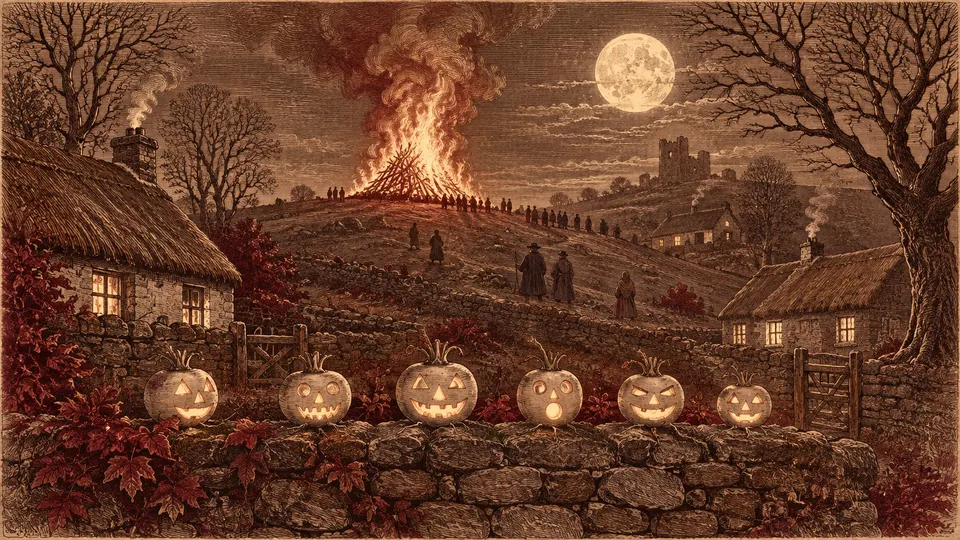
Before the pumpkin, Halloween lanterns were cut from root vegetables. In Ireland and Scotland people carved faces into turnips, mangelwurzels, potatoes and beets and set them beside their homes [10]. Clodagh Doyle, a curator at the National Museum of Ireland, has called carved turnips "the original scary lanterns in Ireland," and the museum's Country Life branch in County Mayo displays a model of one. HISTORY adds that people in Ireland and Scotland placed carved turnips in windows or near doors to frighten away wandering spirits, while in England large beets were used [11].
The written record of these lanterns is not ancient. Turnip lanterns called "Hoberdy's Lanterns" were recorded in Worcestershire, England, at the end of the 18th century [10]. Bitel thinks carved turnips probably began in England, connected with All Saints' Day and Guy Fawkes Day on November 5 [2]. O'Neill offers two possible origins, a light for walking home at night or a face to scare off spirits, and says plainly that the answer is uncertain [3].
The name comes from a folk tale. Stingy Jack tricks the Devil, is refused by both heaven and hell, and wanders the night carrying a burning coal in a hollowed turnip. HISTORY notes that this legend "first appeared in print in the 19th century" [11]. It is a story about the lantern, not evidence of where the lantern came from.
The switch happened in America. When Irish and Scottish emigrants arrived, they found pumpkins plentiful and far easier to carve than turnips [2]. HISTORY argues that these newcomers helped turn pumpkin carving from a general autumn pastime into a custom tied to Halloween itself [11]. The turnip lanterns shown at the top of this page, glowing on a stone wall in rural Ireland, are the older form.
How Did Halloween Reach America, and When Did Trick-or-Treating Begin?
Halloween arrived with immigrants. Hansen writes that the holiday was not widely celebrated in the United States until the 1840s, when newcomers from Ireland and Scotland brought dancing, masquerading, fortune telling and the habit of asking neighbors for treats [5]. O'Neill links the move to the Highland Clearances in Scotland and the Great Irish Famine in the 18th and 19th centuries [3]. Like the first Thanksgiving, the American Halloween grew from customs that settlers and immigrants carried across the Atlantic and then reshaped.
American Halloween soon took on a rough edge. By the late 1800s some stores sold commercially made Halloween candy, but the night was also known for pranks, some serious vandalism and heavy drinking. In the early 20th century, towns and churches tried to make Halloween a family holiday, and that effort eventually produced trick-or-treating [5]. Northeastern University marketing professor Koen Pauwels dates the organized version to the 1930s through the 1950s, when towns used it to curb vandalism [8]. "Postwar suburbs, with their walkable streets and front porches, made it the neighborhood ritual to be enjoyed by all," he said.
The modern holiday also produced its own legends. In 1970 a New York Times opinion piece suggested strangers might poison trick-or-treaters, and by the 1980s some hospitals offered to X-ray candy. In 1985, University of Delaware sociologist Joel Best published a study of 30 years of reported cases and called the poisoned-candy threat an "urban legend," as College of Charleston historian W. Scott Poole recounts [7]. The one notorious 1974 death in Houston was caused by the child's own father.
Which Halloween Customs Are American, and Which Are British or Irish?
Most of the customs started in Britain and Ireland, but the holiday as Americans know it took shape in the United States. American films and television, including the Halloween horror films and E.T. the Extra-Terrestrial, carried that American version back to Britain from the 1980s onward [8]. Not everyone welcomed it: Bitel notes that British schools tried to suppress Halloween in the 1990s [2].
| Custom | Where it is first documented | Notes |
|---|---|---|
| Samhain feast | Ireland, tales written around 800 CE | Feasts, markets and games; meaning debated |
| All Hallows' Eve | Western Church, November 1 feast by the 800s | Source of the name Halloween |
| Souling and soul cakes | England, recipe dated 1604 | Tied to All Souls' Day, November 2 |
| Guising | Scotland and Ireland, recorded from the early 1700s | Masks, straw wigs, songs or tricks |
| Turnip lanterns | England, Ireland and Scotland, late 1700s onward | Mangelwurzels and beets also used |
| Pumpkin jack-o'-lantern | United States, 1800s | Pumpkins easier to carve than turnips |
| Organized trick-or-treating | United States, 1930s to 1950s | Spread through postwar suburbs |
In Britain, Halloween also had a rival. November 5 marks the failed Gunpowder Plot of 1605, and Bonfire Night became the main autumn fire festival there after the Reformation pushed All Hallows' customs to the margins [8] [5]. In Ireland, where the hilltop fires and turnip lanterns of the old countryside are remembered, Halloween kept its own name, Oíche Shamhna. Victoria Millar, a curator at the Ulster Folk Museum in Northern Ireland, summed up the older Irish Halloween: "Masks were worn, fires were lit and stories of ghosts, fairies, and even the devil were shared to entertain, warn, or protect the household" [8].
The commercial scale is American. As of November 2026, the National Retail Federation expected U.S. consumers to spend $13.5 billion on Halloween in 2026, compared with about $940 million in Britain, as reported by Northeastern [8]. A holiday that began as a scattered set of rural British and Irish customs became, in America, a national event. For other holidays that changed as they crossed the Atlantic, browse our holidays section, read the history of Valentine's Day or the history of Labor Day, or explore more of the Middle Ages.
Frequently Asked Questions
Is Halloween a pagan holiday?
Partly, and how much is debated. The name and the October 31 date come from All Hallows' Eve, the night before the Christian feast of All Saints on November 1. Samhain, the Gaelic festival at the end of October, is older, but historians such as Lisa Bitel argue that little is known about how it was celebrated, while others, such as Tok Thompson, see strong continuity {{cite:bitel-ancient-irish-credit}}.
Why is Halloween on October 31?
Because November 1 is All Saints' Day. Pope Gregory III fixed the anniversary of a chapel to all saints on November 1 in the 700s, and Gregory IV extended the feast to the whole Church in the 800s. The evening before became All Hallows' Eve {{cite:catholic-encyclopedia-all-saints}}.
Why were jack-o'-lanterns made from turnips?
In Ireland, Scotland and England, people carved lanterns from turnips, mangelwurzels and beets. Turnip lanterns are recorded in Worcestershire by the end of the 18th century. Immigrants in America switched to pumpkins, which were plentiful and easier to carve {{cite:irishcentral-turnip-lanterns}}.
When did trick-or-treating start in America?
Door-to-door begging for treats came with Irish and Scottish immigrants from the 1840s, but organized trick-or-treating spread between the 1930s and 1950s, when towns promoted it to reduce Halloween vandalism {{cite:northeastern-halloween-america}}.
Our Take
We think Halloween's real history is a better story than the one usually told. The popular version runs in a straight line from druids to doorbells. The record shows something more human: a feast remembered in churchmen's tales, a church calendar slowly settling on November 1, poor villagers asking for soul cakes, Scottish guisers in straw wigs, and Irish families carving faces into turnips. Then immigrants made it American, and America sent it back. We have tried to keep tradition and record apart, and where scholars such as Bitel and Thompson disagree about Samhain, we show both views rather than pick one. Readers curious about other holidays can find more in our on this day pages.
Sources
- All Saints' Day. The Catholic Encyclopedia, 1907.
- The ancient Irish get far too much credit for Halloween. The Conversation, 2024.
- Samhain: the true, non-American origins of Halloween. The Conversation, 2025.
- Halloween's celebration of mingling with the dead has roots in ancient Celtic celebrations of Samhain. The Conversation, 2022.
- Tricking and treating has a history. The Conversation, 2017.
- Halloween foods from history reveal the holiday's surprising romantic side. The Conversation, 2023.
- When Halloween became America's most dangerous holiday. The Conversation, 2019.
- Halloween originated in Scotland 2,000 years ago, so how did it become so big in America?. Northeastern University, 2026.
- Probing Question: What are the origins of Halloween?. Penn State, 2010.
- Jack-o-Lanterns were originally turnips in Ireland. IrishCentral.
- How Jack O'Lanterns Originated in Irish Myth. HISTORY, 2019.
Where historians disagree, we say so and show the main views. Dates are checked against two sources; legend and documented record are labeled separately. Spotted an error? Tell us.
Keep Reading
The History of Memorial Day
Memorial Day began as Decoration Day after the Civil War. Here is who claims to be first, Logan's 1868 order, the Monday move and today's moment of silence.
The History of Juneteenth
How Juneteenth began with General Order No. 3 in Galveston on June 19, 1865, why freedom came late to Texas, and how it became a federal holiday in 2021.
The History of Thanksgiving: Tradition vs Record
What the 1621 Plymouth harvest really was, what the two eyewitness accounts say, what people ate, and how Hale, Lincoln and FDR made the modern holiday.
The History of Labor Day
Labor Day began with a New York parade on September 5, 1882, spread through state laws from 1887 and became a federal holiday in June 1894. Here is the story.
The History of Valentine's Day
Where Valentine's Day really came from: the early martyrs, the disputed Lupercalia link, Chaucer's love poem, and the lace cards that built a U.S. industry.