The History of Memorial Day
Quick Answer
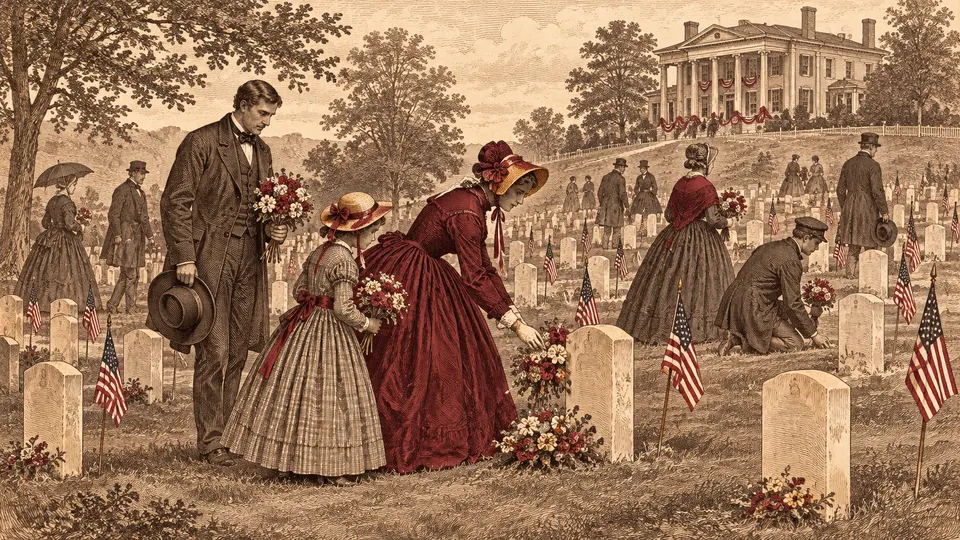
Memorial Day grew out of local customs of decorating soldiers' graves during and after the Civil War. Several towns claim to be first, including Charleston, South Carolina, in 1865 and Waterloo, New York, in 1866. The national holiday traces to General John A. Logan's General Orders No. 11, which set the first national Decoration Day for May 30, 1868, at Arlington National Cemetery.
On this page
- Why did Americans start decorating soldiers' graves?
- Where did Memorial Day begin?
- What did General Logan's order say?
- How did Decoration Day become Memorial Day?
- Why is Memorial Day on the last Monday in May?
- What is the National Moment of Remembrance?
- How is Memorial Day different from Veterans Day?
- Frequently Asked Questions
- Our Take
- Sources
Key Takeaways
- Memorial Day began as "Decoration Day," a spring custom of laying flowers on the graves of Civil War dead.
- Many places claim the first observance, from Boalsburg, Pennsylvania, to Charleston, South Carolina, and Waterloo, New York; Congress recognized Waterloo in 1966, but the record shows several earlier local ceremonies.
- General John A. Logan's General Orders No. 11, issued May 5, 1868, created the first national Decoration Day on May 30, 1868.
- After World War I the day widened to honor Americans who died in all wars, and since 1971 it has fallen on the last Monday in May.
- Memorial Day honors those who died in military service; Veterans Day, on November 11, honors everyone who served.
Why did Americans start decorating soldiers' graves?
The Civil War killed more than 620,000 Americans, about 2 percent of the population at the time [4]. The National Park Service puts the toll at more than 622,000 [2]. Almost every community had graves to tend, and many of the dead lay far from home.
During and after the war, towns in both the North and the South held spring "decoration days," when people gathered at cemeteries to lay flowers on soldiers' graves [1]. Placing flowers on graves is an old custom, but the Park Service dates the modern observance to the years right after this war [2]. These were local events, organized by women's groups, veterans and townspeople, years before any government set a date. The war itself is covered in why the Civil War started, and the wider period in our Civil War and Reconstruction era guide.
Where did Memorial Day begin?
No single town can prove it held the first Memorial Day; the record shows many local ceremonies that grew into one national day. Here the line between tradition and record matters most.
Waterloo, New York has the official title. Druggist Henry Carter Welles proposed a day to honor the Civil War dead, and John Boyce Murray, the Seneca County clerk, led the first celebration on May 5, 1866 [3]. Governor Nelson A. Rockefeller recognized Waterloo as the birthplace on March 7, 1966, and Congress followed in May 1966 with House Concurrent Resolution 587, which President Lyndon B. Johnson endorsed [2]. The Park Service adds a caution: some argue Waterloo's first observance came in 1868, not 1866.
Charleston, South Carolina has an earlier record. On May 1, 1865, weeks after the war's end, a ceremony was held at a cemetery where 257 Union dead were buried [1]. The Park Service, citing historian David Blight's book Race and Reunion, says newly freed African Americans had reburied those 257 Union soldiers and that thousands attended [2].
Southern towns have their own claims. Columbus, Mississippi, decorated both Union and Confederate graves on April 25, 1866, an act that inspired the poem "The Blue and the Gray," published in 1867. Boalsburg, Pennsylvania, points to October 1864, and Carbondale, Illinois, and Petersburg, Virginia, also claim to be first [2]. In Columbus, Georgia, the Ladies Memorial Association decorated Confederate graves on April 26, 1866, and its secretary, Mary Ann Williams, called for an annual day. The National Archives also notes that Sue Langdon Adams of Jackson, Mississippi, decorated unmarked Union graves in 1865 [3].
| Claim | Date | What the sources show |
|---|---|---|
| Boalsburg, Pa. | October 1864 | Local claim of grave decorating; earliest date offered |
| Charleston, S.C. | May 1, 1865 | Freedpeople honored 257 Union dead, as Blight describes it |
| Columbus, Miss. | April 25, 1866 | Graves of both armies decorated |
| Columbus, Ga. | April 26, 1866 | Confederate graves; call for a yearly day |
| Waterloo, N.Y. | May 5, 1866 | Officially recognized as "birthplace" in 1966 |
| Arlington, Va. | May 30, 1868 | First national Decoration Day |
Waterloo's title is a recognition by Congress, not a finding by historians that it came first.
What did General Logan's order say?
On May 5, 1868, John A. Logan, commander-in-chief of the Grand Army of the Republic, a Union veterans' organization, issued General Orders No. 11, which the VA calls the "Memorial Day Act" [1]. It set aside May 30, 1868, for "strewing with flowers or otherwise decorating the graves of comrades who died in defense of their country," and hoped the custom would be kept up each year "while a survivor of the war remains" [3].
The idea did not start with Logan alone. In 1867 Martha G. Kimball wrote to him from Philadelphia, suggesting that Union graves be honored as Southern women honored theirs [3]. The date itself was chosen so that "the choicest flowers of springtime" would be in bloom across the country, according to the VA's cemetery historians [1].
The first national Decoration Day at Arlington
The main ceremony on May 30, 1868, was held at Arlington National Cemetery, on the former estate of Robert E. Lee. General and Mrs. Ulysses S. Grant attended, Representative James A. Garfield of Ohio spoke, and about 5,000 people came [2]. About 11,250 Union and 350 Confederate soldiers were buried there, more than half of them unknown, and children from the Soldiers' and Sailors' Orphan Asylum helped decorate the graves [1]. Grand Army members in 17 states reportedly held observances the same day [3].
How did Decoration Day become Memorial Day?
States made the day official one by one. New York recognized it first, in 1873, and all the other Union states had done so by 1890; the former Confederate states kept their own memorial days on dates from April to June [1].
The broader change came with the First World War. The VA says that after it the holiday expanded to honor Americans who died in all wars, not just the Civil War [1]. The Park Service adds that the South largely joined the national observance only then [2]. The National Archives points to the veterans' groups that grew out of those wars, including the American Legion after World War I [3]. Some Southern states still hold separate Confederate memorial days [2].
The name changed slowly. "Memorial Day" was first used in 1882, became common after World War II, and was made the official name by Congress in 1967 [2].
Why is Memorial Day on the last Monday in May?
For a century the date was May 30. The Uniform Monday Holiday Act, signed by President Lyndon B. Johnson on June 28, 1968, took effect on January 1, 1971 [3]. It moved Memorial Day from May 30 to the last Monday in May [1], creating the three-day weekend Americans know today.
Not everyone welcomed the change. Senator Daniel Inouye of Hawaii introduced a bill to return the holiday to May 30 in every Congress from 1987 until his death in 2012 [2]. The worry was older than the Monday law: the Park Service quotes an 1869 New York Times warning that "joy" was overtaking solemnity, and historian James McPherson's verdict that "commemoration gave way to celebration." The same move to Mondays shaped other holidays in our American holidays series, from Labor Day to Juneteenth.
What is the National Moment of Remembrance?
The National Moment of Remembrance asks Americans to pause for one minute at 3 p.m. local time on Memorial Day. President Bill Clinton signed the National Moment of Remembrance Act on December 28, 2000 [2]. The law, Public Law 106-579, calls for that minute of silence each year [1]. It gives the holiday a fixed point of remembrance within the long weekend.
How is Memorial Day different from Veterans Day?
Memorial Day mourns those who died in military service; Veterans Day honors everyone who served. The VA calls Memorial Day the nation's foremost annual day to mourn and honor deceased service members [1]. Veterans Day, on November 11, celebrates the service of all U.S. military veterans [4].
The two holidays have different roots. Veterans Day began as Armistice Day, marking the end of World War I in 1918; Congress renamed it Veterans Day in 1954, after President Dwight D. Eisenhower signed the change on May 26 of that year [5]. The same 1968 Monday law moved Veterans Day to the fourth Monday of October from 1971 to 1977, before it was permanently changed back to November 11. Memorial Day stayed on its Monday. Our November 11 page collects other events tied to that date, and the war behind it is explained in why World War I started.
Frequently Asked Questions
Why was Memorial Day called Decoration Day?
Because its central act was decorating graves. General Orders No. 11 set aside May 30, 1868, for "strewing with flowers or otherwise decorating the graves" of Union dead {{cite:nara-nations-sacrifice}}. "Memorial Day" was first used in 1882 and became the official name in 1967 {{cite:nps-memorial-day}}.
When did Memorial Day become a federal holiday on a Monday?
The Uniform Monday Holiday Act was signed on June 28, 1968, and took effect on January 1, 1971, moving Memorial Day from May 30 to the last Monday in May {{cite:nara-nations-sacrifice}}.
What time is the Memorial Day moment of silence?
At 3 p.m. local time. The National Moment of Remembrance Act of December 2000 asks Americans to pause for one minute at that hour each Memorial Day {{cite:va-nca-memorial-day}}.
Our Take
We think the honest answer to "where did Memorial Day begin?" is "in many places at once." Waterloo holds the official title, but the records gathered by the VA, the Park Service and the National Archives show grieving communities in the North and the South, including formerly enslaved people in Charleston, decorating graves before Logan's 1868 order. What Logan added was a single national date, and that is the real turning point the sources support. The quieter story is how the day changed: from the Civil War dead to the dead of every American war, and from May 30 to a long weekend. The 3 p.m. moment of silence is a small attempt to keep remembrance at the center. Our methods are explained in our editorial policy.
Sources
- Memorial Day history. U.S. Department of Veterans Affairs, National Cemetery Administration.
- Memorial Day: Over 150 Years of Remembrance. National Park Service.
- The Nation's Sacrifice: The Origins and Evolution of Memorial Day. National Archives, 2018.
- Memorial Day: A Commemoration. National Archives.
- From Armistice to Veterans Day. National Archives, 2018.
Where historians disagree, we say so and show the main views. Dates are checked against two sources; legend and documented record are labeled separately. Spotted an error? Tell us.
Keep Reading
The History of Labor Day
Labor Day began with a New York parade on September 5, 1882, spread through state laws from 1887 and became a federal holiday in June 1894. Here is the story.
The History of Juneteenth
How Juneteenth began with General Order No. 3 in Galveston on June 19, 1865, why freedom came late to Texas, and how it became a federal holiday in 2021.
Why Did the Civil War Start?
Why did the Civil War start? What the seceding states said in their own words, the fight over slavery in the West, Lincoln's election, and Fort Sumter.
Why Did World War I Start?
Why did WW1 start? The long-term causes, the Sarajevo assassination, the July Crisis day by day, how alliances spread the war, and why the U.S. joined in 1917.
The History of Thanksgiving: Tradition vs Record
What the 1621 Plymouth harvest really was, what the two eyewitness accounts say, what people ate, and how Hale, Lincoln and FDR made the modern holiday.
The History of Halloween
How Halloween grew from Samhain tales, the November 1 feast of All Saints, souling and guising, and Irish turnip lanterns into America's pumpkin holiday.