Why Did the Civil War Start?
Quick Answer
The Civil War started because of a long conflict over slavery, above all over whether it could spread into the western territories. When Abraham Lincoln, who opposed that expansion, won the presidency in November 1860, South Carolina and six other Deep South states seceded and formed the Confederacy. The war began when Confederate forces fired on Fort Sumter on April 12, 1861.
On this page
- What did the seceding states say caused secession?
- How did the fight over slavery in the West lead to war?
- Why did Lincoln's election lead to secession?
- How did secession unfold, state by state?
- What happened at Fort Sumter?
- Was the Civil War about states' rights?
- Frequently Asked Questions
- Our Take
- Sources
Key Takeaways
- The seceding states named slavery as their reason. Mississippi's declaration says its position is "thoroughly identified with the institution of slavery."
- Forty years of disputes over slavery in the West, from the Missouri Compromise of 1820 to the Dred Scott decision of 1857, set the stage.
- Lincoln won the election of November 6, 1860, without carrying a single state where slavery was legal; South Carolina seceded on December 20, 1860.
- The war began at Fort Sumter on April 12, 1861. After Lincoln called for 75,000 volunteers, four more states seceded, for eleven in all.
- "States' rights" was argued mainly in defense of slavery, and the later "Lost Cause" story that the war was not about slavery is rejected by historians.
What did the seceding states say caused secession?
The clearest evidence comes from the people who left the Union. Four states, South Carolina, Mississippi, Georgia and Texas, published formal declarations explaining why they were seceding. All four put slavery at the center.
In their own official words, the first states to secede said they were leaving the Union to protect slavery.
| State | Document | What it says (short quote) |
|---|---|---|
| South Carolina | Declaration of the Immediate Causes, December 24, 1860 | Northern states "have denounced as sinful the institution of slavery" |
| Mississippi | Declaration of the Immediate Causes | "Our position is thoroughly identified with the institution of slavery" |
| Georgia | Declaration of causes, approved January 29, 1861 | Complaints against the free states "with reference to the subject of African slavery" |
| Texas | Declaration of the Causes, February 2, 1861 | Texas joined the Union "as a commonwealth holding, maintaining and protecting the institution known as negro slavery" |
South Carolina's declaration objected to the election of a president "whose opinions and purposes are hostile to slavery" [1]. Mississippi's opened by calling slavery "the greatest material interest of the world" [2]. Georgia's complained that the North had tried "to deprive us of an equal enjoyment of the common Territories" [3]. Texas's accused twelve named states of violating the Constitution's fugitive slave clause [4].
Confederate leaders said the same thing in public. In Savannah, Georgia, on March 21, 1861, Confederate Vice President Alexander H. Stephens gave what became known as the Cornerstone Speech. He called slavery "the immediate cause of the late rupture and present revolution" and said the new government's "corner-stone rests" on the claim of racial inequality [5].
How did the fight over slavery in the West lead to war?
For forty years before the war, the sharpest national fight was over the western lands: would they become free states or slave states? Each answer changed the balance of power in Congress, and each compromise lasted only until the next crisis.
The Missouri Compromise (1820). Approved on March 6, 1820, it admitted Missouri as a slave state and Maine as a free state, keeping the balance even, and banned slavery in the rest of the Louisiana Territory north of 36°30' latitude [6].
The Compromise of 1850. A package of laws approved in September 1850 admitted California as a free state, let New Mexico and Utah territories decide on slavery for themselves, banned the slave trade (not slavery) in Washington, D.C., and passed a much tougher Fugitive Slave Act. That law commanded "all good citizens" to help capture people who had escaped slavery, and it barred the accused person's own testimony at hearings [7].
The Kansas-Nebraska Act (1854). Approved on May 30, 1854, Senator Stephen Douglas's law let settlers in Kansas and Nebraska decide on slavery by "popular sovereignty" and repealed the 1820 line. It "reopened the national struggle over slavery in the western territories," and the violent contest that followed became known as "Bleeding Kansas" [8].
Dred Scott v. Sandford (1857). On March 6, 1857, Chief Justice Roger B. Taney's majority opinion held that Black Americans whose ancestors had been enslaved were not citizens and that Congress had no authority to ban slavery from a federal territory [9]. The National Archives notes that the ruling made the Missouri Compromise unconstitutional [6].
Each attempt to settle slavery in the West lasted only until the next crisis, and after Dred Scott there was no compromise line left to defend.
Why did Lincoln's election lead to secession?
The 1860 election split four ways. On November 6, 1860, Abraham Lincoln of the new Republican Party won about 40 percent of the popular vote but 180 electoral votes, well above the 152 needed. He won 18 states, all of them free states, and no state where slavery was legal; some Southern states did not even print ballots for him [10]. John C. Breckinridge took 72 electoral votes, John Bell 39 and Stephen Douglas 12; Lincoln was not on the ballot in any Southern state [11].
Lincoln had long backed "free soil" policies, meaning slavery should not spread into new territories [10]. The Georgia declaration called a ban on slavery in the territories "the cardinal principle" of the Republican Party [3]. The National Park Service describes the result as a "sectional victory" that many Southerners saw as the final straw [12].
How did secession unfold, state by state?
Secession came in two waves. The first seven states, all in the Deep South, left before Lincoln took office. On February 4, 1861, they formed the Confederate States of America, with Jefferson Davis as president [12]. The four states of the Upper South stayed in the Union until after Fort Sumter.
| Wave | States | When | What tipped them |
|---|---|---|---|
| First | South Carolina, Mississippi, Florida, Alabama, Georgia, Louisiana, Texas | December 20, 1860 to February 1, 1861 | Lincoln's election |
| Second | Virginia, Arkansas, North Carolina, Tennessee | April 17 to June 8, 1861 | Fort Sumter and Lincoln's call for troops |
The secession dates in both waves come from the National Park Service [12]. Texas's convention acted on February 1, 1861, and adopted its declaration of causes on February 2 [4].
What happened at Fort Sumter?
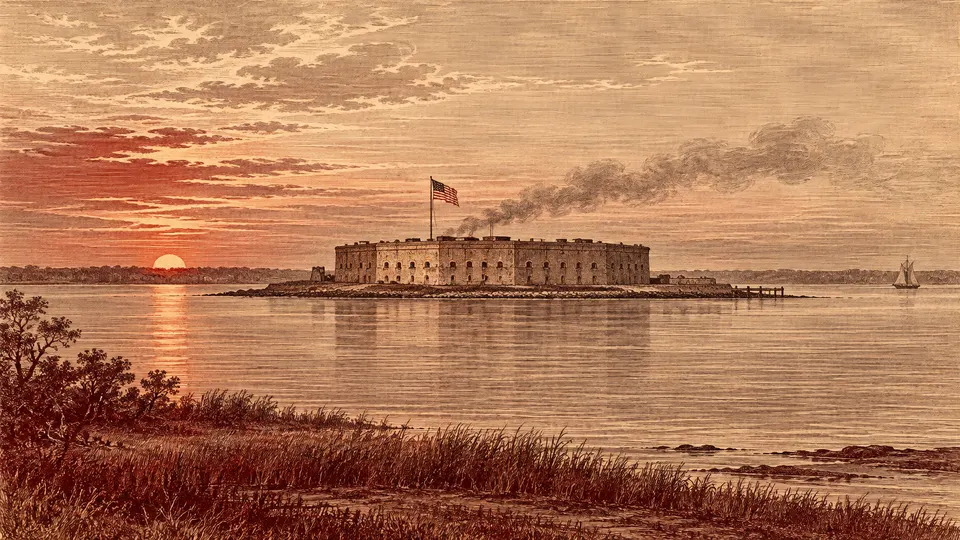
Fort Sumter sat on an island in Charleston Harbor, South Carolina, and was still held by a small U.S. Army garrison under Major Robert Anderson. Confederate Brigadier General P.G.T. Beauregard commanded the forces around the harbor. At 4:30 a.m. on April 12, 1861, a signal shot opened the Confederate bombardment. Anderson lowered the flag at 2:30 p.m. on April 13, and the garrison left the fort on April 14. About 80 Union soldiers faced about 500 Confederates, and the bombardment itself killed no one [13]. The National Park Service calls these "the first shots of the Civil War" [14].
On April 15, Lincoln called for 75,000 volunteers "to suppress the rebellion." Two days later Virginia voted 88 to 55 to secede, and the call angered the other Upper South states that had not yet left, North Carolina, Tennessee and Arkansas [15]. With eleven states in the Confederacy, a political crisis had become a war.
Was the Civil War about states' rights?
The short answer from the documents is: states' rights to what? When the seceding states talked about rights, the right they named again and again was the right to hold people in slavery and to take that system into the territories.
The declarations also show a twist. South Carolina complained that Northern states "have enacted laws which either nullify the Acts of Congress or render useless any attempt to execute them," meaning laws that blocked the return of people who had escaped slavery [1]. Texas objected that free states had punished their own citizens and officers for enforcing the fugitive slave clause [4]. In other words, the seceding states were protesting Northern states using their own powers against slavery, and they wanted the federal government to enforce slavery more strongly, not less. The Texas declaration does not use the phrase "states' rights" at all; it speaks of "the rights of the slave-holding States in their domestic institutions" [4].
What is the "Lost Cause"?
After the war, a different story took hold. The American Battlefield Trust describes the "Lost Cause" as a myth whose first claim was that secession was about states' rights and self-government, not slavery. Its other claims included that slavery had been benign, that the Confederacy lost only because the North had more men and factories, and that Confederate leaders such as Robert E. Lee deserved near-sainthood. Former Confederates promoted it through the Southern Historical Society, founded in 1869, and Jubal Early became its most influential voice; many Northerners accepted it for the sake of reconciliation [16].
Historians have rejected that account because it does not match the record of 1860 and 1861. Writing for the National Park Service, historian James Oliver Horton concludes that "slavery was central to the motivation for secession and war" [17]. Historians still discuss many questions about the war, including why ordinary soldiers enlisted and how Northern war aims changed, but the reason the Deep South seceded is not one of the open questions: the seceding states wrote it down.
The war that began at Fort Sumter ended slavery, a story that continues with the history of Juneteenth, and it cost Lincoln his life, as told in how many presidents have been assassinated. Americans who died in the war are remembered on Memorial Day. You can see where Lincoln falls among the U.S. presidents in order, explore our Civil War era guide, compare this with why World War I started, or browse more questions about why history happened. Our editorial policy explains how we check dates and sources.
Frequently Asked Questions
When did the Civil War start?
The Civil War began on April 12, 1861, when Confederate batteries opened fire on Fort Sumter in Charleston Harbor at 4:30 a.m. The fort surrendered the next day {{cite:american-fort-sumter}}.
How many states seceded from the Union?
Eleven. Seven Deep South states left between December 20, 1860, and February 1, 1861. Virginia, Arkansas, North Carolina and Tennessee followed between April 17 and June 8, 1861, after Fort Sumter {{cite:national-war-declared-states-secede-from}}.
What was the Cornerstone Speech?
A speech by Confederate Vice President Alexander H. Stephens in Savannah, Georgia, on March 21, 1861. He named slavery as "the immediate cause" of secession and said the Confederacy's "corner-stone" was the claim that Black people were not equal to white people {{cite:american-cornerstone-speech}}.
Did anyone die at Fort Sumter?
No one was killed by the bombardment itself. During the 100-gun salute before the garrison left, a round exploded too early, killing Private Daniel Hough and fatally wounding another soldier {{cite:american-fort-sumter}}.
Our Take
We think the question "why did the Civil War start" has an unusually clear answer, because the people who started it explained themselves in writing. South Carolina, Mississippi, Georgia and Texas each put slavery at the center of their declarations, and the Confederacy's vice president called it "the immediate cause." The deeper story is forty years of failed compromises over slavery in the West, which ended when the Dred Scott decision left no middle ground and Lincoln won on a free-soil platform. We also think "states' rights" deserves an honest look rather than a dismissal: read in the documents, it was a demand for one specific right. The Lost Cause story came later, and the primary sources do not support it.
Sources
- Declaration of the Immediate Causes Which Induce and Justify the Secession of South Carolina from the Federal Union. Avalon Project, Yale Law School, 1860.
- A Declaration of the Immediate Causes which Induce and Justify the Secession of the State of Mississippi from the Federal Union. Avalon Project, Yale Law School.
- Confederate States of America: Georgia Secession. Avalon Project, Yale Law School, 1861.
- A Declaration of the Causes which Impel the State of Texas to Secede from the Federal Union. Avalon Project, Yale Law School, 1861.
- Cornerstone Speech. American Battlefield Trust.
- Missouri Compromise (1820). National Archives.
- Compromise of 1850. National Archives.
- Kansas-Nebraska Act (1854). National Archives.
- Dred Scott v. Sandford (1857). National Archives.
- The Election of 1860. American Battlefield Trust, 2024.
- Abraham Lincoln: Campaigns and Elections. Miller Center.
- War Declared: States Secede from the Union!. National Park Service.
- Fort Sumter. American Battlefield Trust.
- Fort Sumter and Fort Moultrie: History and Culture. National Park Service.
- April 1861. National Park Service.
- The Lost Cause: Definition and Origins. American Battlefield Trust, 2020.
- Confronting Slavery and Revealing the Lost Cause. National Park Service.
Where historians disagree, we say so and show the main views. Dates are checked against two sources; legend and documented record are labeled separately. Spotted an error? Tell us.
Keep Reading
Why Did the Cold War Start?
Why did the Cold War start? How the U.S.-Soviet alliance broke down from Yalta and Potsdam to the Truman Doctrine, Berlin Airlift, NATO and the Soviet bomb.
Why Did the Great Depression Happen?
Why did the Great Depression happen? The 1920s boom, the 1929 crash, bank panics, Fed mistakes, the gold standard, Smoot-Hawley, Dust Bowl and what ended it.

Why Did World War II Start?
Why did WW2 start? Versailles, the Depression, Hitler's aims, Japan in China, appeasement at Munich, the Nazi-Soviet Pact, Poland in 1939 and Pearl Harbor.
Why Did the Roman Empire Fall?
Why did the Roman Empire fall? What 476 CE really marks, the main causes historians cite, why the East lasted to 1453, and the decline vs transformation debate.
Why Did the Titanic Sink?
The Titanic sank after an iceberg opened her five forward compartments in April 1912. Why she flooded, why about 1,500 died, and what changed at sea after.
Why Did World War I Start?
Why did WW1 start? The long-term causes, the Sarajevo assassination, the July Crisis day by day, how alliances spread the war, and why the U.S. joined in 1917.