Who Was John F. Kennedy? Life, Presidency and Legacy
Quick Answer
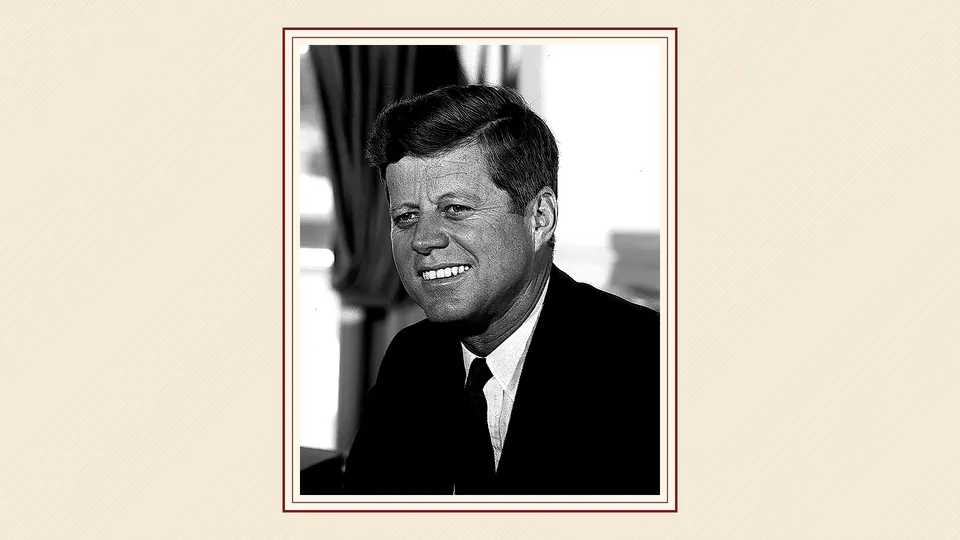
John F. Kennedy was the 35th president of the United States, serving from January 20, 1961, until his assassination in Dallas on November 22, 1963. A Massachusetts Democrat and World War II Navy veteran, he guided the country through the Cuban Missile Crisis, signed the first treaty limiting nuclear tests, founded the Peace Corps, set the goal of landing an American on the Moon and asked Congress for a major civil rights law.
On this page
- Who was John F. Kennedy before he became president?
- How did Kennedy win the 1960 election?
- What did John F. Kennedy do as president?
- What were Kennedy's controversies, and how do historians judge him?
- How was John F. Kennedy assassinated?
- What is John F. Kennedy's legacy?
- Frequently Asked Questions
- Our Take
- Sources
Key Takeaways
- Kennedy was born in Brookline, Massachusetts, on May 29, 1917, and served in the House and Senate before winning the presidency in 1960.
- At 43 years and 236 days, he was the youngest person ever elected president; Theodore Roosevelt was younger but took office by succession.
- His biggest tests were in foreign policy: the failed Bay of Pigs landing in 1961, the Cuban Missile Crisis in 1962 and the Limited Test Ban Treaty in 1963.
- He was shot in Dallas on November 22, 1963. The Warren Commission (1964) concluded Lee Harvey Oswald fired the shots; a House committee (1979) concluded there was "probably" a conspiracy but could not identify anyone else.
- In the 2021 C-SPAN survey of historians, Kennedy ranked 8th among U.S. presidents.
Who was John F. Kennedy before he became president?
John Fitzgerald Kennedy was born on May 29, 1917, in Brookline, Massachusetts, a suburb of Boston [1]. Both of his parents came from wealthy Boston families with political histories. His father, Joseph P. Kennedy, was a businessman who became U.S. ambassador to Great Britain in 1938, and John was one of nine children [2].
Kennedy graduated from Harvard in 1940. His senior essay, written after time in England in 1938, became the bestselling book Why England Slept. During World War II he commanded a Navy patrol torpedo boat, PT-109, in the South Pacific. In August 1943 a Japanese destroyer rammed the boat, and Kennedy received the Navy and Marine Corps Medal and a Purple Heart for his service [2].
His political rise was fast. Boston voters sent him to the U.S. House in 1946, when he was 29. In 1952 he defeated the Republican senator Henry Cabot Lodge Jr. for a U.S. Senate seat, and on September 12, 1953, he married Jacqueline Lee Bouvier [1]. He lost a bid for the 1956 Democratic vice presidential nomination to Estes Kefauver, won the 1957 Pulitzer Prize for biography for Profiles in Courage, and was reelected to the Senate in 1958. Behind the public image of youth and energy, he lived with Addison's disease, malaria picked up in the Pacific and chronic back pain [2].
How did Kennedy win the 1960 election?
Kennedy won one of the closest presidential races in U.S. history. He beat Republican Vice President Richard M. Nixon by fewer than 120,000 votes out of a record 68.8 million cast, and took 303 electoral votes to Nixon's 219, with Virginia's Harry F. Byrd receiving 15 [3].
Two issues shaped the race. The first was age: Kennedy was 43 and Nixon 47, and Kennedy's youth was treated as a hurdle. The second was religion. Some voters worried that a Roman Catholic president would answer to his church, so Kennedy took questions from leading Protestant clergy in Houston, who said they were satisfied with his answers. The campaign also featured four televised debates in late September and early October, and about seventy million people watched the first one [3].
Kennedy took the oath on January 20, 1961, at 43 years and 236 days old, which makes him the youngest person ever elected president. Theodore Roosevelt was younger when he took office, but he reached the presidency through succession; our guide to the youngest U.S. presidents explains the difference. In his inaugural address Kennedy told Americans: "Ask not what your country can do for you," but "ask what you can do for your country" [8]. He was the 35th president, as our list of presidents in order shows.
What did John F. Kennedy do as president?
Kennedy's presidency lasted about two years and ten months, and much of it was spent on the Cold War. His record is a mix of an early failure in Cuba, a nuclear standoff that ended without war, and new programs that outlived him. The table lists the main events in order.
| Year | Event | Why it mattered |
|---|---|---|
| 1961 | Peace Corps created by Executive Order 10924 on March 1; Congress authorized it on September 22 [9] | Volunteers have since served in more than 140 countries |
| 1961 | Alliance for Progress announced in March [5] | Aid program for social and economic conditions in Latin America |
| 1961 | Bay of Pigs landing by about 1,500 anti-Castro Cuban exiles on April 17 [5] | Castro's forces overwhelmed them quickly; an early, public failure |
| 1961 | Moon goal set before Congress on May 25 [15] | Launched the Apollo push; Apollo 11 landed on July 20, 1969 |
| 1961 | Vienna summit with Khrushchev in June; Berlin Wall built in mid-August [5] | Berlin became the sharpest point of East-West tension |
| 1962 | Cuban Missile Crisis, October 14 to 28 [16] | Soviet missiles were withdrawn and a Washington to Moscow hotline followed |
| 1963 | Civil rights address on June 11 [18] | Asked Congress for a law on equal access to public places |
| 1963 | Limited Test Ban Treaty signed in Moscow on August 5 [10] | First treaty to ban nuclear tests in the atmosphere, in space and underwater |
The Moon goal was stated plainly: "this nation should commit itself to achieving the goal, before this decade is out, of landing a man on the moon" [15]. Kennedy did not live to see it, but Apollo 11 met the deadline in July 1969.
The most dangerous moment came in October 1962. A U.S. U-2 plane photographed Soviet missile sites under construction in Cuba on October 14. Kennedy announced a naval "quarantine" of Cuba in a televised address on October 22, and on October 28 Soviet leader Nikita Khrushchev said the missiles would be dismantled. In private, Robert Kennedy had told the Soviet ambassador that U.S. Jupiter missiles in Turkey would also go, and they were removed in April 1963 [16]. Our article on why the Cuban Missile Crisis happened tells the full story, and why the Cold War started explains the rivalry behind it.
At home, Kennedy called his agenda the "New Frontier." He won an increase in the minimum wage, but Congress watered down his tax-cut plans [4]. Civil rights forced its way onto his desk. After the 1961 Freedom Rides and the riot that surrounded James Meredith's enrollment at the University of Mississippi on October 1, 1962, Kennedy went on television on June 11, 1963, and said, "We are confronted primarily with a moral issue" [18]. The bill he sent to Congress became the Civil Rights Act, which President Lyndon B. Johnson signed on July 2, 1964 [11].
What were Kennedy's controversies, and how do historians judge him?
The record contains clear setbacks. The Bay of Pigs was an early error. In Vietnam, Kennedy increased U.S. support in 1961 and sent in Special Forces, and by the end of his presidency 16,000 American military advisers were serving there [5]. His health problems were also far more serious than the public image suggested, and he relied on painkillers and steroids [2].
Interpretations have shifted over time, and the Miller Center's Marc J. Selverstone describes three broad stages [7]:
- Admiring accounts. The first and most influential studies were written by members of Kennedy's own administration and were openly admiring.
- Critical accounts. Later historians focused on the less flattering side of the Kennedy family's dealings and on Kennedy's personal conduct.
- A middle ground. More recent work weighs both. On this view, Kennedy improved as a leader after the fall of 1962, but civil rights gains came mostly in spite of, not because of, the White House, and Vietnam remained unresolved.
Because he died after less than three years, any verdict on Kennedy is partly a judgment about what he might have done, and historians openly disagree about that. Even so, his reputation among scholars remains high. In the 2021 C-SPAN Presidential Historians Survey, which drew on 142 historians and observers, Kennedy ranked 8th overall [19].
How was John F. Kennedy assassinated?
On November 22, 1963, Kennedy and his wife were riding in a motorcade through Dealey Plaza in Dallas, Texas, on a political trip. Shots were fired from a nearby warehouse. Kennedy was mortally wounded and Texas Governor John Connally was also hit [6]. The president was taken to Parkland Memorial Hospital and pronounced dead at 1 p.m. At 2:38 p.m., aboard the presidential plane at Love Field, Lyndon B. Johnson was sworn in as the 36th president by Judge Sarah T. Hughes [12].
Police arrested Lee Harvey Oswald, an employee at the warehouse, within hours. Two days later, Dallas nightclub owner Jack Ruby shot and killed Oswald while he was being moved to another jail. Hundreds of thousands of people filed past Kennedy's coffin in the Capitol rotunda, and on November 25 he was buried at Arlington National Cemetery after a state funeral attended by representatives of ninety-two nations [6]. He was 46. Kennedy was the fourth and most recent president to be assassinated in office; see also what happened on November 22.
Two official investigations reached different conclusions about whether anyone else was involved. The Warren Commission, created on November 29, 1963, found that the shots were fired by Oswald from a sixth floor window of the Texas School Book Depository, and that it had "found no evidence" that Oswald or Ruby was part of any conspiracy, domestic or foreign [12]. In 1979 the House Select Committee on Assassinations agreed that Oswald fired three shots and that his third shot killed the president. Citing acoustic evidence that it said showed "a high probability that two gunmen fired" at the president, it also concluded that Kennedy "was probably assassinated as a result of a conspiracy," while stating that it could not identify another gunman. The same committee found that the Soviet and Cuban governments, organized crime as a group, and the CIA, FBI and Secret Service were not involved [13].
The National Archives now holds the President John F. Kennedy Assassination Records Collection, more than six million pages plus photographs, films, sound recordings and artifacts. Most of it has been declassified, with major releases between 2017 and 2025 [14].
What is John F. Kennedy's legacy?
Several of Kennedy's goals were completed by others after his death. Johnson signed the civil rights bill in 1964, and Apollo 11 landed on the Moon in 1969. The Peace Corps he founded still sends volunteers abroad, and the National Archives notes that hundreds of thousands of Americans have served in more than 140 countries [9].
The Limited Test Ban Treaty, signed in Moscow by the United States, the United Kingdom and the Soviet Union, was ratified by the Senate on September 24, 1963, and entered into force on October 10, 1963 [10]. It banned nuclear tests in the atmosphere, in space and underwater, though not underground [17]. Together with the hotline set up after the missile crisis, it was one of the first concrete steps the two superpowers took to lower the risk of nuclear war.
Kennedy's death also shaped how Americans remember him. The Miller Center notes that in the nation's popular memory he still "commands fascination as a compelling, charismatic leader" [7]. His inauguration day, January 20, and the day he died remain two of the best-known dates of the Cold War era.
Frequently Asked Questions
Was John F. Kennedy the youngest president?
He was the youngest ever elected, at 43 years and 236 days old when he was inaugurated on January 20, 1961. Theodore Roosevelt was younger, 42, when he succeeded William McKinley in 1901, so Roosevelt is the youngest person to serve. Our youngest president guide compares the two records.
How long was Kennedy president?
Kennedy served from January 20, 1961, to November 22, 1963, a total of 1,036 days, or about two years and ten months. His vice president, Lyndon B. Johnson, took the oath that afternoon and served out the term.
How old was John F. Kennedy when he died?
He was 46. Kennedy was born on May 29, 1917, and died in Dallas on November 22, 1963, about six months after his 46th birthday.
Who was Kennedy's wife?
Kennedy married Jacqueline Lee Bouvier on September 12, 1953, about a year after they met. She lived from 1929 to 1994 {{cite:miller-john-f-kennedy-key-events}}.
Our Take
We think Kennedy is best understood as a president whose record and reputation pull in different directions. The record, as the Miller Center lays it out, includes a costly misstep at the Bay of Pigs, a growing commitment in Vietnam and slow movement on civil rights until 1963. It also includes his handling of the missile crisis and a test ban treaty that the National Archives and the Office of the Historian document as real, lasting achievements. His reputation adds to that the eloquence of his speeches and the shock of his death. In our view, readers get the clearest picture by separating the two: judge what the documents show he did, and treat claims about what he would have done next as interpretation, not fact. Our editorial policy explains how we handle that line.
Sources
- John F. Kennedy: Key Events and Biography. Miller Center.
- John F. Kennedy: Life Before the Presidency. Miller Center.
- John F. Kennedy: Campaigns and Elections. Miller Center.
- John F. Kennedy: Domestic Affairs. Miller Center.
- John F. Kennedy: Foreign Affairs. Miller Center.
- John F. Kennedy: Death of the President. Miller Center.
- John F. Kennedy: Impact and Legacy. Miller Center.
- President John F. Kennedy's Inaugural Address. National Archives.
- Executive Order 10924: Establishment of the Peace Corps. National Archives.
- Nuclear Test Ban Treaty. National Archives.
- Civil Rights Act. National Archives.
- Report of the President's Commission on the Assassination of President Kennedy: Chapter 1, Summary and Conclusions. National Archives.
- Report of the Select Committee on Assassinations: Summary of Findings and Recommendations. National Archives.
- JFK Assassination Records. National Archives.
- 60 Years Ago, President Kennedy Proposes Moon Landing Goal in Speech to Congress. NASA.
- The Cuban Missile Crisis, October 1962. Office of the Historian.
- The Limited Test Ban Treaty, 1963. Office of the Historian.
- Radio and Television Report to the American People on the Soviet Arms Buildup in Cuba. The American Presidency Project, 1962.
- Trump Ranks 41st in C-SPAN Presidential Survey. Spectrum News, 2021.
Where historians disagree, we say so and show the main views. Dates are checked against two sources; legend and documented record are labeled separately. Spotted an error? Tell us.
Keep Reading
How Many Presidents Have Been Assassinated?
Four U.S. presidents were assassinated: Lincoln, Garfield, McKinley and Kennedy. When and where each died, who took over, and how protection changed.
Who Was the Youngest U.S. President?
Theodore Roosevelt was the youngest U.S. president at 42 years, 322 days; John F. Kennedy was the youngest elected. See the ranked list and the age-35 rule.
Why Did the Cuban Missile Crisis Happen?
Why did the Cuban Missile Crisis happen? How the Bay of Pigs, the U.S. nuclear lead and missiles in Turkey led Khrushchev to Cuba, and how October 1962 ended.
U.S. Presidents in Order: The Complete List
All 47 U.S. presidencies in order, from George Washington in 1789 to Donald Trump in 2025, with term dates, ages and how each presidency came to an end.
Why Did the Cold War Start?
Why did the Cold War start? How the U.S.-Soviet alliance broke down from Yalta and Potsdam to the Truman Doctrine, Berlin Airlift, NATO and the Soviet bomb.
Who Was Theodore Roosevelt? Life, Presidency and Legacy
Theodore Roosevelt, the 26th president, broke up trusts, protected about 230 million acres and won the Nobel Peace Prize. His life, record and legacy.