Why Did the Cuban Missile Crisis Happen?
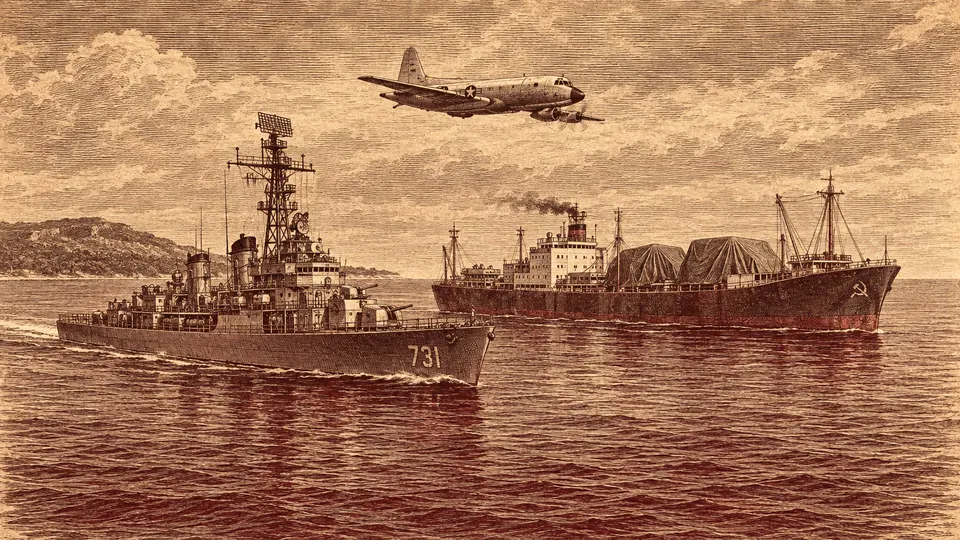
Quick Answer
The Cuban Missile Crisis happened because Soviet leader Nikita Khrushchev secretly sent nuclear missiles to Cuba in 1962. He wanted to protect Fidel Castro's government from a U.S. invasion after the Bay of Pigs, offset America's large lead in nuclear weapons, and answer U.S. missiles in Turkey. When a U-2 spy plane photographed the sites on October 14, 1962, President John F. Kennedy demanded their removal, and both sides came close to war.
On this page
- What happened during the Cuban Missile Crisis?
- Why did Khrushchev put nuclear missiles in Cuba?
- How did the United States find the missiles and respond?
- Why was October 27 the most dangerous day?
- How did the crisis end, and what was the secret deal?
- How do historians explain the causes today?
- What changed after the Cuban Missile Crisis?
- Frequently Asked Questions
- Our Take
- Sources
Key Takeaways
- In July 1962, Khrushchev and Castro secretly agreed to place Soviet nuclear missiles in Cuba to deter another U.S. invasion.
- Soviet motives went beyond Cuba: the United States led in strategic nuclear weapons by about 4 to 1, and U.S. Jupiter missiles sat in Turkey.
- Kennedy chose a naval "quarantine" instead of an air strike, announced on October 22, 1962.
- The crisis ended on October 28 with a public Soviet pledge to remove the missiles, a U.S. promise not to invade Cuba, and a secret promise to pull the Jupiters out of Turkey.
- Documents released decades later showed the danger was greater than leaders knew, including tactical nuclear weapons that U.S. intelligence never detected.
What happened during the Cuban Missile Crisis?
The Cuban Missile Crisis was a confrontation between the United States and the Soviet Union in October 1962 over Soviet nuclear missiles in Cuba. The U.S. Office of the Historian calls it part of "the most dangerous confrontation between the United States and the Soviet Union during the Cold War" [2].
The crisis is often called the "Thirteen Days." That count runs from Tuesday, October 16, when Kennedy received the first hard information at 9 a.m., to Khrushchev's announcement on Sunday, October 28. Kennedy himself described that Tuesday morning briefing in his October 22 address [5]. The National Security Archive argues the nuclear crisis really lasted 59 days, because Soviet warheads reached Cuba on October 4, 1962, and did not leave until December 1 [9].
The timeline below follows the thirteen days, with the U-2 flight that started them and the end of the naval quarantine that closed the public crisis. For other events on these dates, see what happened on November 20.
Why did Khrushchev put nuclear missiles in Cuba?
Khrushchev had several reasons, and historians still weigh them differently. The documents point to three main ones.
Defending Cuba. In April 1961, a CIA-trained force of Cuban exiles landed at the Bay of Pigs and was defeated within two days. Castro's government then moved closer to the Soviet Union, and the Kennedy administration began Operation Mongoose, a covert campaign against Castro [2]. The Miller Center gives about 1,500 exiles in the landing of April 17, 1961 [8]. In July 1962, Khrushchev and Castro reached a secret agreement to place Soviet nuclear missiles in Cuba to deter any future invasion [1]. In his memoirs, Khrushchev said the missiles would restrain the United States from "precipitous military action against Castro's government" [9].
The nuclear balance. The United States held a strategic nuclear advantage of about 4 to 1, and as high as 17 to 1 by some measures, according to the National Security Archive [9]. From Cuba, the missiles could reach most of the continental United States within minutes. The Miller Center says Khrushchev wanted to "neutralize the massive American advantage in nuclear weapons," as well as protect Castro and compete with China for the loyalty of revolutionaries worldwide [8].
The missiles in Turkey. The United States had nuclear missiles in Turkey that targeted the Soviet Union [8]. Biographer William Taubman, as summarized by the National Security Archive, argues the Cuban deployment gave Americans "a taste of their own medicine." Historians Aleksandr Fursenko and Timothy Naftali report Khrushchev's own image for the plan: why not "throw a hedgehog at Uncle Sam's pants" [9].
How did the United States find the missiles and respond?
Through 1962, U.S. surveillance flights tracked a Soviet arms buildup in Cuba. On September 4, Kennedy publicly warned against placing offensive weapons there. On October 14, a U-2 photographed medium-range and intermediate-range ballistic missile sites under construction [1]. The National Archives holds a briefing board from that flight showing a launch site at San Cristobal, and notes that Kennedy had warned Khrushchev again on September 13 [6]. The Miller Center puts the Soviet force at about 42,000 troops [8].
Kennedy's advisers, known as the ExComm, argued for a week over what to do. The Office of the Historian says all of the Joint Chiefs of Staff favored an air strike followed by invasion, while others preferred stern warnings. Kennedy chose a middle course [1].
| Option | Who favored it | Outcome |
|---|---|---|
| Air strike, then invasion | All of the Joint Chiefs of Staff | Not chosen |
| Stern warnings | Other advisers | Not chosen on its own |
| Naval "quarantine" of Cuba | Kennedy's middle course | Chosen; the word avoided "blockade," which implied a state of war, and allowed support from the Organization of American States |
On the evening of October 22, 1962, Kennedy told the nation on television that "unmistakable evidence has established the fact that a series of offensive missile sites is now in preparation" on Cuba. He said some missiles were "capable of striking Washington, D.C., the Panama Canal, Cape Canaveral, Mexico City," and that sites still under construction could reach "as far north as Hudson Bay, Canada, and as far south as Lima, Peru." He announced that "a strict quarantine on all offensive military equipment under shipment to Cuba is being initiated" and warned that the United States would treat "any nuclear missile launched from Cuba" as "an attack by the Soviet Union on the United States" [5]. The Joint Chiefs raised U.S. forces to DEFCON 3 that day, and later to DEFCON 2 [1]. For more on the president at the center of these choices, see our profile of John F. Kennedy.
Kennedy picked the word "quarantine" on purpose, because a "blockade" would have been an act of war.
Why was October 27 the most dangerous day?
On October 24, Khrushchev called the quarantine an "act of aggression." Some Soviet ships then turned back, and others were stopped, found to carry no offensive weapons and allowed through [1]. On October 26, Khrushchev sent a long letter offering a way out. He wrote that "we and you ought not now to pull on the ends of the rope in which you have tied the knot of war," and linked the weapons question to a U.S. promise not to invade Cuba [3].
Then, on Saturday, October 27, events nearly ran out of control:
- A second Khrushchev message added a new demand: remove the U.S. Jupiter missiles from Turkey [1].
- A U.S. U-2 was shot down over Cuba the same day.
- Castro had ordered his anti-aircraft crews to fire on U.S. reconnaissance planes, and he dictated a message recommending a Soviet preemptive strike [9].
- That night, U.S. ships signaling the Soviet submarine B-59 to surface were mistaken for an attack. Captain Valentin Savitsky called for the preparation of a torpedo with a nuclear warhead. Vasily Arkhipov, the brigade's chief of staff, saw that the Americans were signaling and calmed him, and the order was never carried out [10].
None of this was fully visible in Washington. Soviet records later showed that tactical nuclear warheads were moved to their launchers on October 26 and were ready on October 27, and U.S. intelligence never knew they were on the island. Gen. Anatoly Gribkov disclosed in 1992 that the Soviet plan included 80 tactical nuclear weapons from the start [9].
How did the crisis end, and what was the secret deal?
On the night of October 27, Kennedy ignored Khrushchev's second message and answered the first. He proposed that the Soviet missiles be removed under United Nations supervision in exchange for a U.S. guarantee not to attack Cuba. At the same time, Attorney General Robert Kennedy met Soviet Ambassador Anatoly Dobrynin in secret and told him the United States planned to remove its Jupiter missiles from Turkey soon, but that this could not be part of any public deal. On October 28, Khrushchev announced that the Soviet missiles would be dismantled and removed [1].
The quarantine stayed in place until the Soviets also agreed to remove their IL-28 bombers. On November 20, Kennedy said Khrushchev had informed him that "all of the IL-28 bombers in Cuba will be withdrawn in thirty days," and lifted the quarantine [6]. The Jupiter missiles left Turkey in April 1963 [1].
The Turkey trade was kept secret for decades, so for years the public story was that Khrushchev simply backed down. The National Security Archive describes this part of the bargain as "TOP SECRET" for decades [9].
How do historians explain the causes today?
Views of the crisis have changed as new records appeared. At the time, U.S. policymakers assumed the missiles were meant to put pressure on Berlin [9]. Khrushchev had renewed his threat to "solve" the Berlin problem at the Vienna summit with Kennedy in June 1961, and the Miller Center still links the missiles to "any new Berlin gambit" [8].
Later evidence pushed in other directions. The National Security Archive notes that the Soviet Presidium notes barely mention Berlin, and that defending Cuba was a leading Soviet motive. At a 1989 conference in Moscow, former Defense Secretary Robert McNamara conceded that the Soviet decision rested on a misconception that U.S. policy had partly caused, calling it "a clearly understandable one." The Archive concludes that it took U.S. advisers decades to accept that American pressure on Cuba, including Operation Mongoose and invasion planning, had raised Soviet fears [9].
| View | Main cause it stresses | Where it appears |
|---|---|---|
| Soviet gamble over Berlin | Khrushchev testing Kennedy for leverage in Europe | U.S. officials in 1962; the Miller Center notes the Berlin link |
| Defense of Cuba | Fear of a U.S. invasion after the Bay of Pigs and Mongoose | Khrushchev's memoirs; Soviet Presidium notes, per the National Security Archive |
| Strategic balance | A quick way to offset a U.S. lead of about 4 to 1 | Miller Center; National Security Archive |
| Mirror of Turkey | Giving Americans "a taste of their own medicine" | William Taubman, per the National Security Archive |
These views are not exclusive. Most accounts combine them, and they differ mainly on which motive mattered most.
What changed after the Cuban Missile Crisis?
Both leaders had struggled to read each other's intentions, so Washington and Moscow set up a direct communications link, the "Hotline." The two governments also began to rethink the arms race [1]. The Office of the Historian says the rapid escalation of the crisis "compelled leaders" in both countries to seek a test ban agreement [4]. The Limited Test Ban Treaty, signed in Moscow on August 5, 1963, banned nuclear tests in the atmosphere, in outer space and under water [7].
The crisis did not end the Cold War, but it pushed both sides toward their first real limits on nuclear testing. To see how the rivalry began, read why the Cold War started, and for how it wound down in Europe, see why the Berlin Wall fell. More stories from these decades are collected in our Cold War era hub and the Why section.
Frequently Asked Questions
How long did the Cuban Missile Crisis last?
The public crisis is usually counted as thirteen days, from Kennedy's briefing on October 16 to Khrushchev's announcement on October 28, 1962. {{cite:the-radio-and-television-report-to}} The quarantine ended on November 20. The National Security Archive counts 59 days, the time Soviet nuclear warheads spent in Cuba, from October 4 to December 1, 1962. {{cite:national-the-cuban-missile-crisis-60}}
Who won the Cuban Missile Crisis?
Each side got something. The Soviet missiles left Cuba, and the Office of the Historian says the outcome strengthened Kennedy's standing at home and abroad. {{cite:office-the-cuban-missile-crisis-october}} Khrushchev got a U.S. pledge not to invade Cuba and the secret removal of the Jupiter missiles from Turkey in April 1963. {{cite:miller-john-f-kennedy-foreign-affairs}}
What do Cubans call the crisis?
In Cuba it is known as the "October Crisis," according to the National Security Archive. {{cite:national-the-cuban-missile-crisis-60}}
How close did the world come to nuclear war?
Closer than leaders knew at the time. On October 27, a U-2 was shot down, Soviet tactical nuclear weapons were ready for use, and a Soviet submarine captain called for preparing a nuclear torpedo before an officer on board calmed him down. {{cite:national-the-underwater-cuban-missile}}
Our Take
We think the Cuban Missile Crisis happened because each side read the other's moves as aggression and its own as defense. The Bay of Pigs and Operation Mongoose convinced Moscow and Havana that an invasion was coming; the U.S. lead in nuclear weapons and the Jupiters in Turkey gave Khrushchev reasons to want a bold equalizer. To Washington, missiles so close to American shores looked like a sudden threat that could not be left in place. The records released since 1989 change the lesson more than the outline. The secret Turkey trade, the undetected tactical warheads and the B-59 submarine show that the peaceful ending owed a great deal to restraint, back channels and luck. We would not credit one leader alone: Kennedy's choice of a quarantine and Khrushchev's decision to step back both mattered.
Sources
- The Cuban Missile Crisis, October 1962. Office of the Historian.
- The Bay of Pigs Invasion and its Aftermath, April 1961 to October 1962. Office of the Historian.
- Foreign Relations of the United States, 1961 to 1963, Volume XI, Document 84: Telegram From the Embassy in the Soviet Union to the Department of State. Office of the Historian, 1962.
- The Limited Test Ban Treaty, 1963. Office of the Historian.
- Radio and Television Report to the American People on the Soviet Arms Buildup in Cuba. The American Presidency Project, 1962.
- Aerial Photograph of Missiles in Cuba (1962). National Archives.
- Test Ban Treaty (1963). National Archives.
- John F. Kennedy: Foreign Affairs. Miller Center.
- The Cuban Missile Crisis @ 60: Nuclear Crisis Lasted 59 Days, Not Just 13. National Security Archive, 2022.
- The Underwater Cuban Missile Crisis at 60. National Security Archive, 2022.
Where historians disagree, we say so and show the main views. Dates are checked against two sources; legend and documented record are labeled separately. Spotted an error? Tell us.
Keep Reading
Why Did the Berlin Wall Fall?
Why did the Berlin Wall fall in 1989? Gorbachev's reforms, the East German exodus and protests, a botched press conference and Western pressure, explained.
Why Did the French Revolution Start?
Why did the French Revolution start? The debt crisis, the three estates, bread prices, the events of 1789, and how historians from Lefebvre to Furet explain it.
What Happened at Chernobyl? Why the Reactor Exploded
On April 26, 1986, Chernobyl's Unit 4 reactor exploded during a safety test. How design flaws and operator choices combined, and what each death toll counts.
Why Did the Cold War Start?
Why did the Cold War start? How the U.S.-Soviet alliance broke down from Yalta and Potsdam to the Truman Doctrine, Berlin Airlift, NATO and the Soviet bomb.
Why Did the Great Depression Happen?
Why did the Great Depression happen? The 1920s boom, the 1929 crash, bank panics, Fed mistakes, the gold standard, Smoot-Hawley, Dust Bowl and what ended it.
Why Did the Civil War Start?
Why did the Civil War start? What the seceding states said in their own words, the fight over slavery in the West, Lincoln's election, and Fort Sumter.