Why Did the French Revolution Start?
Quick Answer
The French Revolution started in 1789 because the French monarchy ran out of money and could not make its privileged elites accept new taxes. War debts, including the cost of helping the American Revolution, pushed King Louis XVI to call the Estates-General, which had not met since 1614. When the commoners demanded a fair vote, a money crisis became a political revolution, sharpened by poor harvests and expensive bread.
On this page
Key Takeaways
- The immediate cause was a royal budget crisis: France was near bankruptcy by the late 1780s, partly because of its costly support for the American Revolution.
- Nobles and clergy kept tax privileges, and the old voting rules let them outvote the Third Estate, which represented about 98 percent of the people.
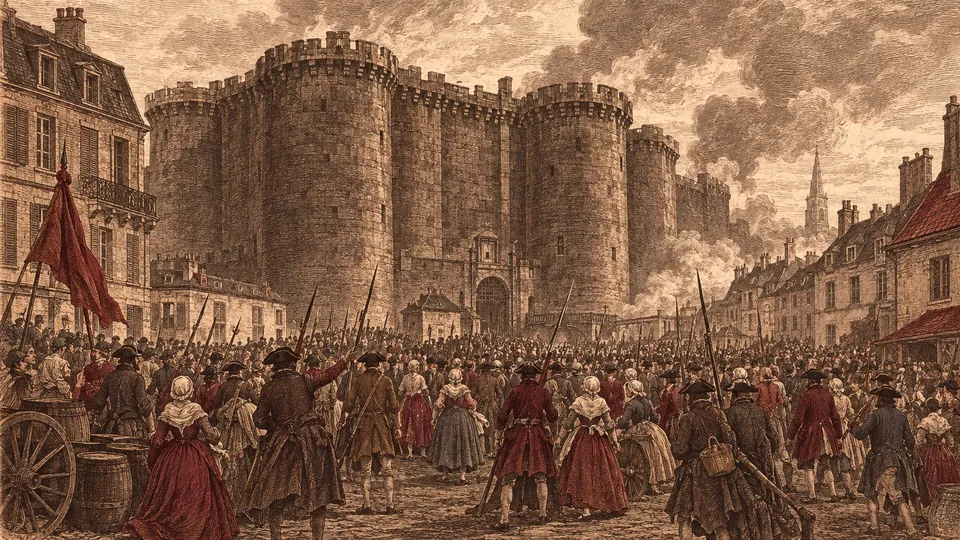
- On June 17, 1789, the Third Estate declared itself the National Assembly; on July 14, 1789, Parisians stormed the Bastille.
- Historians disagree about the deeper causes: the older social (Marxist) view of Georges Lefebvre and Albert Soboul, the revisionist challenge of Alfred Cobban and François Furet, and later work on political culture and on the king's own choices.
What was France like before 1789?
France in the 1780s was a kingdom of privilege. Its society was divided into three traditional "orders," or estates: the clergy, the nobility and the common people [3]. Privileges passed mainly through inheritance, although they could also be bought and sold, and this tended to limit social mobility (same source).
The kingdom was large and mostly rural. Of the nearly 30 million French people under Louis XVI, about 80 percent lived in villages of 2,000 people or fewer, and Paris was home to about 600,000 by 1789 [3]. Historians have estimated that in lean years, 90 percent of peasants lived at or below the subsistence level (same source).
The Third Estate, everyone who was neither clergy nor noble, represented about 98 percent of the people, yet under the old rules it could still be outvoted by the other two estates [1]. Because nobles dominated the clergy, most representatives in practice came from the two privileged orders [3].
How did a money crisis turn into a political crisis?
The French Revolution began as a budget crisis that the old system could not solve. By the late 1780s France was near bankruptcy, a result of its costly involvement in the American Revolution and the extravagant spending of Louis XVI and his court [1]. France had signed a Treaty of Alliance with the United States on February 6, 1778, and later sent troops and naval support that proved crucial to the British surrender at Yorktown in 1781; it even granted a loan to the Americans in 1782 despite its own financial troubles [7]. That help is part of the story of George Washington's war, and it came with a bill.
The crown's first fix was tax reform. On August 20, 1786, Controller General Charles Alexandre de Calonne presented reform proposals to Louis XVI [2], including a universal land tax that would have ended the aristocracy's exemption [1]. An Assembly of Notables met on February 22, 1787, discussed raising taxes and rejected it; Calonne was replaced in April 1787 by Étienne Charles de Loménie de Brienne [2].
The law courts, called parlements, resisted too. They had clashed with the crown for decades: in 1770 Louis XV dissolved all thirteen parlements, and the Parlement of Paris argued that the government needed its participation to "ensure sufficient credit to cover the mounting deficit" [4]. In August 1787 the Parlements of Paris and Bordeaux were exiled, and in June 1788 a revolt broke out in Grenoble over the local parlement [2].
Out of options, the crown gave in. On August 8, 1788, the Estates-General was summoned for May 1789, and on August 24 Jacques Necker replaced Brienne at the head of the finances [2]. The Estates-General had not met since 1614 [1]. In September 1788 the Parlement of Paris demanded the "forms of 1614," meaning separate voting by estate, and on December 27, 1788, Necker agreed to double the Third Estate's representation [2]. The open question was whether the deputies would vote by head or by order.
What happened in 1789?
The Estates-General opened at Versailles on May 5, 1789 [2]. The Third Estate wanted voting by head rather than by estate, and on June 17 it met alone and took the title National Assembly [1]. Three days later, on June 20, locked out of their meeting hall, the deputies swore in an indoor tennis court not to separate until France had a constitution, the Tennis Court Oath [2]. On June 27, Louis XVI ordered the nobles and clergy to join the Assembly (same source).
Paris then moved. Necker was dismissed on July 11, and Parisians learned of it on July 12 [5]. On July 14, 1789, crowds stormed the Bastille fortress, looking for gunpowder and weapons [1]. The fortress was a symbol more than a prison: the seven inmates freed that day included no actual victims of political oppression [5].
In the countryside, a panic known as the Great Fear spread as peasants rose against what remained of feudalism [2]. On the night of August 4, 1789, the National Assembly abolished feudalism, and on August 26 it adopted the Declaration of the Rights of Man and of the Citizen [1]. On October 5, women from Paris marched on Versailles, and the royal family was forced back to Paris [2].
Did hunger and new ideas cause the revolution?
Hunger made the crisis dangerous. Several years of poor harvests, drought, cattle disease and rising bread prices fueled unrest in the late 1780s [1]. In a country where most peasants lived close to subsistence in bad years, expensive bread turned a quarrel at Versailles into a matter of survival in towns and villages.
Ideas gave the crisis a direction. The revolutionaries aimed to replace the institutions of hereditary monarchy with new ones built on the principles of the Enlightenment, justified by reason rather than tradition [6]. Pamphlets poured out once the Estates-General was called; one of the most influential was written by a clergyman, the Abbé Sieyès (same source), and his "What is the Third Estate?" appeared in January 1789 [2].
America mattered here as well. Virginia's Bill of Rights and Thomas Jefferson's Declaration of Independence had an immediate influence on the French declaration of rights [6]. Hunger explains why ordinary people acted in 1789; Enlightenment and American ideas help explain what they demanded.
Still, social distress alone does not explain the timing. The Roy Rosenzweig Center's own essay notes that social unrest "may not necessarily have been the basic cause" of the outbreak, and it raises the possibility that the nobility's fear of losing its privileges played a role [3]. That is exactly where historians part ways.
Why do historians disagree about the causes?
Historians agree on what happened in 1789, but not on what it meant or why it happened. The debate has moved through several schools, summarized in Pamela Pilbeam's survey of the historiography [8].
| View | Main historians | What caused the revolution |
|---|---|---|
| Social or Marxist interpretation | Georges Lefebvre, Albert Soboul | A rising bourgeoisie overthrew a feudal order; 1789 was made by and for the bourgeoisie |
| Revisionist challenge | Alfred Cobban, François Furet, Denis Richet | A political crisis over power and legitimacy; the revolutionary bourgeoisie were officials, lawyers and landowners, not capitalists |
| Political culture | François Furet, Keith Baker, Lynn Hunt | New political language, symbols and ideas turned a crisis into a revolution |
| Contingency and choices | William Doyle, Timothy Tackett | Chance and personal decisions, above all Louis XVI's indecision and failure to reform |
The social interpretation. According to Pilbeam, French academic historians led by Georges Lefebvre held that the 1789 Revolution was made by and for the bourgeoisie, in line with the Marxist idea of history moving through class struggle. Albert Soboul opened his 1965 account by calling the Revolution the arrival of bourgeois and capitalist society in French history [8].
The revisionist challenge. The British historian Alfred Cobban attacked this view in his 1954 inaugural lecture, "The Myth of the French Revolution," and in The Social Interpretation of the French Revolution (1964). Using Lefebvre's own research, he pointed out that the Third Estate deputies of 1789 were mostly bureaucrats, state servants and professionals, especially lawyers and landowners, not capitalists. In France, François Furet, author of Penser la Révolution française (1978), argued that 1789 was less about class interest than about challenges to political legitimacy, and he revived Alexis de Tocqueville's idea that the revolution continued earlier attempts at reform [8].
Political culture. Historians influenced by this turn looked at how revolutionaries spoke and acted. Keith Baker, a student of Cobban, became known for his work on the revolutionary content of philosophical ideas in 1789 [8]. Lynn Hunt's Politics, Culture, and Class in the French Revolution (1984) shifted the discussion toward "the discovery of the potential of political action" to transform society [9].
Chance and choices. Pilbeam writes that the outbreak "tends now to be explained more by chance and personal decisions," with William Doyle and Timothy Tackett blaming the king for ineptitude, indecision and stubbornness in failing to reform absolutism. Peter McPhee prefers the label "minimalist" for historians who accept the revolution's huge institutional impact but stress how slowly French society changed [8].
None of these views is simply wrong. The social view explains the anger of peasants and townspeople; the revisionist and political views explain why a budget crisis became a fight over sovereignty. Readers who like this kind of debate will find a similar one in why the Roman Empire fell.
What happened after 1789?
The revolution did not stop with the Declaration of Rights. Louis XVI tried to escape the country on June 21 and 22, 1791, and the revolution grew more radical in the years that followed [5]. Its wars and upheavals eventually opened the road for a young general, Napoleon Bonaparte, whose rise is part of the same age of revolutions covered in our civil war era hub. For more questions like this one, see all our why articles.
Frequently Asked Questions
When did the French Revolution start?
Most historians date the start to 1789. The Estates-General opened on May 5, 1789, the Third Estate declared itself the National Assembly on June 17, and Parisians stormed the Bastille on July 14, 1789 {{cite:roy-liberty-equality-fraternity-timeline}}. The crisis that led there began with Calonne's reform plan in 1786.
Did the American Revolution cause the French Revolution?
It contributed. France's costly involvement in the American Revolution helped push the monarchy toward bankruptcy {{cite:history-french-revolution-timeline-key}}, and American documents such as the Declaration of Independence influenced the French Declaration of Rights. It was one cause among several, not the only one.
What were the three estates in France?
The three estates were the clergy (First Estate), the nobility (Second Estate) and everyone else (Third Estate). The Third Estate represented about 98 percent of the people but could be outvoted by the other two {{cite:history-french-revolution-timeline-key}}.
Why was the Bastille stormed?
On July 14, 1789, Parisians stormed the Bastille looking for gunpowder and weapons, days after the popular minister Necker was dismissed {{cite:history-french-revolution-timeline-key}}. Only seven prisoners were inside, but the fortress stood for royal power.
Our Take
We think the clearest answer has two layers. The trigger was fiscal: a bankrupt crown, partly bankrupted by its help to the American Revolution, could not tax its privileged orders without asking the nation. The explosion was political: once the Third Estate claimed to be the nation on June 17, 1789, the question was no longer taxes but who held sovereignty. Hunger and Enlightenment ideas gave that fight its energy and its language. On the deeper causes, we do not think readers should pick one school blindly. The Lefebvre and Soboul view still explains real social anger, while Cobban, Furet and later historians such as Doyle and Tackett show how much depended on politics and on Louis XVI's own choices.
Sources
- French Revolution: Timeline, Causes, Key Figures & Events. HISTORY, 2009.
- Liberty, Equality, Fraternity: Timeline. Roy Rosenzweig Center for History and New Media.
- Monarchy Embattled. Roy Rosenzweig Center for History and New Media.
- Paris and the Politics of Rebellion. Roy Rosenzweig Center for History and New Media.
- The Enlightenment and Human Rights. Roy Rosenzweig Center for History and New Media.
- French Alliance, French Assistance, and European Diplomacy during the American Revolution. Office of the Historian.
- The Historiography of the 1789 Revolution from Alfred Cobban to Recent Times (Pamela Pilbeam). French History and Civilization.
- Politics, Culture, and Class in the French Revolution (Lynn Hunt). University of California Press, 2004.
Where historians disagree, we say so and show the main views. Dates are checked against two sources; legend and documented record are labeled separately. Spotted an error? Tell us.
Keep Reading
Why Did the Berlin Wall Fall?
Why did the Berlin Wall fall in 1989? Gorbachev's reforms, the East German exodus and protests, a botched press conference and Western pressure, explained.
Why Did the Cuban Missile Crisis Happen?
Why did the Cuban Missile Crisis happen? How the Bay of Pigs, the U.S. nuclear lead and missiles in Turkey led Khrushchev to Cuba, and how October 1962 ended.
What Happened at Chernobyl? Why the Reactor Exploded
On April 26, 1986, Chernobyl's Unit 4 reactor exploded during a safety test. How design flaws and operator choices combined, and what each death toll counts.
Why Did the Cold War Start?
Why did the Cold War start? How the U.S.-Soviet alliance broke down from Yalta and Potsdam to the Truman Doctrine, Berlin Airlift, NATO and the Soviet bomb.
Why Did the Great Depression Happen?
Why did the Great Depression happen? The 1920s boom, the 1929 crash, bank panics, Fed mistakes, the gold standard, Smoot-Hawley, Dust Bowl and what ended it.
Why Did the Civil War Start?
Why did the Civil War start? What the seceding states said in their own words, the fight over slavery in the West, Lincoln's election, and Fort Sumter.