Napoleon Bonaparte: Rise, Empire and Fall
Quick Answer
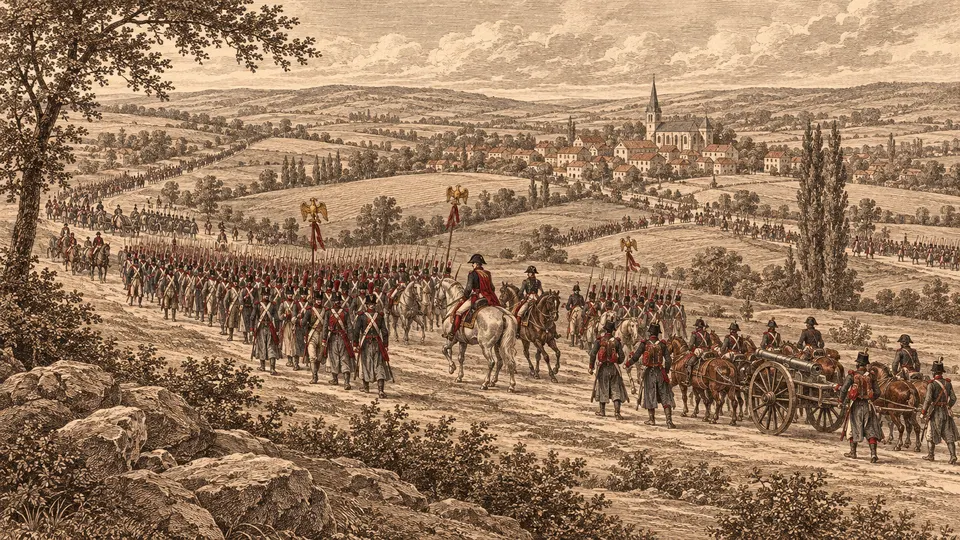
Napoleon Bonaparte (1769 to 1821) was a French general from Corsica who seized power in France in a coup in November 1799 and was crowned emperor in 1804. He gave France the Civil Code, sold Louisiana to the United States in 1803, and conquered much of Europe. Defeats in Russia and at Leipzig ended his empire, and after Waterloo in 1815 he died in exile on Saint Helena.
On this page
- Who was Napoleon Bonaparte?
- How did Napoleon rise to power so fast?
- What did Napoleon change inside France?
- Why did Napoleon sell Louisiana to the United States?
- How did Napoleon's empire fall?
- How tall was Napoleon, really?
- Was Napoleon a reformer or a conqueror?
- Frequently Asked Questions
- Our Take
- Sources
Key Takeaways
- Napoleon was born in Ajaccio, Corsica, on August 15, 1769, and trained at French military schools.
- He took power in the coup of 18 Brumaire (November 9 to 10, 1799) and was crowned Emperor of the French on December 2, 1804.
- The Civil Code of March 21, 1804, is his longest-lasting reform; it still shapes French law and influenced Louisiana's civil law.
- His 1812 invasion of Russia began with about 600,000 men; HISTORY.com estimates only about 100,000 made it out.
- He lost at Waterloo on June 18, 1815, and died in exile on the island of Saint Helena on May 5, 1821.
Who was Napoleon Bonaparte?
Napoleon Bonaparte was born on August 15, 1769, in Ajaccio, on the Mediterranean island of Corsica, the second child of the Bonaparte family [1] [3]. As a boy he was sent to mainland France for a military education.
In 1779 he entered the military college at Brienne, and in 1785 he left the École militaire in Paris ranked 42nd out of 58 [1].
The French Revolution, which began in 1789, turned France upside down while he was still a young lieutenant. Revolutionary France was soon at war with much of Europe, and a talented officer who won battles could rise far faster than under the old monarchy. Our companion article on why the French Revolution started explains the crisis that made his rise possible.
How did Napoleon rise to power so fast?
Napoleon climbed from captain to ruler of France in about six years. Each step came from a military success that he turned into political capital.
- Toulon, 1793. His artillery won the siege of Toulon against the British in December 1793, destroying ten English ships, and he was promoted to brigadier general on December 22 at the age of 24 [1] [4].
- Paris, 1795. On October 5, 1795, he used cannon against a royalist uprising in Paris, and three weeks later he was made a full general [4].
- Italy, 1796 to 1797. In March 1796 he married Joséphine de Beauharnais, then led the French army in Italy to a string of victories over Austria, ending in the 1797 Treaty of Campo Formio [3].
- Egypt, 1798 to 1799. He invaded Egypt and won the Battle of the Pyramids in July 1798, but the British destroyed most of his fleet at the Battle of the Nile in August. He left his army behind and sailed back to France in August 1799 [3].
- Brumaire, 1799. On November 9 and 10, 1799 (18 and 19 Brumaire in the revolutionary calendar), he joined a coup that overthrew the Directory, the government of the time, and became First Consul [1] [3].
On May 18, 1804, he was proclaimed Emperor of the French, and on December 2, 1804, he was crowned at Notre-Dame Cathedral in Paris [1] [3]. The coronation is one of the entries on our December 2 page.
In just over ten years, a young officer from Corsica rose to become Emperor of the French.
What did Napoleon change inside France?
Napoleon used his years as First Consul to rebuild French institutions after a decade of revolution. Several of these creations still exist. The dates below come from the Fondation Napoléon's chronology, drawn from Jean Tulard's Dictionnaire Napoléon [1].
| Date | Reform | Why it mattered |
|---|---|---|
| February 13, 1800 | Banque de France created | Gave France a national bank |
| February 17, 1800 | Prefects instituted | Gave the central government its own officials in every region |
| July 15, 1801 | Concordat signed with the pope | Repaired relations with the Catholic Church after the Revolution |
| May 1, 1802 | Lycées created | Founded state secondary schools |
| May 19, 1802 | Legion of Honor established | Created a national award for merit |
| May 20, 1802 | Slavery re-established in the colonies | Brought back slavery in the French colonies |
| March 21, 1804 | Civil Code promulgated | Set out one body of private law for all of France |
The Civil Code is the reform most people remember. It gathered 36 laws into 2,281 articles in three parts covering people, goods and property [2]. A commission led by Cambacérès, with the jurists Portalis, Tronchet, Bigot de Préameneu and Maleville, did the drafting, and Napoleon chaired the Council of State sittings that debated it, with Cambacérès standing in when he was away. In 1807 it was renamed the Code Napoléon.
The code swept away feudal property rules and divided inheritances equally among children. It also made the husband and father the head of the family: a wife could not perform legal acts without her husband's agreement, and children stayed under paternal authority until 25 [2]. HISTORY.com notes that it still forms the foundation of French civil law [3].
There is an American link too. Louisiana is the only U.S. jurisdiction with a civil law system, and the Encyclopedia of Louisiana says the French code served as a model there, although scholars still debate whether the first Louisiana Digest of 1808 drew mainly on Spanish or French law [12].
Why did Napoleon sell Louisiana to the United States?
Napoleon sold Louisiana because his plans for a French empire in the Americas collapsed in the Caribbean. France had regained Louisiana from Spain in 1800, and he hoped to retake the rich sugar colony of Saint-Domingue (today's Haiti) from a slave rebellion and use Louisiana to feed it. Yellow fever devastated the French army in Saint-Domingue, and a new war with Britain loomed, so he offered the whole territory to the American envoys [11].
President Thomas Jefferson had sent James Monroe to join Robert Livingston in Paris with authority to pay up to $10 million for New Orleans and the Floridas. Instead, on April 30, 1803, they signed a treaty for about 828,000 square miles west of the Mississippi for $15 million, roughly 4 cents an acre [9]. François Barbé-Marbois, the French treasury minister, signed for the First Consul, and the treaty's first article quotes the October 1, 1800, agreement in which Spain handed Louisiana back to France [10].
The State Department's historians add that Jefferson backed the deal even though the Constitution said nothing about buying territory. Our profile of Thomas Jefferson covers how the purchase strained his own strict reading of the Constitution.
How did Napoleon's empire fall?
Napoleon's empire fell because his enemies kept forming new coalitions, while his own wars drained France of men and money. Three blows proved decisive.
Spain and the blockade. From 1806 he tried to strangle Britain's economy with the Continental System, a ban on British trade in European ports. He also sent his armies into the Iberian Peninsula, where Spanish and Portuguese forces, aided by the British, fought the French from 1808 to 1814 and finally drove them out [3].
Russia, 1812. On June 24, 1812, he invaded Russia with more than 600,000 men from across his empire, including Italians, Poles and Germans as well as French [5]. The Russians retreated rather than fight a decisive battle. His army reached Moscow on September 14 to find it nearly deserted and soon on fire. After waiting for a surrender that never came, he ordered a retreat into the Russian winter, and HISTORY.com estimates that only about 100,000 soldiers made it out [3].
Leipzig and Paris, 1813 to 1814. Napoleon raised a new army and won at Lützen on May 2, 1813, but in the fall the allies, outnumbering him two to one, beat him in a three-day battle at Leipzig [6]. Allied troops marched into Paris on March 31, 1814. Napoleon abdicated on April 6, 1814, and under the Treaty of Fontainebleau he was sent to rule the small Mediterranean island of Elba [3] [1].
The Hundred Days and Waterloo, 1815. He slipped off Elba on February 26, 1815, and was back in Paris on March 20 [3]. He beat the Prussian marshal Blücher at Ligny on June 16, but on Sunday, June 18, 1815, near the village of Waterloo in present-day Belgium, the Duke of Wellington's army, joined by Blücher's Prussians, defeated him [7]. He abdicated again on June 22 and was exiled to Saint Helena, a remote island in the South Atlantic, where he arrived on October 16, 1815 [1].
He died there on May 5, 1821, at 51. HISTORY.com says the cause was most likely stomach cancer [3], and the Fondation Napoléon notes his stomach troubles in his final months.
How tall was Napoleon, really?
Napoleon was not unusually short. The popular image of a tiny, angry emperor is a tradition, not the record.
The Fondation Napoléon reports that, according to the memoirs of his valet Marchand, his doctor Antommarchi measured his body after death at about 1.686 meters [1]. That is about 5 feet 6 inches in U.S. units. HISTORY.com gives his height as 5 feet 7 inches [3].
So why does he look small in our imagination? The Fondation Napoléon suggests the answer was mostly visual: people saw him in his famous hat, while the officers around him wore tall plumes and his Imperial Guard grenadiers wore towering bearskin caps.
Was Napoleon a reformer or a conqueror?
Napoleon was both, and that is why historians and the public still argue about him. PBS's companion site to its Napoleon documentary frames the question as "Tyrant or Hero?" and lays out evidence on each side [4].
The reformer view. Admirers point to the Civil Code, the schools, the central bank and a state open to talent. Napoleon promised "a career open to all talents, without distinctions of birth," a direct break with the old aristocratic order [4]. PBS calls the Civil Code his most important legacy and says it carried the Revolution's ideals beyond his own rule, into legal systems even in countries that once fought him [8].
The conqueror view. Critics point to almost continuous war from Italy to Moscow and to a police state at home. Under his rule, spies were everywhere, and the number of Paris newspapers fell from over sixty in 1799 to four by 1814 [4]. In 1802 he re-established slavery in the French colonies [1], and his Civil Code placed married women under their husbands' legal control.
The same man who swept away feudal property rules in his Civil Code also restored slavery, censored the press and led Europe into a decade of war. The record supports both portraits; the disagreement is about which part should weigh more.
His name also outlived him politically. His nephew Louis Napoleon used it to win power in 1848 and ruled France as Napoleon III until 1870 [8]. For more stories like this one, browse our history-of collection or see how another empire ended in why the Roman Empire fell.
Frequently Asked Questions
When and where was Napoleon born?
Napoleon Bonaparte was born on August 15, 1769, in Ajaccio, on the island of Corsica {{cite:fondation-napoleon-i-from-jean-tulard}}.
How did Napoleon die?
He died on May 5, 1821, at 51, in exile on the island of Saint Helena. HISTORY.com says the most likely cause was stomach cancer {{cite:history-com-napoleon-bonaparte}}.
What is the Napoleonic Code?
It is the French Civil Code, promulgated on March 21, 1804: 2,281 articles of private law on people, goods and property, renamed the Code Napoléon in 1807 {{cite:fondation-the-french-civil-code-an}}.
How much did the United States pay Napoleon for Louisiana?
The United States paid $15 million under the treaty signed in Paris on April 30, 1803, for about 828,000 square miles of land {{cite:national-louisiana-purchase-treaty}}.
Our Take
We think Napoleon is best understood as two people sharing one career. The reformer built institutions that outlasted him: a single civil code, a central bank, state schools and a civil service open to talent, and the code still shapes law from Paris to Louisiana. The conqueror sent hundreds of thousands of soldiers into wars that ended with allied troops marching into Paris, silenced the press and restored slavery in the colonies. We do not think either picture cancels the other. Admirers who stop at the Civil Code leave out its cost; critics who stop at the battlefields miss why so many of his reforms survived his fall. The sources support both readings, and readers can judge which should weigh more.
Sources
- Napoleon I (from Jean Tulard, Dictionnaire Napoléon). Fondation Napoléon.
- The French Civil Code: An Overview. Fondation Napoléon.
- Napoleon Bonaparte. HISTORY.com, 2009.
- Napoleon: Tyrant or Hero?. PBS.
- Napoleon at War: The Russia Campaign. PBS.
- Napoleon at War: From Lützen to Elba. PBS.
- Napoleon at War: The Waterloo Campaign. PBS.
- Napoleon's Legacy. PBS.
- Louisiana Purchase Treaty. National Archives.
- Louisiana Purchase Treaty. Avalon Project, Yale Law School.
- Louisiana Purchase. Office of the Historian, U.S. Department of State.
- Napoleonic Code. 64 Parishes, 2022.
Where historians disagree, we say so and show the main views. Dates are checked against two sources; legend and documented record are labeled separately. Spotted an error? Tell us.
Keep Reading
The Black Death: What Caused It and How It Changed Europe
What caused the Black Death? The plague bacterium, its spread from Central Asia in 1346 to 1353, the death toll ranges sources give, and how it changed Europe.
The History of the Statue of Liberty
The history of the Statue of Liberty: Laboulaye's 1865 idea, Bartholdi and Eiffel's work in Paris, Pulitzer's pedestal drive, the 1886 dedication and beyond.
The History of the Olympics
The history of the Olympics: the traditional 776 BCE start at Olympia, the end around 393 CE, Coubertin's revival, Cold War boycotts and the Paralympics.
The History of Pizza
How pizza went from cheap street food in Naples to a global favorite: the Margherita legend, the first U.S. pizzerias, postwar chains and UNESCO's 2017 listing.