Who Was Thomas Jefferson? Life, Presidency and Legacy
Quick Answer
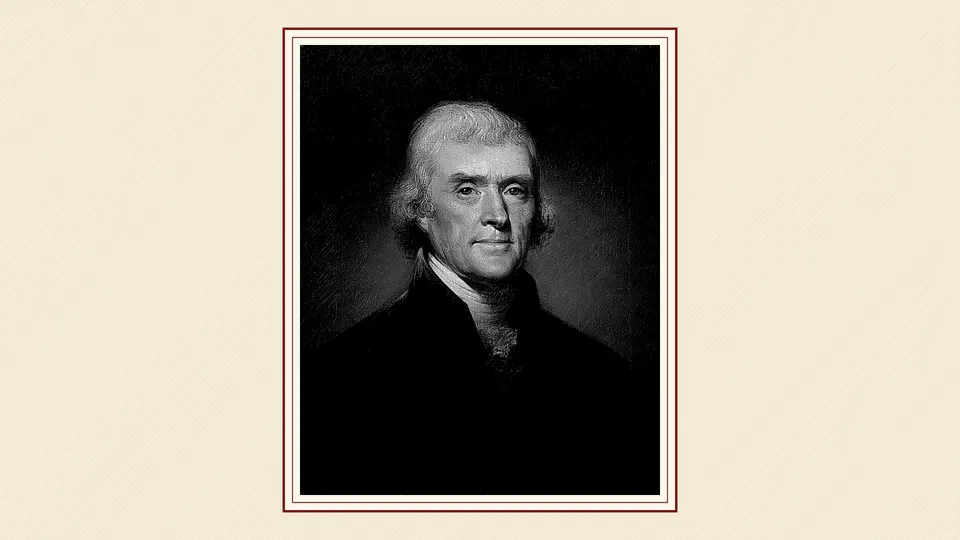
Thomas Jefferson was the main author of the Declaration of Independence and the third president of the United States, serving from 1801 to 1809. As president he bought the Louisiana Territory from France for $15 million, sent Lewis and Clark west and signed the 1807 ban on importing enslaved people. He also enslaved more than 600 people over his lifetime, a contradiction historians still weigh.
On this page
Key Takeaways
- Jefferson drafted the Declaration of Independence, which the Continental Congress adopted on July 4, 1776.
- As the third president (March 4, 1801, to March 4, 1809), he made the Louisiana Purchase, covering about 530 million acres.
- His Embargo Act of December 22, 1807, halted American foreign trade and was repealed on March 1, 1809.
- He enslaved more than 600 people during his life, and most historians now accept that he fathered Sally Hemings's children.
- He died at Monticello on July 4, 1826, fifty years to the day after the Declaration was adopted.
Where did Thomas Jefferson come from, and how did he reach the presidency?
Thomas Jefferson was born on April 13, 1743, at Shadwell plantation in Goochland County, Virginia. He graduated from the College of William and Mary in 1762 and was admitted to the Virginia bar in April 1767 [1]. Before national office he served in Virginia's legislature, and in 1776 he was sent to the Second Continental Congress [2].
That Congress appointed a Committee of Five to draft a statement of the colonies' case for independence. Jefferson later recalled that the other members "unanimously pressed on myself alone to undertake the draught." Congress approved the Lee Resolution for independence on July 2, 1776, revised Jefferson's text, and officially adopted the Declaration on July 4 [5]. The Declaration's claim that "all men are created equal" became the line by which Americans, and Jefferson himself, would later be judged.
His career after 1776 moved quickly through state and national posts. He served two years as governor of Virginia during the Revolution, then as American minister to France. Under George Washington he was Secretary of State, but quarrels with Treasury Secretary Alexander Hamilton led him to resign in 1793. In the 1796 election he finished second to John Adams and, under the rules of the time, became Adams's vice president [2]. In Virginia, his Statute for Religious Freedom was passed in 1786 and is often described as a forerunner of the First Amendment [8]. For the president before him, see our profile of George Washington; Jefferson's years in Paris overlapped the crisis described in why the French Revolution started.
The election of 1800 nearly broke the young system. Jefferson tied in the Electoral College with his own running mate, Aaron Burr, and the House of Representatives had to break the tie, choosing Jefferson [8]. Miller Center historians describe "a protracted deadlock in the House" before the result [2].
What did Thomas Jefferson do as president?
Jefferson was president for two full terms, from March 4, 1801, to March 4, 1809, and was the first president inaugurated in Washington, D.C. [3]. He was 57 years and 325 days old on his first inauguration day, counted from the birth and term dates the Miller Center lists. Where he fits among the other presidents is shown in our list of U.S. presidents in order.
| Date | Event | Why it mattered |
|---|---|---|
| Feb. 24, 1803 | Supreme Court decides Marbury v. Madison | The Court declared an act of Congress void for the first time, establishing judicial review [3] |
| Apr. 30, 1803 | Treaty for the Louisiana Purchase | About 530 million acres for $15 million, land that became all or part of 15 states [6] |
| Aug. 31, 1803 | Meriwether Lewis sets out from Pittsburgh | Start of the Lewis and Clark Expedition into the new territory, which ran 1804 to 1806 [3] |
| Dec. 9, 1803 | Congress passes the Twelfth Amendment | Electors would vote separately for president and vice president, ending the system that produced the 1800 tie [3] |
| 1805 | Treaty ends the war with Tripoli | Ransom for American prisoners, but no further tribute [7] |
| Mar. 2, 1807 | Ban on importing enslaved people | Took effect January 1, 1808, at Jefferson's urging [3] |
| Dec. 22, 1807 | Embargo Act signed | Halted American trade with every foreign country [3] |
The Louisiana Purchase is the act most closely tied to Jefferson's presidency, and it roughly doubled the size of the nation. Jefferson sent James Monroe to join Robert Livingston in France to negotiate over New Orleans. Napoleon's government instead offered the whole territory, at a price that went far beyond the envoys' instructions [6]. The Miller Center describes the result as "doubling the size of the nation" [2]. Historian Peter Onuf notes that Jefferson, usually a champion of a narrowly read Constitution, "jettisoned strict construction when the nation's vital interests were threatened" [4].
The new land also had to be explored. On June 20, 1803, Jefferson wrote formal instructions for Captain Meriwether Lewis [1], and the expedition Lewis led with William Clark ran from 1804 to 1806 [2]. Abroad, the United States had paid the Barbary states for years to protect its shipping, and Jefferson's effort to end those payments led to a war with Tripoli [2]. Tripoli's ruler had declared war on the United States over late tribute payments, and the treaty that ended the conflict in 1805 ransomed American prisoners without promising new tribute [7].
Politics at home stayed bitter. Jefferson's first vice president, Aaron Burr, shot Alexander Hamilton in a duel on July 11, 1804; Hamilton died the next day. Burr was later arrested on February 19, 1807, over an alleged conspiracy against the government, and a circuit court in Richmond acquitted him of treason on September 1, 1807 [3].
His second term was harder. Britain and France were at war, and both interfered with American shipping. After the British warship Leopard fired on the U.S. frigate Chesapeake on June 22, 1807, Jefferson answered with economic pressure rather than war. He signed the Embargo Act on December 22, 1807 (see what else happened on December 22), and Congress repealed it on March 1, 1809, replacing it with the Non-Intercourse Act, which closed American ports only to Britain and France [3]. The Miller Center calls the trade suspension "disastrous" for the American economy [2].
Why is Thomas Jefferson controversial?
The main controversy is slavery. Jefferson wrote that all men are created equal, yet he enslaved more than 600 people over the course of his life [8]. Of those people, he freed only 10, most of them members of the Hemings family [11]. As a young politician he argued against slavery in new territories, but he never freed most of the people he held, and the Miller Center concludes that "he never resolved his internal conflict on this issue" [2]. HISTORY also reports that he believed African Americans were biologically inferior to whites [8].
What is documented about Sally Hemings?
Sally Hemings was an enslaved woman at Monticello, likely born in 1773, and a half-sister of Jefferson's wife, Martha. At 14 she accompanied Jefferson's daughter Maria to Paris, where Jefferson was serving as minister [9]. Because she was enslaved by Jefferson, she was legally his property for the whole of their relationship.
In 1998 the scientific journal Nature published DNA test results bearing on the question. In January 2000 a research committee of the Thomas Jefferson Foundation, which owns and runs Monticello, reported "a high probability that Thomas Jefferson fathered Eston Hemings," and judged that he probably fathered all six of Sally Hemings's children [10]. The Foundation now treats the matter as settled, saying the DNA study proved paternity by a Jefferson family member and "corroborated the ample documentary and oral history evidence." Her sons Madison and Eston were freed under Jefferson's will, and her children were the only enslaved family he ever freed [9]. Most historians now believe that Jefferson and Hemings had a long-term sexual relationship [2].
How do historians judge him?
Historians do not agree on one verdict, and the disagreement is mostly about weight rather than facts. In C-SPAN's 2021 Historians Survey of Presidential Leadership he ranked seventh of 44 presidents, with 704 points; his weakest category was pursuing equal justice for all, where he placed 20th [12]. Peter Onuf, writing for the Miller Center, notes that "successive generations of critics have condemned him as a hypocritical slave owner" and that Jefferson "presided over" slavery's rapid expansion to the South and West. Onuf also calls him "a great democratic icon" whose words gave Americans their national creed [4]. Harvard historian Annette Gordon-Reed calls the gap between his words and his life "a huge contradiction," yet she does not think his negatives outweigh the lasting value of the Declaration's ideals [11]. The conflict over slavery that Jefferson left unresolved is traced in why the Civil War started.
How did Thomas Jefferson die, and what is his legacy?
Jefferson died at Monticello on July 4, 1826, at age 83. His former rival and friend John Adams died the same day [8]. Jefferson died exactly fifty years to the day after the Declaration of Independence was adopted. He was buried at Monticello near Charlottesville, Virginia [1].
His retirement produced two lasting institutions. In 1815 he sold his 6,700-volume personal library to Congress for $23,950, replacing books lost when the British burned the Capitol during the War of 1812. He also founded the University of Virginia, which held its first classes in 1825 and had no religious requirements for its students. He left heavy debts, and after his death his property was sold at auction [8].
His reputation has shifted with each generation. Jacksonian Democrats claimed him as a guide to political orthodoxy, while Whigs invoked his warnings against monarchy [4]. Andrew Jackson's own record is covered in our profile of Andrew Jackson, and the wider founding period in our colonial America era guide. Today, Monticello's memorial lists 610 names, one for each enslaved person who lived and worked there [11].
Frequently Asked Questions
Did Thomas Jefferson write the Declaration of Independence by himself?
He wrote the draft, but not alone in the final sense. Congress appointed a Committee of Five, whose other members asked Jefferson to write the first draft. Congress then debated and revised the text before officially adopting it on July 4, 1776 {{cite:national-the-declaration-of-independence}}.
How much did the Louisiana Purchase cost?
The United States paid France $15 million in 1803 for about 530 million acres, or 828,000 square miles, between the Mississippi River and the Rocky Mountains. The land later made up all or part of 15 states {{cite:office-the-louisiana-purchase}}.
Did Thomas Jefferson free the people he enslaved?
Only a few. Of the more than 600 people he owned during his life, he freed 10, most of them members of the Hemings family {{cite:pbs-thomas-jefferson-s-complicated}}. Sally Hemings's sons Madison and Eston were freed under his will {{cite:history-thomas-jefferson-and-sally}}.
Our Take
We think Jefferson cannot be summarized by either his best sentence or his worst record. The documents support both at once: he wrote the founding statement of equal rights and doubled the country's size, and he held more than 600 people in slavery while freeing only 10. The Hemings evidence, assessed by Monticello's own foundation, belongs in any honest account of his life rather than in a footnote. Historians such as Peter Onuf and Annette Gordon-Reed disagree about how to weigh these facts, and we present that disagreement instead of settling it. What seems clear to us is that his ideals outgrew him. The words "all men are created equal" became the measure that later Americans, including those he enslaved and their descendants, used to judge the nation and Jefferson himself.
Sources
- Thomas Jefferson. Miller Center.
- Thomas Jefferson: Life in Brief. Miller Center.
- Thomas Jefferson: Key Events. Miller Center.
- Thomas Jefferson: Impact and Legacy. Miller Center.
- The Declaration of Independence: A History. National Archives.
- The Louisiana Purchase. Office of the Historian.
- Barbary Wars. Office of the Historian.
- Thomas Jefferson. HISTORY, 2009.
- Thomas Jefferson and Sally Hemings: What's Known. HISTORY, 2025.
- Is It True? Jefferson's Blood. PBS Frontline.
- Thomas Jefferson's complicated legacy 250 years after the Declaration of Independence. PBS NewsHour, 2026.
- C-SPAN 2021 Survey of Presidential Leadership: Final Scores and Ranks. C-SPAN, 2021.
Where historians disagree, we say so and show the main views. Dates are checked against two sources; legend and documented record are labeled separately. Spotted an error? Tell us.
Keep Reading
Who Was George Washington? Life, Presidency and Legacy
George Washington led the Continental Army, chaired the Constitutional Convention and was the first U.S. president, 1789 to 1797. His life, record and legacy.
U.S. Presidents in Order: The Complete List
All 47 U.S. presidencies in order, from George Washington in 1789 to Donald Trump in 2025, with term dates, ages and how each presidency came to an end.
Who Was Andrew Jackson? Life, Presidency and Legacy
Andrew Jackson, the 7th U.S. president (1829 to 1837), fought the national bank, stopped nullification and signed the Indian Removal Act. His life and legacy.
Who Was Abraham Lincoln? Life, Presidency and Legacy
Who was Abraham Lincoln? How he rose from a Kentucky log cabin, led the Union through the Civil War, moved to end slavery, and how historians judge him today.
Why Did the Civil War Start?
Why did the Civil War start? What the seceding states said in their own words, the fight over slavery in the West, Lincoln's election, and Fort Sumter.
Why Did the French Revolution Start?
Why did the French Revolution start? The debt crisis, the three estates, bread prices, the events of 1789, and how historians from Lefebvre to Furet explain it.