What Happened at Chernobyl? Why the Reactor Exploded
Quick Answer
At 1:23 a.m. local time on April 26, 1986, two explosions destroyed the Unit 4 reactor at the Chernobyl nuclear power plant in Soviet Ukraine during a safety test. The reactor had been run into an unstable, low-power state with too few control rods in its core. Its design made power rise when steam formed, and pressing the emergency shutdown button briefly added power instead of cutting it.
On this page
- What happened at Chernobyl on April 26, 1986?
- What was the test, and how did it go wrong?
- Why did the Chernobyl reactor explode?
- Who was to blame: the operators or the reactor design?
- What happened after the explosion?
- How many people died because of Chernobyl?
- What changed after Chernobyl?
- Frequently Asked Questions
- Our Take
- Sources
Key Takeaways
- Unit 4 exploded at 1:23 a.m. on April 26, 1986, during a test of the plant's cooling pumps.
- Two design traits made it unstable at low power: more steam meant more power, and the control rods' graphite tips briefly added power as they went in.
- Operators ran the reactor far below its minimum number of control rods; the 1986 and 1992 safety reports weigh their role against the design differently.
- Pripyat was evacuated on April 27, and about 116,000 people had left the 30 km zone by May 14.
- Death tolls range from 31 early deaths to estimates in the tens of thousands, because each body counts something different.
What happened at Chernobyl on April 26, 1986?
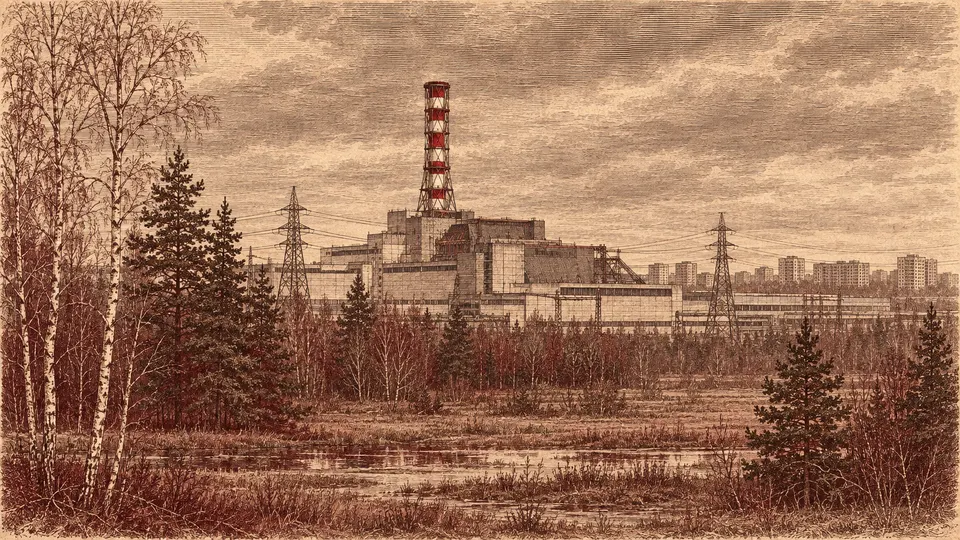
Chernobyl was a four-reactor power station about 110 km north of Kyiv (spelled Kiev in older sources) and about 10 km south of the border with Belarus, in what was then the Soviet republic of Ukraine [1] [4]. Unit 4 was an RBMK-1000, a Soviet reactor design rated at 1,000 megawatts of electricity [1].
The accident came at 01:23 on Saturday, April 26, 1986, when two explosions destroyed the core of Unit 4 and the roof of the reactor building [3].
The new city of Pripyat, with 49,000 inhabitants, lay about 3 km from the reactor [3]. The accident happened during the Cold War, and its handling inside the Soviet system shaped how the world learned about it. For another Cold War crisis, see the Cuban Missile Crisis.
What was the test, and how did it go wrong?
The test asked a narrow question. If the station lost outside power, could the turbine, still spinning as it slowed down, make enough electricity to run the core cooling pumps until the diesel backup generators started [3]?
The timetable slipped. Power reduction began at 01:06 on April 25, but the grid controller in Kyiv asked the plant to keep supplying electricity, so the test was put off until late that night [2].
Shortly after midnight the power fell much further than planned, to about 30 megawatts thermal, a level where the reactor's most dangerous trait took over [3]. To raise it again, operators pulled control rods out. By about 01:00 the reactor was held at roughly 200 megawatts thermal [2].
By 01:22:30 the reactor's safety margin equaled only eight control rods, below the required minimum of 15. That is the World Nuclear Association's account of the calculation [2]. The OECD Nuclear Energy Agency describes the rule differently: a standing order required at least 30 rods, and only 6 to 8 were in use during the test [3].
Why did the Chernobyl reactor explode?
The reactor exploded because two features of its design turned the operators' last moves into a runaway power surge. On an RBMK reactor, more steam in the core meant more power, and more power made more steam. Engineers call this a positive void coefficient, and the World Nuclear Association says the fuel's burn-up, the rod positions and the low power made it dominant that night [1].
The second feature was in the control rods. Each had a graphite "displacer" on its end that, as the rod started down, pushed water out of the bottom of the channel and briefly added reactivity there. This "positive scram" effect had been identified at another RBMK plant, Ignalina, in 1983. The INSAG-7 safety report, quoted by the World Nuclear Association, says the restrictions that should have followed "were never imposed and apparently the matter was forgotten" [2].
The rods were also slow. If there were a power surge, about 20 seconds would be needed to lower them and shut the reactor down [3]. Pressing the emergency button at 01:23:40 started the rods moving, and within three seconds power was above 530 megawatts thermal and still rising. Fuel channels ruptured, and the operator log records severe shocks and rods stopping before they reached the bottom [2].
A steam explosion came first, and a second explosion followed 2 to 3 seconds later; experts still disagree about what caused the second one. The overpressure partly lifted the reactor's 1,000-tonne cover plate and threw out graphite and fuel, starting fires [1].
Who was to blame: the operators or the reactor design?
The official answer changed over time. The International Nuclear Safety Advisory Group's first report, INSAG-1 in 1986, blamed "a remarkable range of human errors and violations of operating rules" combined with features of the reactor [1].
Its 1992 update, INSAG-7, shifted the weight toward the reactor's physics and its control rod design. It still called the operators' critical actions "most ill judged." A Soviet commission in 1991 went further in the operators' defense, concluding that they had not broken established policies, because none had been clearly set out [1].
The OECD Nuclear Energy Agency combines both views: the design was poor for safety and unforgiving to operators, the operators did not follow procedures, and the plant lacked a "safety culture." It notes that later assessments gave more weight to the design flaws [3].
What happened after the explosion?
The first 14 firefighters reached the plant at 1:28 a.m. Fires in the buildings were out by about 5:00 a.m., but the graphite in the core kept burning [3]. From the second to the tenth day, helicopters dropped about 5,000 tonnes of material onto the burning core [1].
Pripyat was evacuated on April 27, the day after the explosion. The World Nuclear Association puts the number at 45,000 residents; History.com gives 50,000 [1] [7]. By May 14, about 116,000 people had been moved out of the 30 km zone around the plant, and about 220,000 more were resettled in later years [1] [4].
The outside world learned of the accident from Sweden. On Monday, April 28, a worker at Sweden's Forsmark nuclear plant set off a radiation alarm, and Sweden, Finland, Norway and Denmark reported higher than normal radioactivity. That same day the Soviet news agency Tass announced that "an accident has occurred at the Chernobyl atomic power plant" [8]. History.com also dates the Kremlin's first report to April 28 [7].
How many people died because of Chernobyl?
There is no single death toll. The figures run from 31 early deaths to estimates in the tens of thousands, because each body counts something different. Some count confirmed deaths, some count possible future cancers in a defined group, and the largest figures are claims that other bodies dispute. Following our editorial policy, we list each figure with the body that gives it rather than picking one.
| Figure | What it counts | Who gives it |
|---|---|---|
| 2 | Workers killed by the explosions | World Nuclear Association; U.S. NRC |
| 28 | Acute radiation syndrome deaths in the first three months, of 134 cases | WHO, citing UNSCEAR |
| 31 | Early deaths: 2 from the blasts, 28 from radiation, 1 reported heart attack | World Nuclear Association |
| Fewer than 50 | Deaths directly attributed to radiation by mid-2005 | Chernobyl Forum (WHO, 2005) |
| 15 | Thyroid cancer deaths by 2005, among about 6,000 childhood cases | U.S. NRC; WHO, citing UNSCEAR |
| Up to 4,000 | Possible eventual deaths among about 600,000 most exposed people | Chernobyl Forum (WHO, 2005) |
| Up to 9,000 | Possible eventual excess cancer deaths | Chernobyl Forum, as summarized by History.com [7] |
| About 16,000 | Possible fatal cancers across Europe through 2065 | IARC study (2006), cited by WHO |
| 125,000 | Deaths claimed from Chernobyl radiation | Government of Ukraine (1995), as reported by History.com [7] |
The early figures are the firmest. The World Health Organization, citing the UN Scientific Committee on the Effects of Atomic Radiation (UNSCEAR), says 134 of the roughly 600 workers on site that morning developed acute radiation syndrome, and 28 of them died in the first three months [5]. The NRC also reports 28 deaths within four months [4].
Thyroid cancer is the clearest long-term effect. History.com reports that a 2011 U.S. National Institutes of Health study linked these cancers to radioactive iodine-131 in the fallout [7]. In 2005 the Chernobyl Forum counted about 4,000 cases, with at least nine child deaths [6]. The World Nuclear Association cites a 2018 UNSCEAR report of about 20,000 cases diagnosed from 1991 to 2015 in people who were 18 or younger in 1986, about 5,000 of them "probably" caused by radiation [1].
The projections are where the views split. The Chernobyl Forum, eight UN agencies working with Belarus, Russia and Ukraine, put possible eventual deaths at up to 4,000 [6], while a 2006 International Agency for Research on Cancer study cited by WHO projects about 16,000 fatal cancers across Europe through 2065 [5]. The World Nuclear Association, an industry body, calls some published figures "exaggerated" and cites UNSCEAR's finding of no evidence of a major public health impact from radiation 20 years on, apart from thyroid cancer [1].
What changed after Chernobyl?
A concrete shelter was built around it over the seven months after the accident, designed to last 20 to 30 years [1]. In November 2016 a huge steel arch, the New Safe Confinement, was slid on tracks over the old shelter [7]. The NRC says it was handed to Ukrainian authorities in 2020 and is designed to last at least 100 years [4].
The plant's last working reactor closed in December 2000 [1] [4]. All remaining RBMK reactors were modified, with changes to the control rods, added neutron absorbers and fuel enrichment raised from 1.8% to 2.4% uranium-235 [1].
Chernobyl remains the only accident in the history of commercial nuclear power in which radiation-related deaths occurred, according to the World Nuclear Association. For readers in the United States, the NRC concludes that differences in plant design, broader shutdown capabilities and strong containment structures protect U.S. reactors against the combination of lapses that led to Chernobyl [4]. More from the Soviet Union's last years is in our Cold War era guide and in why the Berlin Wall fell; more disasters that grew from chains of decisions, like the sinking of the Titanic, are among our why questions.
Frequently Asked Questions
When did the world find out about Chernobyl?
Two days later. On April 28, 1986, radiation alarms in Sweden and higher readings across Scandinavia were reported, and the Soviet news agency Tass announced that an accident had occurred at the plant {{cite:upi-soviets-say-reactor-damaged-in}}.
Could a Chernobyl-type accident happen in the United States?
The U.S. Nuclear Regulatory Commission says many factors protect U.S. reactors against the combination of lapses that caused Chernobyl, including different plant designs, broader shutdown capabilities and strong structures to hold in radioactive material {{cite:u-s-backgrounder-on-chernobyl-nuclear}}.
Is the Chernobyl reactor still covered today?
Yes. The original 1986 concrete shelter is now enclosed by the New Safe Confinement, a steel arch moved into place in November 2016 and designed to last at least 100 years {{cite:u-s-backgrounder-on-chernobyl-nuclear}}.
Our Take
We read Chernobyl as a design failure that operators walked into, not a choice between the two. The safety reports moved from blaming people in 1986 to blaming the reactor in 1992, but neither account lets either side off the hook: a reactor that gained power from steam and from its own shutdown rods met a crew working far outside its rod rule after a delayed test. The death toll deserves the same care. The 28 radiation deaths and the thyroid cancers are documented; the larger numbers are projections or claims that measure different things. We think readers are best served by seeing every figure with its author, and by remembering that two days of official silence were part of the disaster too.
Sources
- Chernobyl Accident 1986. World Nuclear Association.
- Sequence of Events: Chernobyl Accident Appendix 1. World Nuclear Association.
- Chernobyl: Chapter I. The site and accident sequence (Chernobyl: Assessment of Radiological and Health Impacts). OECD Nuclear Energy Agency, 2002.
- Backgrounder on Chernobyl Nuclear Power Plant Accident. U.S. Nuclear Regulatory Commission, 2024.
- Radiation: The Chernobyl accident (questions and answers). World Health Organization, 2011.
- Chernobyl: the true scale of the accident. World Health Organization, 2005.
- Chernobyl. History.com, 2018.
- Soviets say reactor damaged in Ukraine nuclear accident. UPI, 1986.
Where historians disagree, we say so and show the main views. Dates are checked against two sources; legend and documented record are labeled separately. Spotted an error? Tell us.
Keep Reading
Why Did the Cold War Start?
Why did the Cold War start? How the U.S.-Soviet alliance broke down from Yalta and Potsdam to the Truman Doctrine, Berlin Airlift, NATO and the Soviet bomb.
Why Did the Cuban Missile Crisis Happen?
Why did the Cuban Missile Crisis happen? How the Bay of Pigs, the U.S. nuclear lead and missiles in Turkey led Khrushchev to Cuba, and how October 1962 ended.
Why Did the Berlin Wall Fall?
Why did the Berlin Wall fall in 1989? Gorbachev's reforms, the East German exodus and protests, a botched press conference and Western pressure, explained.
Why Did the Titanic Sink?
The Titanic sank after an iceberg opened her five forward compartments in April 1912. Why she flooded, why about 1,500 died, and what changed at sea after.
Why Did the French Revolution Start?
Why did the French Revolution start? The debt crisis, the three estates, bread prices, the events of 1789, and how historians from Lefebvre to Furet explain it.

Why Did the Great Depression Happen?
Why did the Great Depression happen? The 1920s boom, the 1929 crash, bank panics, Fed mistakes, the gold standard, Smoot-Hawley, Dust Bowl and what ended it.