Why Did the Berlin Wall Fall?
Quick Answer
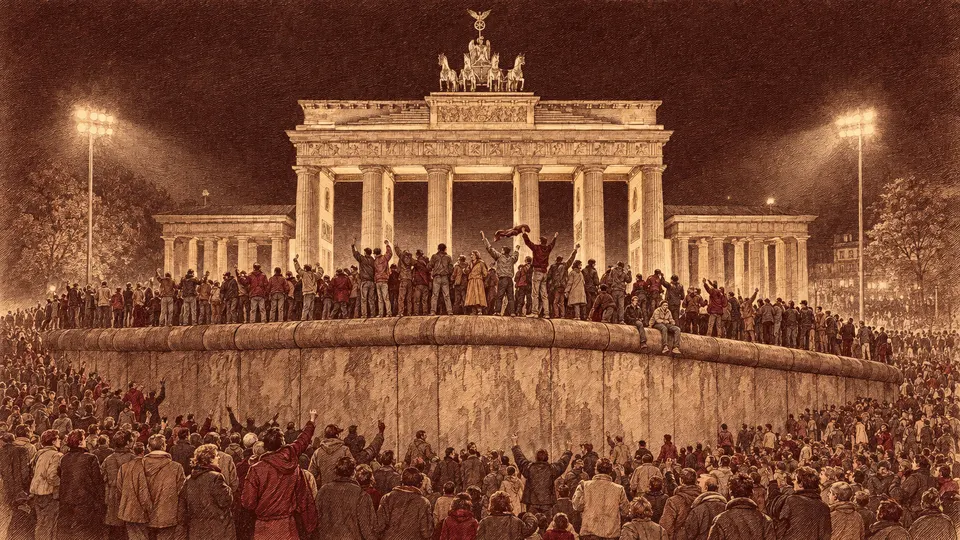
The Berlin Wall fell on the night of November 9, 1989, because East Germany's communist government was losing control. Gorbachev's Soviet Union would no longer send troops to save it, tens of thousands of East Germans were fleeing through Hungary and Czechoslovakia, and mass protests filled its cities. When an official wrongly announced that new travel rules took effect "immediately," crowds forced the border open.
On this page
- What was the Berlin Wall, and why was it built?
- What happened on November 9, 1989?
- How did Gorbachev's reforms make the fall possible?
- Why did East Germans flee and protest in 1989?
- Did Reagan and Western pressure bring down the Wall?
- Which explanation do historians favor?
- What happened after the Wall fell?
- Frequently Asked Questions
- Our Take
- Sources
Key Takeaways
- The Wall opened on November 9, 1989, after an East German spokesman announced new travel rules as "effective immediately, without delay."
- Underneath that mistake lay deeper causes: Gorbachev's reforms, the end of Soviet military intervention, East Germany's economic collapse and a mass exodus.
- East Germans themselves forced the issue, through emigration via Hungary and Czechoslovakia and through weeks of peaceful protest in cities like Leipzig.
- Western pressure, including Reagan's 1987 "tear down this wall" speech, mattered, but U.S. leaders were cautious when the Wall actually opened.
- Historians weigh these causes differently; many documents point to "accident and contingency, rather than conspiracy or strategy."
What was the Berlin Wall, and why was it built?
The Berlin Wall was a 155-kilometer (about 96-mile) barrier that surrounded West Berlin from August 13, 1961, to November 9, 1989 [1]. East Germany's ruling party, the SED, sealed the sector borders that morning, first with barbed wire and a few days later with walls. By then, according to the Berlin Wall Foundation, the German Democratic Republic (GDR) had lost at least four million people, about a sixth of its population, to the West [1]. HISTORY counts "nearly 3 million" refugees in the years after the 1948 to 1949 Berlin Blockade alone, many of them skilled workers [2].
The Wall was the answer to that drain. Over the following decades it grew into a layered system with an inner wall, watchtowers and lighting. At least 140 people were killed or died at the Berlin Wall between 1961 and 1989; 91 of them were shot by GDR border soldiers [1]. The verbal order to shoot was not lifted until April 1989.
For U.S. readers, Berlin was also a symbol of American commitment. President John F. Kennedy spoke in West Berlin on June 26, 1963, and the National Archives holds the speech cards that prompted him [3]. Our profile of John F. Kennedy covers that visit, and our explainer on why the Cold War started shows how Berlin became a front line in the first place.
What happened on November 9, 1989?
The Wall opened by mistake, at least in its timing. Under pressure from refugees and protests, East Germany's leadership prepared new rules for travel and permanent exit. On the evening of November 9, Politburo member Günter Schabowski announced them at a press conference broadcast live. Asked when they took effect, he read out that they were "effective immediately, without delay" [4] [5]. The U.S. Office of the Historian describes him as "an obviously ill-prepared East German spokesman" who told reporters the rules also applied to Berlin [6].
Western television spread the news at once. The National Security Archive notes that Schabowski's statements "led Western TV reporters to declare the Berlin Wall open when it was not" [7]. East Berliners who heard the reports went to the checkpoints to see for themselves.
The biggest crowd gathered at Bornholmer Strasse. According to deutschland.de's timeline, between 500 and 1,000 people were there by 9:30 p.m., and the situation became dangerous for the guards around 11 p.m. [4]. The crowd "persuaded the senior official at the largest inner-city checkpoint at Bornholmer Strasse to open the gates," and other crossings followed [5]. Later reports put the number who crossed there between 11:30 p.m. and 12:15 a.m. at around 20,000. No one in East Berlin's leadership ordered the Wall opened that night; the crowd at the checkpoints did.
How did Gorbachev's reforms make the fall possible?
The first cause came from Moscow. Mikhail Gorbachev became Soviet general secretary on March 11, 1985, and began a reform policy [4]. The Office of the Historian says his policies of perestroika (restructuring) and glasnost (transparency) gave more legitimacy to calls for reform inside the Eastern bloc [6].
The decisive change was military. Soviet tanks had crushed demonstrators in East Berlin in June 1953, in Hungary in 1956 and in Czechoslovakia in 1968. Gorbachev made clear, first privately and then publicly, that the Soviet Union had abandoned that policy of "military intervention in support of communist regimes" [6]. Once East Germany's rulers knew Soviet troops would not rescue them, the threat behind the Wall lost much of its force.
Gorbachev also pushed East Berlin directly. On his visit in early October 1989, he urged the East German leadership to reform and privately concluded that Erich Honecker had to go [6]. Honecker gave up his post as SED leader on October 18, 1989, and Egon Krenz succeeded him [4]. The same Soviet openness had another, more dangerous side for Moscow: our explainer on why Chernobyl exploded shows how the 1986 disaster tested glasnost.
Why did East Germans flee and protest in 1989?
The second cause is East Germans themselves. The Office of the Historian links the exodus to economics: "The economic collapse of East Germany led increasing numbers of East Germans to seek to emigrate to the West" [6].
Hungary opened the first door. It began dismantling its border fence on May 2, 1989 [1]. At the Pan-European Picnic on August 19, 1989, about 300 East Germans crossed into Austria, and hundreds more camped at the West German embassy in Budapest [5]. Later the Hungarian government ordered its border with the West opened, and thousands of East Germans sought refuge in West German embassies in other communist countries [6].
Czechoslovakia became the next route. From November 4 to 10, more than 62,000 refugees passed through, and on November 8 Prague's communist leaders asked East Berlin to let its citizens go directly to West Germany, "in effect to open the border" [7].
Those who stayed began to protest. Monday demonstrations in Leipzig started on September 4, 1989, and grew week by week; on October 30, 300,000 people marched in Leipzig alone [4]. The Office of the Historian notes that "hundreds of thousands marched in protest throughout major East German cities" [6]. The Berlin Wall Foundation sums it up: mass emigration and protests pushed the SED into concessions, including easier travel [1].
Did Reagan and Western pressure bring down the Wall?
Western pressure is the explanation most familiar to American readers. On June 12, 1987, at the Brandenburg Gate in West Berlin, President Ronald Reagan said: "General Secretary Gorbachev, if you seek peace, if you seek prosperity for the Soviet Union and Eastern Europe, if you seek liberalization: Come here to this gate! Mr. Gorbachev, open this gate! Mr. Gorbachev, tear down this wall!" [8] [9].
The Office of the Historian gives that pressure a real role. It says the Reagan administration's strong backing of political aspirations in Eastern Europe and the Soviet Union after 1985 was met by "a new type of leader in the Soviet Union" [6]. It also notes that few people in 1987 would have predicted the collapse two years later.
The record of November 1989 shows caution rather than a Western plan. When reporters asked President George H. W. Bush on November 9 why he did not seem elated, he answered, "I am not an emotional kind of guy." The next day he told West German Chancellor Helmut Kohl he wanted to avoid "especially hot rhetoric that might by mistake cause a problem" [10]. National Security Advisor Brent Scowcroft described U.S. policy as moving "from quietly supporting the transformations to cultivating Soviet acquiescence, even collaboration, in them" [6]. Some European leaders were more worried still: in a call with Gorbachev on November 14, French President François Mitterrand said, "There is a certain equilibrium that exists in Europe, and we should not disturb it" [10].
Which explanation do historians favor?
Historians agree on the events but weigh the causes differently. The table below sets out the four main explanations and who stresses each one.
| Explanation | What it stresses | Who emphasizes it | Its limits |
|---|---|---|---|
| Gorbachev's reforms | Perestroika, glasnost and the end of Soviet military intervention | The Office of the Historian, which says the USSR "abandoned" the Brezhnev Doctrine | Reform in Moscow did not open any border by itself |
| East German exodus and protest | Emigration via Hungary and Czechoslovakia, Leipzig marches, crowds at the checkpoints | The Berlin Wall Foundation, which credits mass emigration and protest | Needs Soviet restraint to explain why no crackdown came |
| The Schabowski mistake | A botched announcement and live TV turned a planned concession into an open border | National Security Archive editors ("accident and contingency"); Mary Elise Sarotte's book The Collapse | Explains the date, not why the regime was already failing |
| Western pressure | Reagan's 1987 challenge, decades of containment, U.S. support for reform | The Office of the Historian notes Reagan's backing of reform after 1985 | U.S. leaders were cautious in November 1989 and did not plan the opening |
The National Security Archive's 2014 collection argues that the documents show "accident and contingency, rather than conspiracy or strategy." It traces the collapse back to Hungarian reformers in early 1989 and credits Czechoslovak pressure, television coverage and Gorbachev's non-violence [5]. The same collection highlights historian Mary Elise Sarotte's book The Collapse: The Accidental Opening of the Berlin Wall, whose title states its emphasis on chance.
The Office of the Historian presents a broader picture: East Germany's economic collapse, Gorbachev's reforms, the end of the Brezhnev Doctrine and steady U.S. support for reform all appear in its account [6]. The Berlin Wall Foundation, which runs the memorial in Berlin, puts East Germans at the center: emigration and protest forced the concessions, and the border "was opened under the onslaught" of the crowds [1]. The deep causes explain why the Wall was doomed; the Schabowski blunder explains why it fell on November 9 rather than some later day.
What happened after the Wall fell?
The opening of the Wall turned into the end of East Germany within a year. Before the end of November 1989, Chancellor Kohl unveiled a plan for reunifying the two German states [6]. Bush and Gorbachev met at Malta in December 1989, where, in a Gorbachev staffer's phrase quoted by the Office of the Historian, they "buried the Cold War at the bottom of the Mediterranean."
Systematic demolition of the border grounds began in June 1990 and was largely finished by the end of that year, while some sections, including the one at Bernauer Strasse, were placed under monument protection [1]. The reunification of East and West Germany was made official on October 3, 1990 [2]. The Wall, built in 1961 to stop people leaving, came down because people kept leaving anyway. For the rest of the period, browse our Cold War era hub, the 1962 standoff in why the Cuban Missile Crisis happened, more why history happened explainers, and what happened on this day in history.
Frequently Asked Questions
When exactly did the Berlin Wall fall?
The border opened on the night of November 9 to 10, 1989, after Günter Schabowski's evening press conference on November 9. Crowds at Bornholmer Strasse got through first, and other crossings followed {{cite:national-the-fall-of-the-berlin}}. Physical demolition of the Wall came later, mostly in 1990.
Did Reagan's "tear down this wall" speech make the Wall fall?
Not directly. Reagan's June 12, 1987, speech was a famous public challenge, and the Office of the Historian credits U.S. support for reform. But the Wall opened two years later through East German protest, Soviet restraint and a botched announcement, and President Bush reacted cautiously {{cite:national-fall-of-berlin-wall-caused}}.
How many people died at the Berlin Wall?
The Berlin Wall Foundation counts at least 140 people who were killed or died at the Berlin Wall between 1961 and 1989. Of them, 91 were shot by East German border soldiers, most while trying to flee {{cite:berlin-the-berlin-wall}}.
Was the fall of the Berlin Wall the end of the Cold War?
It became the symbol of the Cold War's end, according to the Office of the Historian, but leaders at the time were unsure. Scowcroft did not yet think the Cold War was over in November 1989 {{cite:office-fall-of-communism-in-eastern}}.
Our Take
We think the Berlin Wall fell because of a stack of causes, with a mistake on top. Gorbachev's refusal to use force removed the regime's last guarantee. East Germany's economic failure drove people to leave, and the exodus through Hungary and Czechoslovakia, together with the Leipzig marches, forced the SED to bargain. Western pressure kept the issue alive for decades, but the sources show U.S. leaders reacting with caution, not steering events. Schabowski's "immediately, without delay" decided the date, and ordinary East Berliners at Bornholmer Strasse decided the outcome. We would not crown a single cause. The most honest answer is that the deep causes made the Wall's end likely, and the people at the checkpoints made it happen on November 9, 1989.
Sources
- The Berlin Wall. Berlin Wall Foundation.
- Berlin Wall. HISTORY, 2009.
- The Cold War. National Archives.
- Fall of the Berlin Wall. deutschland.de.
- The Fall of the Berlin Wall, 25th Anniversary. National Security Archive, 2014.
- Fall of Communism in Eastern Europe, 1989. Office of the Historian.
- Prague Communists Called for Wall to Open on November 8, 1989. National Security Archive, 2009.
- Remarks on East-West Relations at the Brandenburg Gate in West Berlin. American Presidency Project, 1987.
- Remarks on East-West Relations at the Brandenburg Gate in West Berlin. Ronald Reagan Presidential Library, 1987.
- Fall of Berlin Wall Caused Anxiety More than Joy at Highest Levels. National Security Archive, 2009.
Where historians disagree, we say so and show the main views. Dates are checked against two sources; legend and documented record are labeled separately. Spotted an error? Tell us.
Keep Reading
Why Did the Cuban Missile Crisis Happen?
Why did the Cuban Missile Crisis happen? How the Bay of Pigs, the U.S. nuclear lead and missiles in Turkey led Khrushchev to Cuba, and how October 1962 ended.
Why Did the French Revolution Start?
Why did the French Revolution start? The debt crisis, the three estates, bread prices, the events of 1789, and how historians from Lefebvre to Furet explain it.
What Happened at Chernobyl? Why the Reactor Exploded
On April 26, 1986, Chernobyl's Unit 4 reactor exploded during a safety test. How design flaws and operator choices combined, and what each death toll counts.
Why Did the Cold War Start?
Why did the Cold War start? How the U.S.-Soviet alliance broke down from Yalta and Potsdam to the Truman Doctrine, Berlin Airlift, NATO and the Soviet bomb.
Why Did the Great Depression Happen?
Why did the Great Depression happen? The 1920s boom, the 1929 crash, bank panics, Fed mistakes, the gold standard, Smoot-Hawley, Dust Bowl and what ended it.
Why Did the Civil War Start?
Why did the Civil War start? What the seceding states said in their own words, the fight over slavery in the West, Lincoln's election, and Fort Sumter.